I searched the entire solution for the keyword "AbpGuidsModule" and found that no module explicitly depends on AbpGuidsModule — it is likely that other built-in modules have a transitive dependency on it. I verified this through code testing:
var actualGenerator = LazyServiceProvider.LazyGetService<IGuidGenerator>();
Console.WriteLine($"GUID generator:{actualGenerator.GetType().FullName}");

var guid = GuidGenerator.Create();
Console.WriteLine($" GUID:{guid}");
The test result confirmed that the generator in use is SequentialGuidGenerator, and the issue has been resolved.
Hi there, Thanks for your reply! Let me clarify my confusion in detail: I confirm that IGuidGenerator is resolved correctly in the application (no resolution failures). My core question is about the default implementation binding in ABP’s DomainService/ApplicationService:The base classes (e.g., DomainService) have a protected property:
protected IGuidGenerator GuidGenerator => LazyServiceProvider.LazyGetService<IGuidGenerator>(SimpleGuidGenerator.Instance);
This means if IGuidGenerator is not explicitly registered, it falls back to SimpleGuidGenerator.Instance (which just wraps Guid.NewGuid()). Is this design expected and reasonable in ABP?
To replace the default with SequentialGuidGenerator, I’m considering registering it via DI:
context.Services.AddSingleton<IGuidGenerator, SequentialGuidGenerator>();
Could you confirm if this is the ABP-idiomatic way to override the default implementation globally? Will this registration correctly replace the fallback SimpleGuidGenerator in DomainService/ApplicationService (i.e., make LazyGetService resolve SequentialGuidGenerator instead of the fallback)?
thanks for your reply! But I’m confused — according to the ABP Vnext source code for DomainService, the default IGuidGenerator is explicitly set to SimpleGuidGenerator.Instance, not SequentialGuidGenerator:
public abstract class DomainService : IDomainService { public IAbpLazyServiceProvider LazyServiceProvider { get; set; } = default!;
[Obsolete("Use LazyServiceProvider instead.")]
public IServiceProvider ServiceProvider { get; set; } = default!;

protected IClock Clock => LazyServiceProvider.LazyGetRequiredService<IClock>();

protected IGuidGenerator GuidGenerator => LazyServiceProvider.LazyGetService<IGuidGenerator>(SimpleGuidGenerator.Instance);

protected ILoggerFactory LoggerFactory => LazyServiceProvider.LazyGetRequiredService<ILoggerFactory>();

protected ICurrentTenant CurrentTenant => LazyServiceProvider.LazyGetRequiredService<ICurrentTenant>();

protected IAsyncQueryableExecuter AsyncExecuter => LazyServiceProvider.LazyGetRequiredService<IAsyncQueryableExecuter>();

protected ILogger Logger => LazyServiceProvider.LazyGetService<ILogger>(provider => LoggerFactory?.CreateLogger(GetType().FullName!) ?? NullLogger.Instance);
}
This code shows that if IGuidGenerator isn’t resolved from DI, it falls back to SimpleGuidGenerator. But you mentioned ABP "already wires SequentialGuidGenerator as the default".
Could you clarify: Does ABP automatically register SequentialGuidGenerator as the IGuidGenerator implementation in DI (overriding the SimpleGuidGenerator fallback in DomainService)? If DI registration takes precedence, why does DomainService explicitly set SimpleGuidGenerator as the fallback? In a standard ABP app (with EF Core), can I safely rely on the default DI registration for SequentialGuidGenerator, or do I need to manually replace the DomainService’s fallback? I want to confirm that production (large datasets, GUID PKs) is using SequentialGuidGenerator to avoid index fragmentation. Thanks again!
thank you all for the previous solutions – they successfully fixed my index page auto-redirect issue! Now I have one more question regarding the AuthServer configuration: How to configure the ABP vNext AuthServer to restrict direct access to its login/home page, forcing all login requests to come from the main application with a valid returnUrl parameter? Are there built-in ABP module options or middleware configurations to achieve this? Thanks in advance for your help!
Can ABP Suite download previous versions?
After configuring the "NUGET_PACKAGES" environment variable, everything works fine. Thanks for the technical support.
After following the provided method, the problem still persists. I've noticed two issues. 1: My computer doesn't have the .NET 9 SDK. I'm not sure if this has any impact. 2: The .nuget folder directory has been changed to the D: drive. When I execute "abp suite" in the command prompt, it prompts that the Volo.Abp.Studio.Extensions.StandardSolutionTemplates can't be found in the .nuget folder directory on the C: drive, and then it keeps looping continuously.
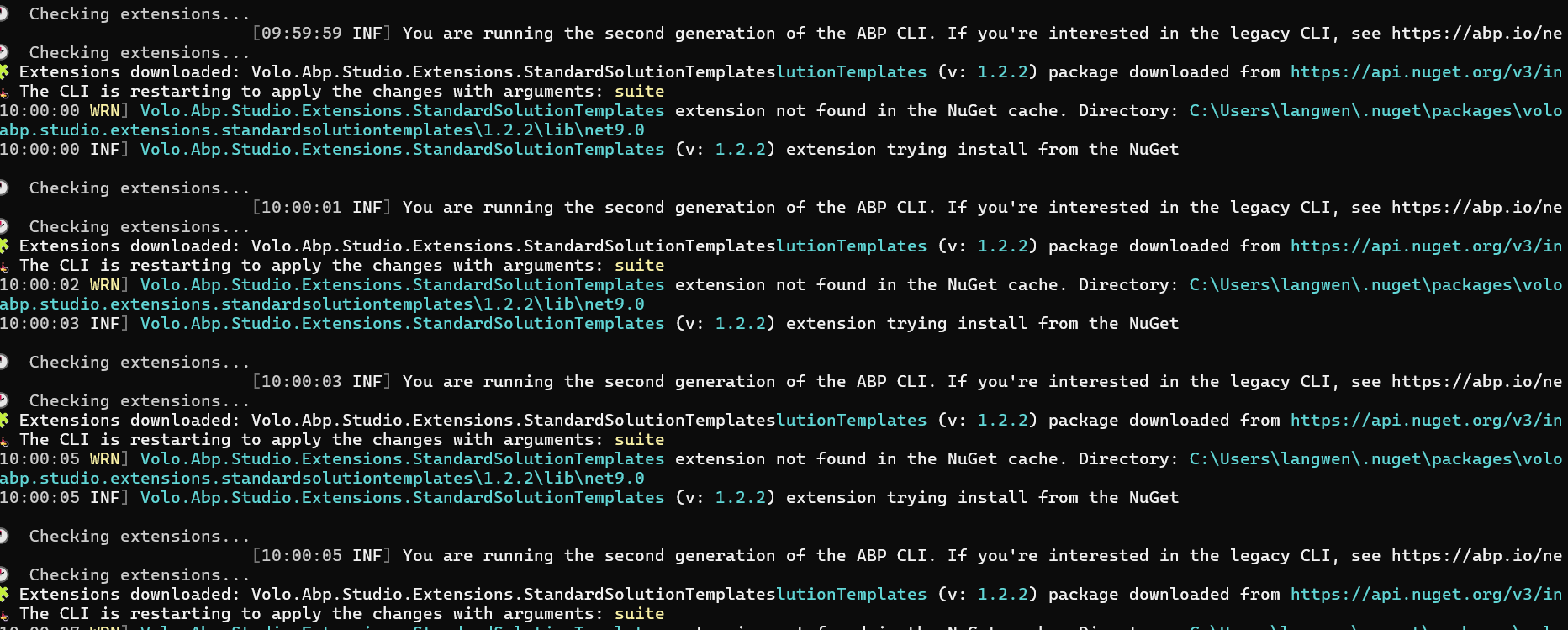
"abp suite " still unable to resolve try using 'abp studio' received notification :


dotnet tool uninstall -g Volo.Abp.Cli sucess
dotnet tool install -g Volo.Abp.Studio.Cli sucess
run "abp suite" display this:
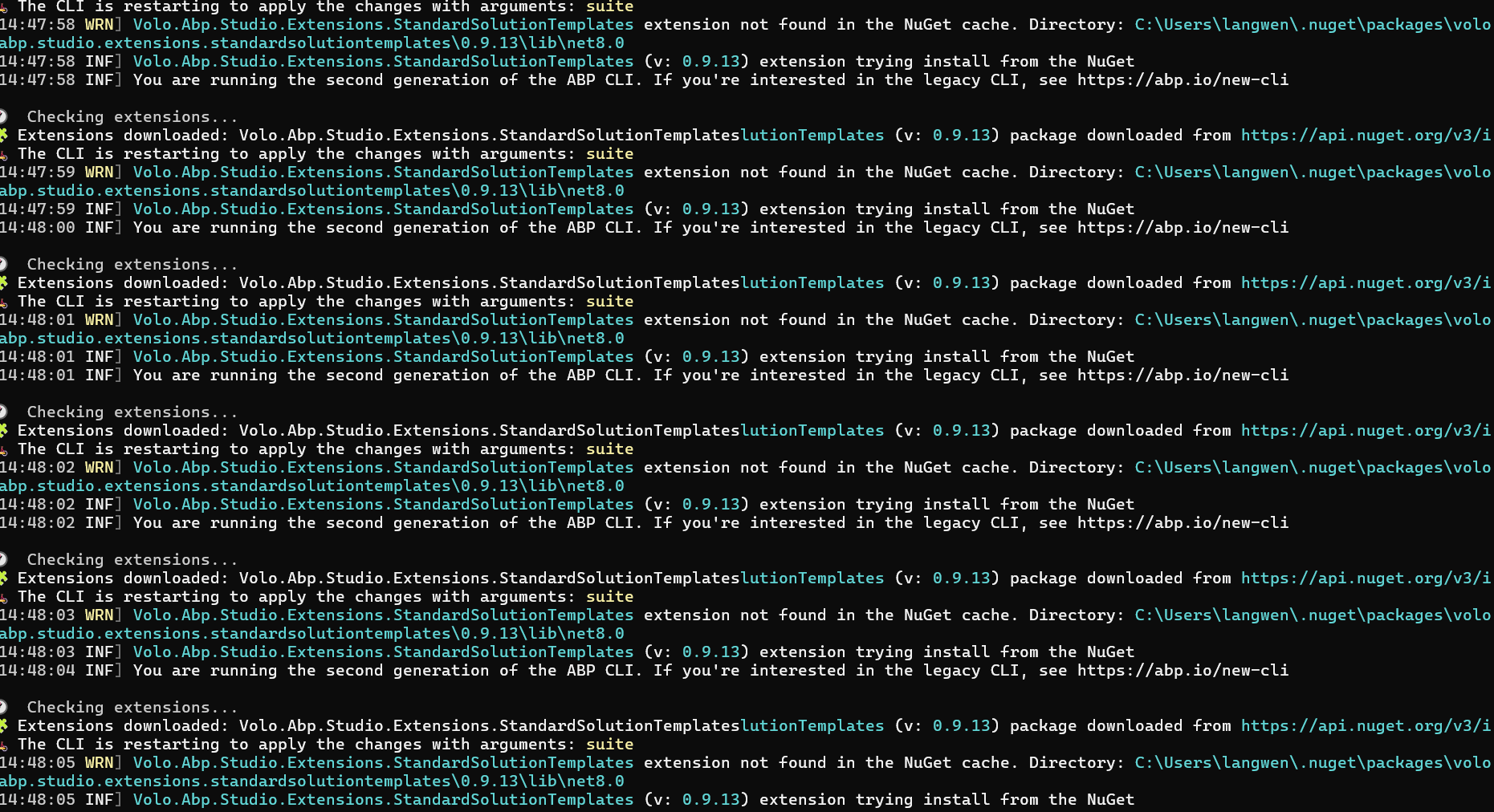
hi: maliming
my problem has been solved. Thank you.









