[maliming] said: hi
our clients app display @Copyright Volosoft in parts of the backend and we don't know how to remove it?
Can you share a screenshot? What is the UI type of this copyright component?
Thanks.
This is already mentioned in the thread including a screen shot :)
[maliming] said: hi
I will remove these files from the IDE file views in the next LeptonX version. You can ignore it now.
Thanks.
Not exactly sure how that affects things but it seems you are on top of that.
We still (if I have not misunderstood something here), no solution to the fact that our clients app display @Copyright Volosoft in parts of the backend and we don't know how to remove it?
[maliming] said: hi
This is IDE behavior. You can try to add code below to your solution's
common.propsfile<ItemGroup> <None Remove="**\*.abppkg" /> <None Remove="**\*.abppkg.analyze.json" /> <Content Remove="$(UserProfile)\.nuget\packages\*\*\contentFiles\any\*\*.abppkg*" /> </ItemGroup>Thanks.
That is already in there as default it seems but not sure how that would affect this?
There are no such files/folders as there isn't even a .Web project
It is there if you create a MVC project but that isn't any help if you don't use MVC but Angular or similar.
Please fix this so that we don't have to deal with this in a commercial product at all in the future and also please let us know how we can fix it ourselves in our current project.
Please also note that this Copyright Volosoft only seem to be shown on errorpage when trying to do authentication, like when you config isn't setup correctly and you get 4XX errors etc.
Thank you.
Thanks, but that is not what we asked for but instead the ability to included these properties as selectable in ABP Suite somehow. Modifying the template probably works as well but not sure if those settings can be put in Git as well so they would work for all developers etc?
Thanks.
[sumeyye.kurtulus] said: Yes, you’re right. You’ll need to adjust the application configuration based on your test environment. You can refer to this preview documentation for more details: https://abp.io/docs/10.1/framework/ui/react-native?Architecture=Monolith#web-view-recommended---quickest-method
I believe you need to adjust the code of the OpenIddict seeder as well as it wont work with just one value for RootUrl. Since we have never been able to get the React Native / Expo template to work even out of the box we have never tried logging into it though.
    "RedirectUris": [
      "http://replace.replace/auth/callback",
      "xxx://auth/callback"
    ],
    "PostLogoutRedirectUris": [
      "http://replace.replace",
      "xxxxx://"
    ]


            redirectUris: azureDevMobileRedirectUris,
            postLogoutRedirectUris: azureDevMobilePostLogoutRedirectUris
Besides the previous errors we have reported with regard to the included Expo template, I don't think this will work either for Expo Web as that would require a normal URL instead of a deep link (protocol handler)
  "AbpSolution4_Mobile": {
    "ClientId": "AbpSolution4_Mobile",
    "RootUrl": "exp://localhost:19000"
[maliming] said: hi
We have changed this behavior so that, even without IIS or Nginx, it will no longer show errors.
Thanks.
Thanks.
Please also consider if there is a need to update docs to highlight this (requirements for getting dynamic envs to work) and also considering this ticket as it seem to have been valid for a needed fix. Thanks.
[maliming] said: hi
Every template project will include a footer component. You can change it in MVC. blazor and angular.
Thanks.
Is this something that will be introduced as at least in our :NET + Angular we don't seem to have this, even though I assume we could create a new MVC project, take that footer.cshtml and move it into the existing structure.
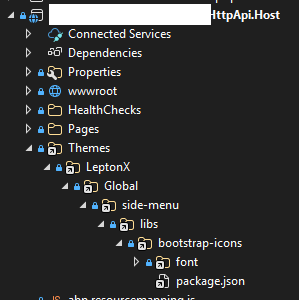
[maliming] said: hi
We provide the
_Footer.cshtmlfile instead of an empty file in the template, allowing the customer to change it more easily.Thanks.
But this template assumes that you are using MVC from what I understand, if not, things get more complicated just to remove a Copyright notice which, at least according to me, never should have been there to begin with (even though the option to enable it if needed would be nice).
Thanks.









