I created a localization resource to override some of the default values. For example, I wanted to override the default values of 'Name' and 'Surname' to 'First Name' and 'Last Name for AbpAccount and AbpIdentity. I am able to get the desired behavior when I run my application local. However, I don't see my modifications when running from production.
Any suggestions?
By default, the home page is shown first, and users can navigate to the login page from there.
However, I would like the application to start directly at the login page and only show the home page after the user has been authenticated. To achieve this, I added the canActivate: [authGuard] to account-routing.module.ts, which correctly makes the login page the default page when navigating to the root URL (e.g., http://localhost:4200).
Despite this, I am encountering an issue where the home page is briefly visible for a split second before the login page appears when initially accessing the application. I would like to prevent the home page from being visible before authentication.
Could you please provide guidance or suggestions on how to resolve this issue? Any help would be greatly appreciated.
Does the ABP Studio desktop application support creating new solutions in older versions of ABP Commercial? For example, can I use ABP Studio to create a new project with v8.3.4, similar to how we can change the version of the ABP Suite?
Thank you in advance.
Is there a quick way of hiding the logo and name without creating a custom login page? If yes, please explain.
Thank you
Hello,
I defined an ENUM as an extra property for the user entity as follows.
OneTimeRunner.Run(() =>
{
    ObjectExtensionManager.Instance.Modules()
        .ConfigureIdentity(identity =>
        {
            identity.ConfigureUser(user =>
            {
                user.AddOrUpdateProperty<UserType>("UserType", property =>
                {
                    property.DisplayName = LocalizableString.Create<RxPortalResource>("::UserType");
                    property.Attributes.Add(new RequiredAttribute());
                    property.Configuration[IdentityModuleExtensionConsts.ConfigurationNames.AllowUserToEdit] = false;
                });
            });
        });
});
I want this extra property visible on the user administration user table and dialog box but not visible from the user’s personal information section. However, I am seeing this property in the user’s personal information section.
Is IdentityModuleExtensionConsts.ConfigurationNames.AllowUserToEdit only supported for Blazor? How would I accomplish this in Angular?
I am trying to get my Angular UI to set the tenant based on the subdomain. I modified the enviroment.prod.ts file to include a baseUrl.
export const environment = {
  //...
  application: {
    baseUrl: 'https://{0}.mydomain.com/'
  },
  //...
}
I also tried with and without the following tenant resolver in the Host project:
Configure<AbpTenantResolveOptions>(options =>
{
    options.TenantResolvers.Insert(1, new DomainTenantResolveContributor("{0}.mydomain.com"));
});
I can't figure out how to use two or more ngx-datatables on the same page using the ListService.
Table 1:
ngx-datatable [rows]="data.items" [count]="data.totalCount" [list]="list" default>
Table 2:
<ngx-datatable [rows]="dataMessages.items" [count]="dataMessages.totalCount" [list]="list" default>
Going to page 2 on one table causes the other table to also go to page two. How do I break this synchronization?
ABP Framework version: v2.9 UI type: Angular Tiered (MVC) or Identity Server Seperated (Angular): no
I have a console application that needs to modify records accross multiple tenants. The console application uses the host admin credentials. I tested out the code below without success:
using (_dataFilter.Disable<IMultiTenant>())
{
    var unit = await _unitAppService.GetAsync(Guid.Parse("ED9D4AC2-BC3F-1FA4-71D6-39F5F9048F20"));
    Console.WriteLine(unit.UniqueIdentifier);
}
I get the following error:
**Volo.Abp.Http.Client.AbpRemoteCallException: 'There is no entity Unit with id = ed9d4ac2-bc3f-1fa4-71d6-39f5f9048f20!'**
If I change the console application to the tenant's credentials and use ICurrentTenant to change the tenant I can find the record.
Any thoughts on what I am doing wrong?
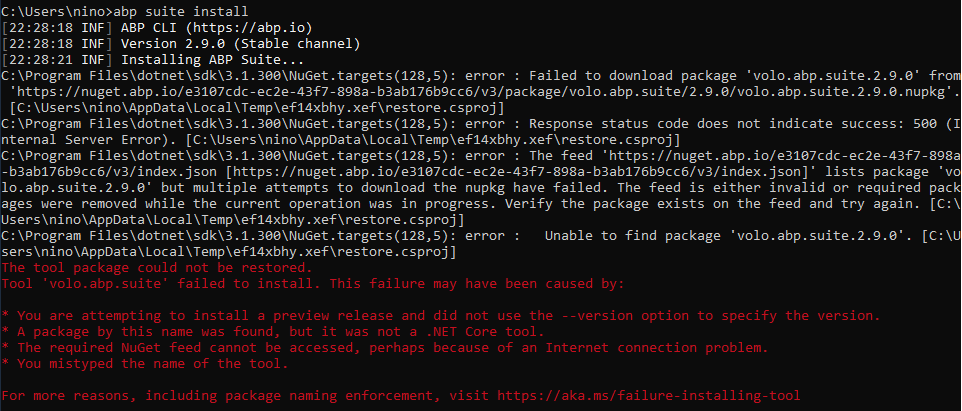
Would you please provide guidance on why I am unable to install ABP Suite v2.9.0. Here are the steps taken:
Step 1: dotnet tool install -g volo.abp.cli (Success)
Step 2: abp login <username> -p <password> (Success)
Step 3: abp suite install (Error below)
Thank you in advance









