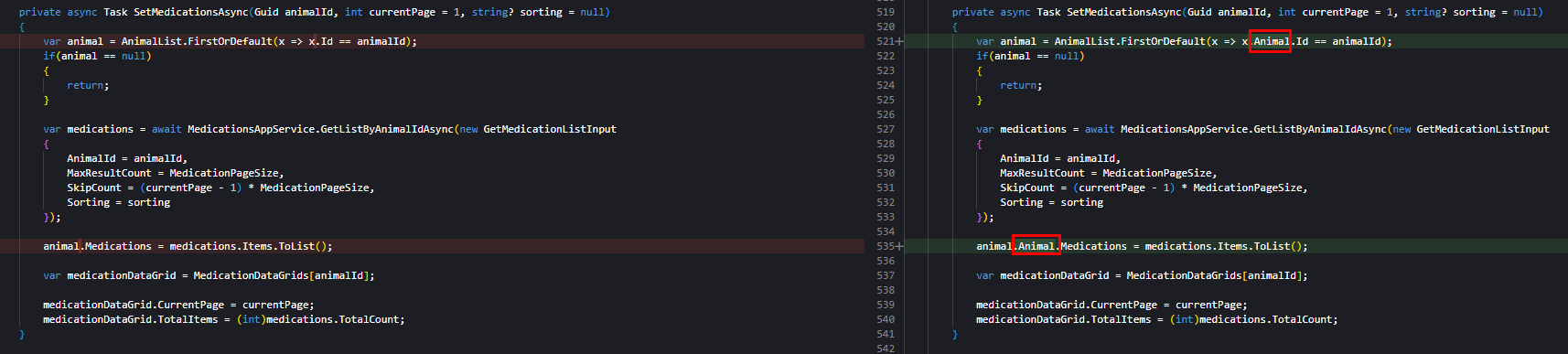
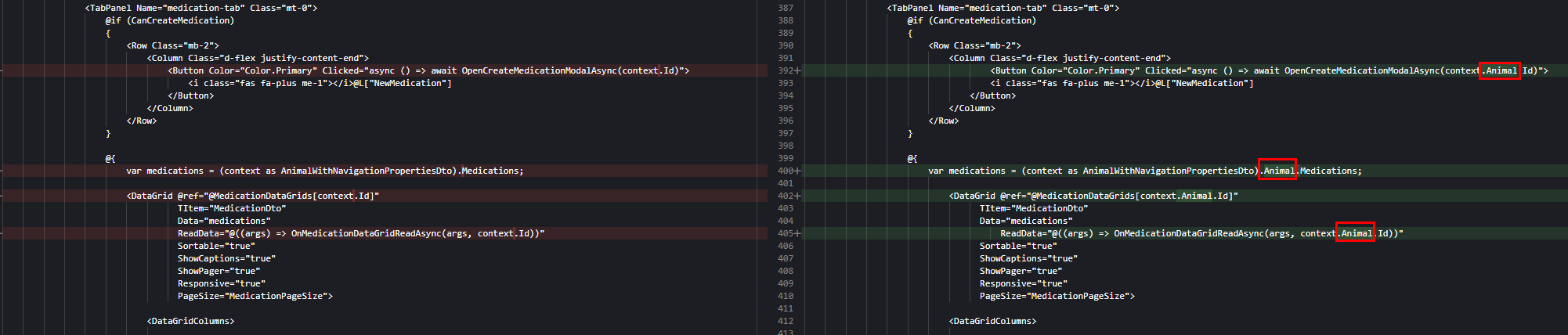
We have to apply certain CSPs (Content Security Headers) for our customer. I have problems with the following policy:
style-src 'self'
For example, the column widths are no longer set correctly in the DataGrid and, more importantly, the modal components are no longer displayed.
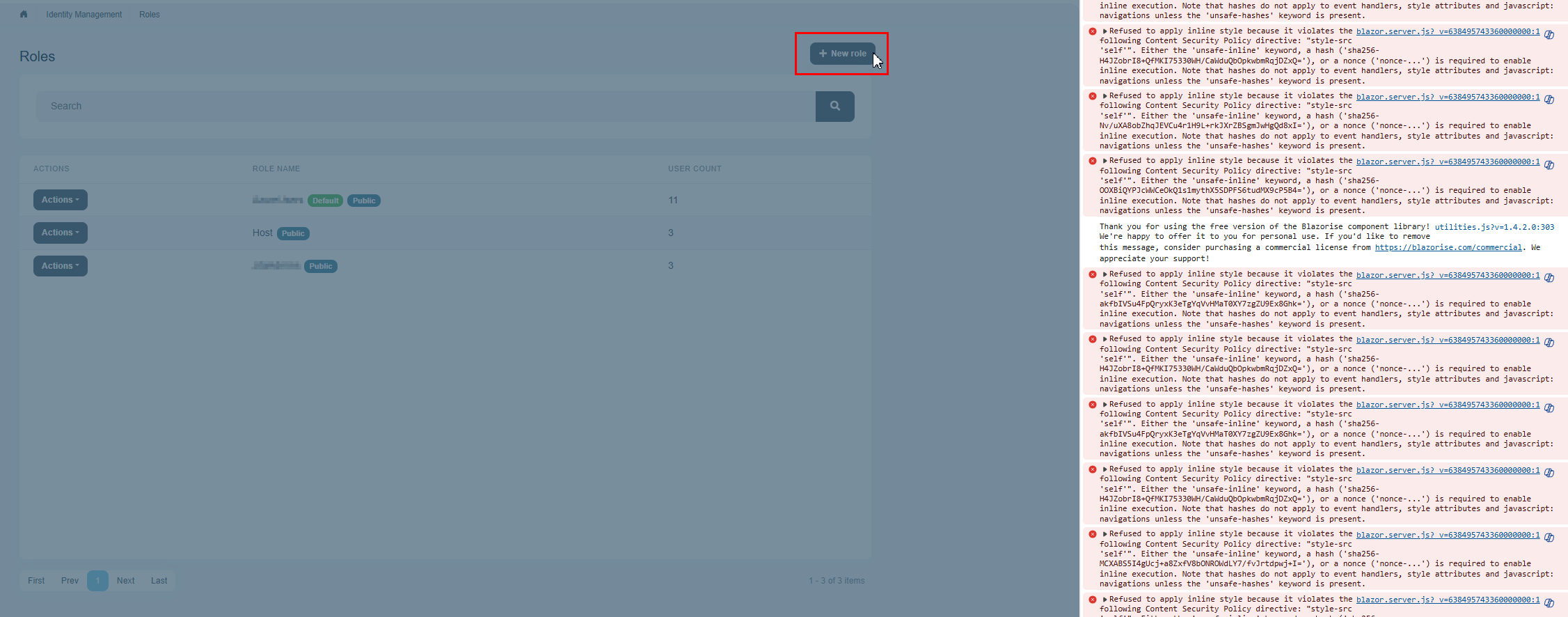
The policy looks like this:
options.UseContentSecurityPolicyHeader = true;
options.ContentSecurityPolicyValue = "base-uri 'self'; default-src 'none'; img-src 'self' data:; script-src 'self'; style-src 'self'; font-src 'self'; connect-src 'self'; frame-ancestors 'none'";
With style-src 'self' 'unsafe-inline' it would work... but is not allowed.
Need a solution as soon as possible... Thank you!
Thanks for the hint and the link.
I have now implemented this as follows:
AppService method:
[AuthorizeWithOrCondition(MyProjectPermissions.TargetSystems.UserWrite, MyProjectPermissions.TargetSystems.AgentWrite)]
public virtual async Task CreateAsync(TargetSystemCreateDto input)
{
   ...
}
AuthorizeAttribute:
    public class AuthorizeWithOrConditionAttribute : AuthorizeAttribute,  IAuthorizationRequirementData
    {
        public string[] PermissionNames { get; }

        public AuthorizeWithOrConditionAttribute(params string[] permissionNames)
        {
            PermissionNames = permissionNames;
        }

        public IEnumerable<IAuthorizationRequirement> GetRequirements()
        {
            yield return new PermissionsRequirement(PermissionNames, requiresAll: false);
        }
    }
Our customer gives us a certain authorization structure that is not quite standard. Different permissions should grant access to a service method (not just one permission as usual).
Example:
If I use the AuthorizeAttribute twice, the permissions are AND combined. However, I need them with an OR combination.
I tried it with my own AuthorizeAttribute, but failed. It also didn't work in combination with my own AuthorizationHandler, as I couldn't access the AuthorizationService there (-> circular dependency).
The only variant that worked was to implement this directly in the service method:
public virtual async Task<TargetSystemDto> CreateAsync(TargetSystemCreateDto input)
{
    var authUserWrite = await AuthorizationService.AuthorizeAsync(_currentPrincipalAccessor.Principal, null, MyProjectPermissions.TargetSystems.UserWrite);
    var authAgentWrite = await AuthorizationService.AuthorizeAsync(_currentPrincipalAccessor.Principal, null, MyProjectPermissions.TargetSystems.AgentWrite);
    if (!authUserWrite.Succeeded && !authAgentWrite.Succeeded)
    {
        throw new AbpAuthorizationException();
    }

    var targetSystem = await _targetSystemManager.CreateAsync(...);
    return ObjectMapper.Map<TargetSystem, TargetSystemDto>(targetSystem);
}
But I would prefer to have this in an attribute. So that I could call it up as follows, for example:
[AuthorizeWithOrCondition(MyProjectPermissions.TargetSystems.AgentWrite, MyProjectPermissions.TargetSystems.UserWrite)]
How could this be realized? There must be a way...
Thanks, Adrian
I would like the resources (localized strings) to have better names (keys). Or that they could be customized.
The problem is as follows: You often have the same property names in different entities. For example Name, Description, Remark, IsActive, ... But now you might want to call the "Name" property "Customer name" in the customer views and translate Name as "Company name" in the company views. This currently requires a lot of manual adjustments (or you have to be extremely careful when regenerating and make manual adjustments again).
I have adapted the templates accordingly so that this is generated according to the following scheme:
@L["Entity:%%entity-name%%:%%property-name%%"]"
This makes future updates of the templates very time-consuming for me ( this is why I asked for a better update option). Because there are about 28 templates that I had to modify. But a structured resource file was more important to me.
Possible solution: ...would be if you could also specify the resource key to be used for a property in the suite. As a default, you could use %%property-name%% as in the past, which would also ensure backwards compatibility. But you would have the option of overwriting this.
I have also given all common resources (generated by the suite) the prefix "Common" (e.g. @L["Common:Update"]). This allows me to sort the resource file and see immediately which strings have been generated and belong together. These strings are defined in Frontend.Blazor.Page.Partials.Localizations.txt.
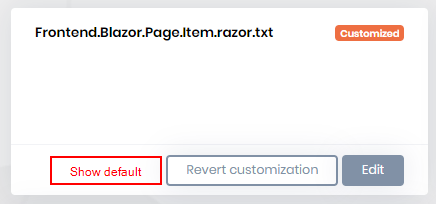
Because the templates are not yet perfect and sometimes contain errors, I had to customize them. When a new version is released, it is relatively time-consuming to find out whether I can switch back to the original template, whether I have to continue using my modified template or whether I should even perform a merge.
Several possible solutions come to mind:
The test classes are not generated correctly by the suite. Especially in the repository tests, the GetListAsync() methods are also called with the parameters that no longer appear in the method because "Filterable" has been deactivated.
I also have problems with a child entity that has navigation properties. The generated test classes of the navigation property entities require a DataSeedContributor of the child entity, but this class was not generated.
When I generate an entity several times in the ABP Suite, certain usings are added to the (extended) manager class each time (MyProject.Domain\Customers\CustomerManager.Extended.cs).
I believe these are the entities that contain enums and navigation properties (the namespace is added, regardless of whether it already exists).
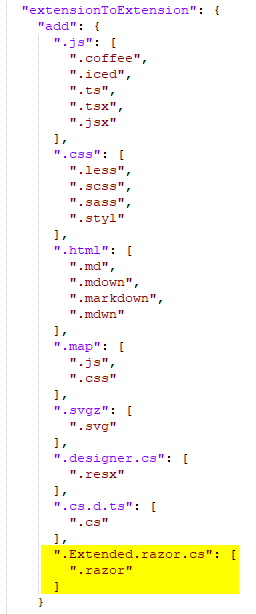
For a clean look of the extended classes in Blazor, an addition would have to be made in the .filenesting.json file (this is overwritten every time I generate something with ABP Suite...).
Add the following to the extensionToExtension section:
".Extended.razor.cs": [
    ".razor"
  ]
In general, it would be nice if the lines of code were indented correctly in the from ABP Suite generated code.
I get compilation errors when I have generated master-child entities. I am using version 8.1.0.
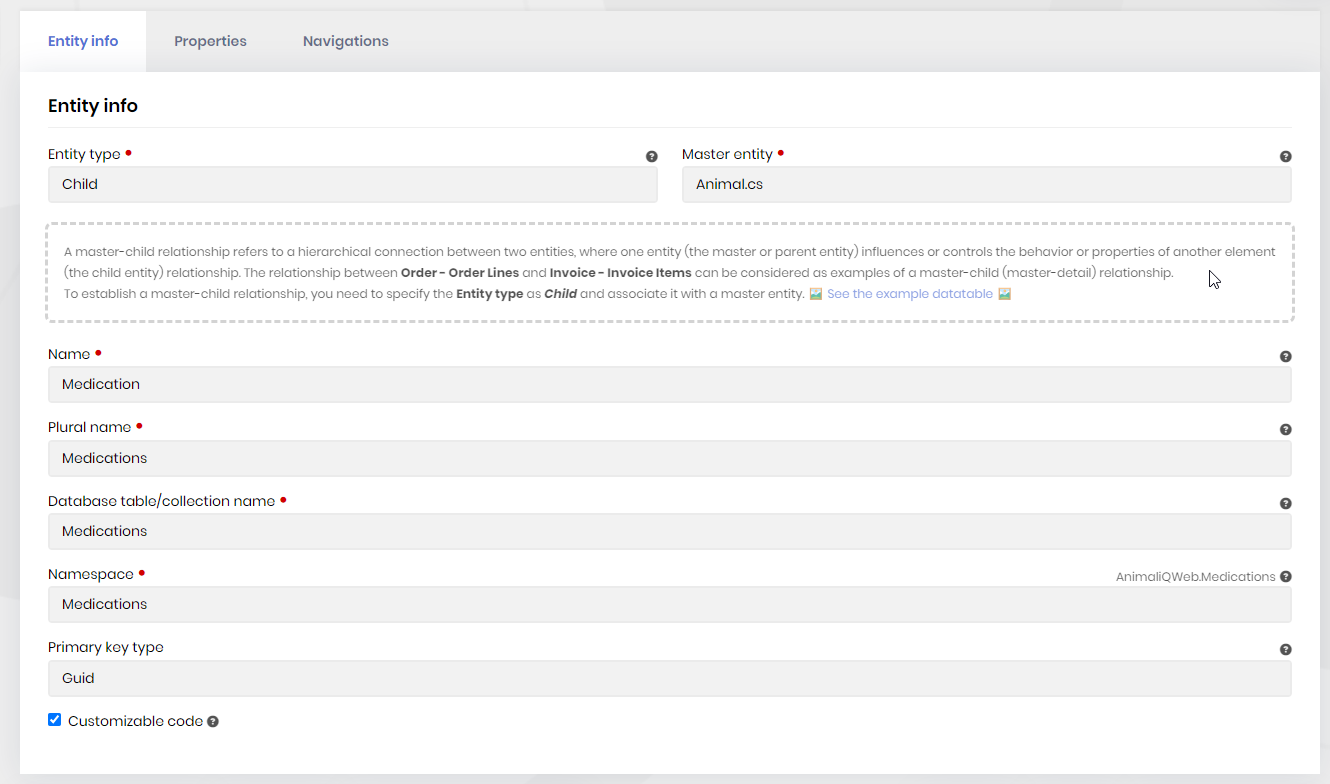
I had to remove %%<if:HasMasterEntityNavigationProperties>%% and %%</if:HasMasterEntityNavigationProperties>%% in the following two templates:
This does not seem to be applied correctly.
After my change, the entites were generated correctly. The changed result looks like this: