These classes are in the Volo.Abp.Account.Pro.Public.Web.OpenIddict package.
btw, can you share your csproj file of backed?
hi
The base class of LoginModel should be Volo.Abp.Account.Web.Pages.Account.OpenIddictSupportedLoginModel and the LoggedOutModel namespace is Volo.Abp.Account.Public.Web.Pages.Account LoggedOutModel
hi
Have you tried that?
https://support.abp.io/QA/Questions/7178/SystemInvalidOperationException-IDX20803-Unable-to-obtain-configuration-from-%27httplocalhost44395well-knownopenid-configuration%27#answer-3a1281eb-547b-98e3-ba12-1a21983d3197
Also, there is an etc/docker folder in the template project that you can refer to.
If your project doesn't have,You can try to create a new template project to see it.
hi
We are not experts in Docker. You can give it a try. I think it is possible.
If you face any problems, you can provide feedback here.
Please set the correct AuthServer:Authority URL in your docker environment.
Example:
{
  "AuthServer": {
    "Authority": "http://backoffice-authserver",
    "RequireHttpsMetadata": false,
    "MetaAddress": "http://backoffice-authserver",
    "SwaggerClientId": "MyProjectName_Client_Id"
  }
}
The link can be reached on your computer. But the container is in Docker.
There are different networks between Docker and your computer.
hi
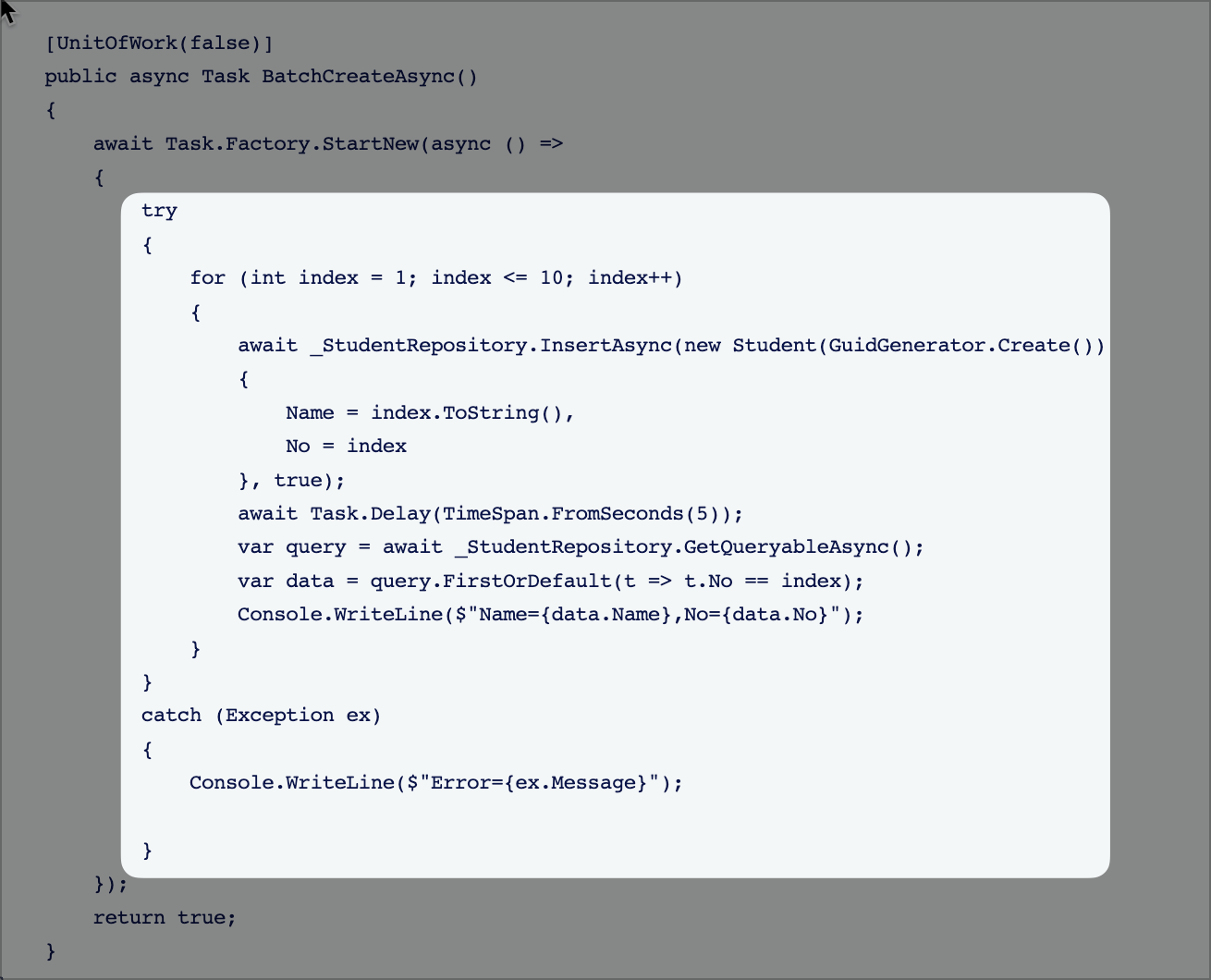
Please create an uow in your thread method. https://docs.abp.io/en/abp/latest/Unit-Of-Work#begin-a-new-unit-of-work
hi
Can you try setting the log level to Debug and sharing the iOS and Android logs?
liming.ma@volosoft.com
Thanks
public class Program
{
    public async static Task<int> Main(string[] args)
    {
        Log.Logger = new LoggerConfiguration()
            .MinimumLevel.Debug()
            .MinimumLevel.Override("Microsoft.EntityFrameworkCore", LogEventLevel.Warning)
            .Enrich.FromLogContext()
            .WriteTo.Async(c => c.File("Logs/logs.txt"))
            .WriteTo.Async(c => c.Console())
            .CreateLogger();
hi
Can you use GIT to help you to degrade? Use git to check all files' previous content.
We will release the 8.1.2 soon.
https://www.google.com/search?q=git+revert+to+previous+commit
hi
Cannot assign requested address (localhost:44395)
Is http://localhost:44395/ can communicate in your backoffice-api container?
Please set the correct AuthServer:Authority URL in your docker environment.
Example:
{
  "AuthServer": {
    "Authority": "http://backoffice-authserver",
    "RequireHttpsMetadata": false,
    "MetaAddress": "http://backoffice-authserver",
    "SwaggerClientId": "MyProjectName_Client_Id"
  }
}