Ok, one solution I got is the following.
var genderPermission = myGroup.AddPermission(AbpAppTmpltMvcPvtPermissions.Genders.Default, L("Permission:Genders"), MultiTenancySides.Host);
Added the parameter MultiTenancySides.Host.
That file is AbpAppTmpltMvcPvtPermissionDefinitionProvider from the contract project AbpAppTmpltMvcPvt.Application.Contracts and inside Permissions folder.
I created an multi tenant application as per the options shown here in these images in this issue(closed now).
I created a new entity called Gender as per the steps explained in this section. I
I did not want mult-tenant feature on this, so ensured the multi-tenant check box is NOT Selected.
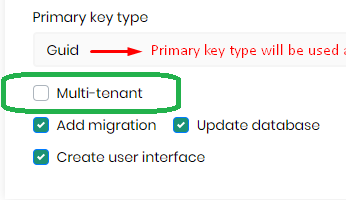
When I run the appication, every thing is working fine.
The host admin is now able to created objects of Gender.
Now I dont want the tenants to create such objects. I logged in as CompanyA/Admin(tenant - CompanyA) and I am able to create Gender.
I want to restrict this. Tenants should not be allowed to create Gender objects while the host should be allowed. How can I achieve that?
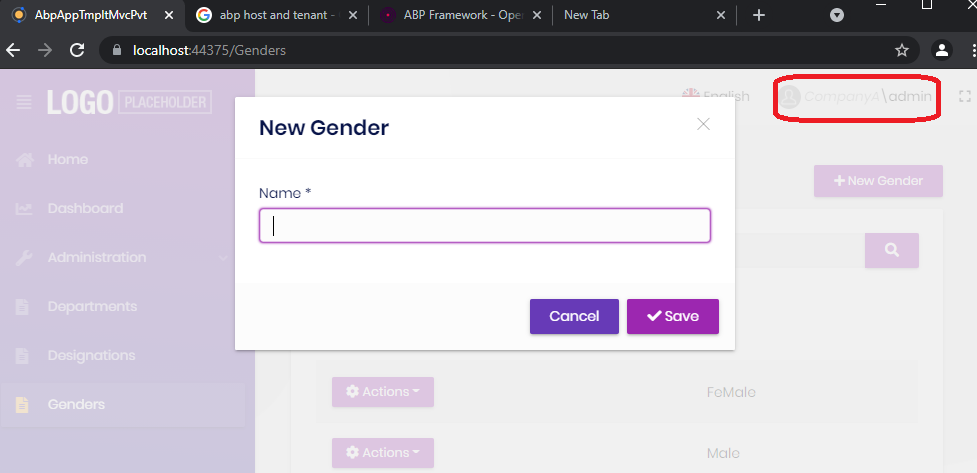
Looking at the code, it appears that this should be something to do with Permissions. But I have no clue what do with this.
public class Genders {
    public const string Default = GroupName + ".Genders";
    public const string Edit = Default + ".Edit";
    public const string Create = Default + ".Create";
    public const string Delete = Default + ".Delete";
}
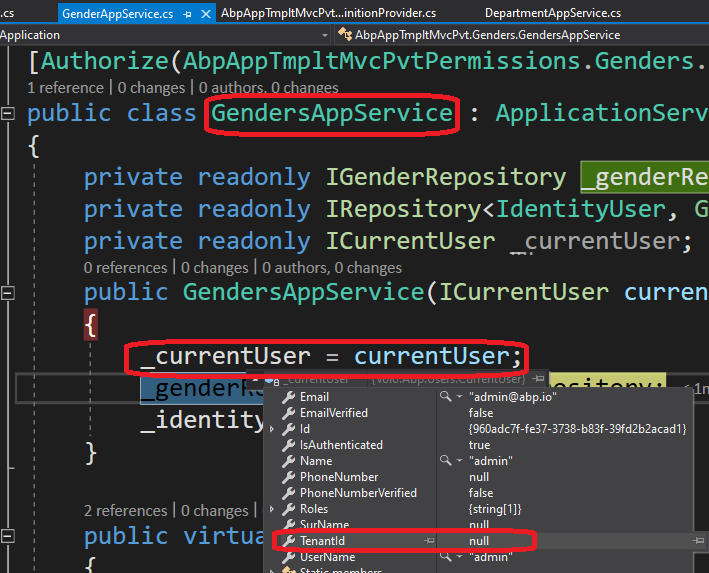
One way I found is to ensure that the tenant id is null in the GenderAppService class. If the tenant id is not null, then it means that the user is from a tenant. Then in such a case throw some exception. But this is from the developers perspective. Can the end host admin do something himself to impose such a restriction?
Thank You Dave.
When I created a new Tennant I choose Standard Edition(see my first image) and I got into that problem. Then I tried without the 'Standard' edition(chose blank). It worked.
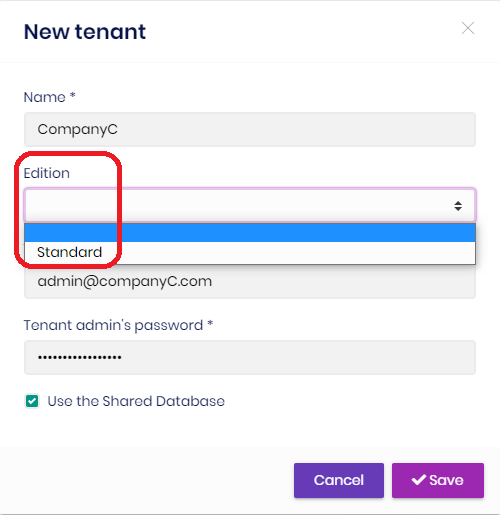
From then on, it started working even with Standard Edition.
I created a new application as per the steps here.
The options choosen during solution creation are as per the images shown in this issue(closed now)
I am not able to successifully login, able to create another admin also and login.
But when it comes to creating a new tenant, the login to the new tenant is always failing.
I tried three times, completely deleting the database and starting fresh everytime.
What am I missing?
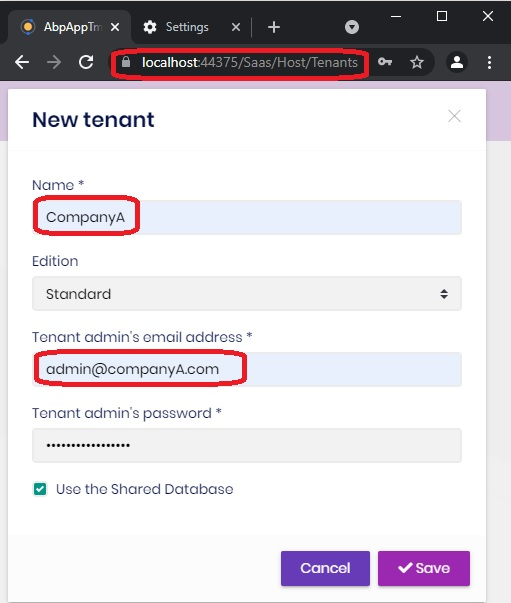
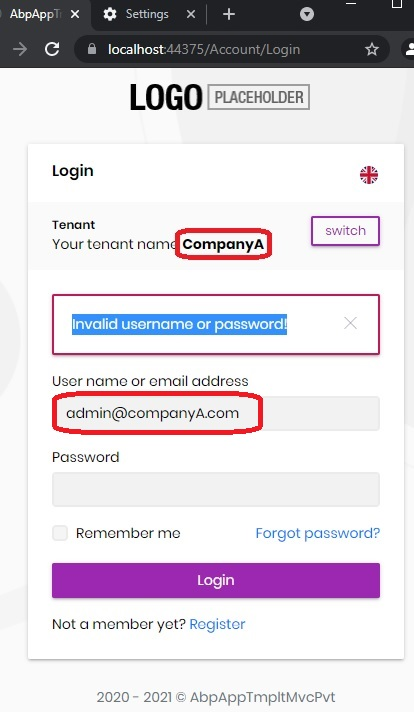
Yes, thank you. Thats the problem
From the commercial login, I created a mvc app as follows(see first 3 images below).
Next I created a database on localdb as shown in 4th image below and updated the connection strings.
Now when I run the app, I get the exception
SqlException: Invalid object name 'AbpLanguages'. Microsoft.Data.SqlClient.SqlCommand+<>c.<ExecuteDbDataReaderAsync>b__169_0(Task<SqlDataReader> result)
The full exception stack is pasted below the images. If you need the full solution as zipped file, let me know how to attach, I will do that. But there is nothing that I had done to it except for the connection strings updation.
So what am I missing?
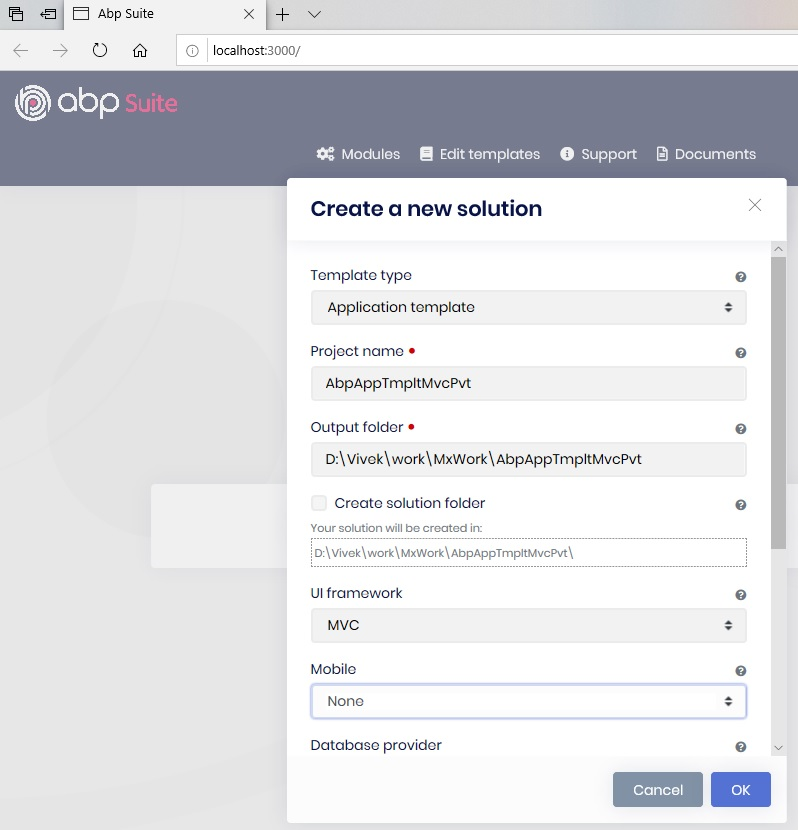
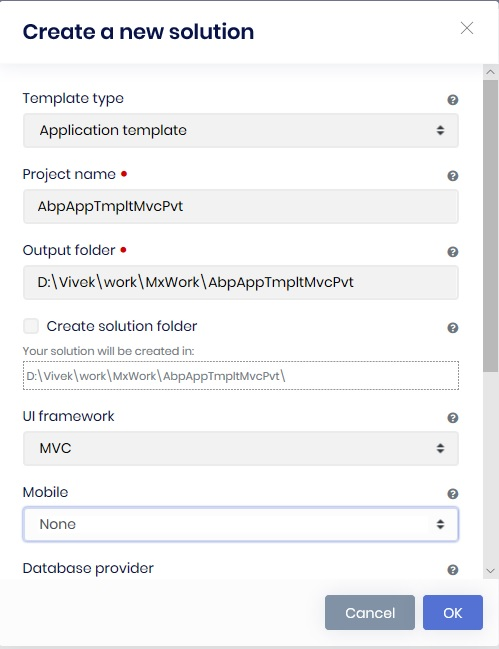
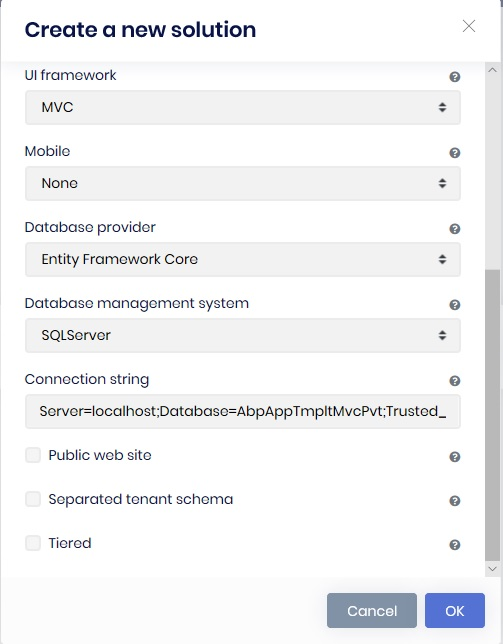
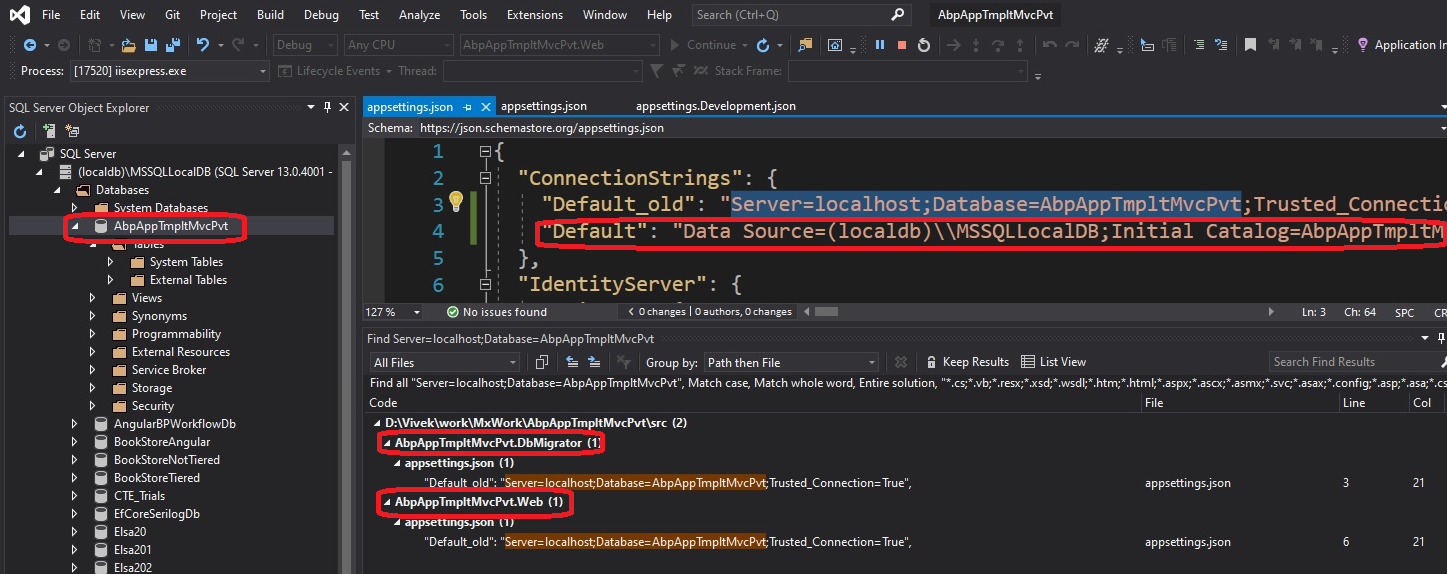
Exception full Info
SqlException: Invalid object name 'AbpLanguages'. Microsoft.Data.SqlClient.SqlCommand+<>c.<ExecuteDbDataReaderAsync>b__169_0(Task<SqlDataReader> result)
Stack Query Cookies Headers Routing SqlException: Invalid object name 'AbpLanguages'. Microsoft.Data.SqlClient.SqlCommand+<>c.<ExecuteDbDataReaderAsync>b__169_0(Task<SqlDataReader> result) System.Threading.Tasks.ContinuationResultTaskFromResultTask<TAntecedentResult, TResult>.InnerInvoke() System.Threading.Tasks.Task+<>c.<.cctor>b__277_0(object obj) System.Threading.ExecutionContext.RunInternal(ExecutionContext executionContext, ContextCallback callback, object state) System.Threading.ExecutionContext.RunInternal(ExecutionContext executionContext, ContextCallback callback, object state) System.Threading.Tasks.Task.ExecuteWithThreadLocal(ref Task currentTaskSlot, Thread threadPoolThread) Microsoft.EntityFrameworkCore.Storage.RelationalCommand.ExecuteReaderAsync(RelationalCommandParameterObject parameterObject, CancellationToken cancellationToken) Microsoft.EntityFrameworkCore.Storage.RelationalCommand.ExecuteReaderAsync(RelationalCommandParameterObject parameterObject, CancellationToken cancellationToken) Microsoft.EntityFrameworkCore.Query.Internal.SplitQueryingEnumerable<T>+AsyncEnumerator.InitializeReaderAsync(DbContext _, bool result, CancellationToken cancellationToken) Microsoft.EntityFrameworkCore.SqlServer.Storage.Internal.SqlServerExecutionStrategy.ExecuteAsync<TState, TResult>(TState state, Func<DbContext, TState, CancellationToken, Task<TResult>> operation, Func<DbContext, TState, CancellationToken, Task<ExecutionResult<TResult>>> verifySucceeded, CancellationToken cancellationToken) Microsoft.EntityFrameworkCore.Query.Internal.SplitQueryingEnumerable<T>+AsyncEnumerator.MoveNextAsync() Microsoft.EntityFrameworkCore.EntityFrameworkQueryableExtensions.ToListAsync<TSource>(IQueryable<TSource> source, CancellationToken cancellationToken) Microsoft.EntityFrameworkCore.EntityFrameworkQueryableExtensions.ToListAsync<TSource>(IQueryable<TSource> source, CancellationToken cancellationToken) Volo.Abp.LanguageManagement.EntityFrameworkCore.EfCoreLanguageRepository.GetListByIsEnabledAsync(bool isEnabled, CancellationToken cancellationToken) Castle.DynamicProxy.AsyncInterceptorBase.ProceedAsynchronous<TResult>(IInvocation invocation, IInvocationProceedInfo proceedInfo) Volo.Abp.Castle.DynamicProxy.CastleAbpMethodInvocationAdapterWithReturnValue<TResult>.ProceedAsync() Volo.Abp.Uow.UnitOfWorkInterceptor.InterceptAsync(IAbpMethodInvocation invocation) Volo.Abp.Castle.DynamicProxy.CastleAsyncAbpInterceptorAdapter<TInterceptor>.InterceptAsync<TResult>(IInvocation invocation, IInvocationProceedInfo proceedInfo, Func<IInvocation, IInvocationProceedInfo, Task<TResult>> proceed) Volo.Abp.LanguageManagement.DatabaseLanguageProvider.d2bvcd7xA() Volo.Abp.Caching.DistributedCache<TCacheItem, TCacheKey>.GetOrAddAsync(TCacheKey key, Func<Task<TCacheItem>> factory, Func<DistributedCacheEntryOptions> optionsFactory, Nullable<bool> hideErrors, bool considerUow, CancellationToken token) Volo.Abp.LanguageManagement.DatabaseLanguageProvider.GetLanguagesAsync() Microsoft.AspNetCore.RequestLocalization.DefaultAbpRequestLocalizationOptionsProvider.GetLocalizationOptionsAsync() Microsoft.AspNetCore.RequestLocalization.AbpRequestLocalizationMiddleware.InvokeAsync(HttpContext context, RequestDelegate next) Microsoft.AspNetCore.Builder.UseMiddlewareExtensions+<>c__DisplayClass6_1+<<UseMiddlewareInterface>b__1>d.MoveNext() Microsoft.AspNetCore.Diagnostics.DeveloperExceptionPageMiddleware.Invoke(HttpContext context)
Show raw exception details
Microsoft.Data.SqlClient.SqlException (0x80131904): Invalid object name 'AbpLanguages'.
at Microsoft.Data.SqlClient.SqlCommand.<>c.<ExecuteDbDataReaderAsync>b__169_0(Task1 result) at System.Threading.Tasks.ContinuationResultTaskFromResultTask2.InnerInvoke()
at System.Threading.Tasks.Task.<>c.<.cctor>b__277_0(Object obj)
at System.Threading.ExecutionContext.RunInternal(ExecutionContext executionContext, ContextCallback callback, Object state)
--- End of stack trace from previous location ---
at System.Threading.ExecutionContext.RunInternal(ExecutionContext executionContext, ContextCallback callback, Object state)
at System.Threading.Tasks.Task.ExecuteWithThreadLocal(Task& currentTaskSlot, Thread threadPoolThread)
--- End of stack trace from previous location ---
at Microsoft.EntityFrameworkCore.Storage.RelationalCommand.ExecuteReaderAsync(RelationalCommandParameterObject parameterObject, CancellationToken cancellationToken)
at Microsoft.EntityFrameworkCore.Storage.RelationalCommand.ExecuteReaderAsync(RelationalCommandParameterObject parameterObject, CancellationToken cancellationToken)
at Microsoft.EntityFrameworkCore.Query.Internal.SplitQueryingEnumerable1.AsyncEnumerator.InitializeReaderAsync(DbContext _, Boolean result, CancellationToken cancellationToken) at Microsoft.EntityFrameworkCore.SqlServer.Storage.Internal.SqlServerExecutionStrategy.ExecuteAsync[TState,TResult](TState state, Func4 operation, Func4 verifySucceeded, CancellationToken cancellationToken) at Microsoft.EntityFrameworkCore.Query.Internal.SplitQueryingEnumerable1.AsyncEnumerator.MoveNextAsync()
at Microsoft.EntityFrameworkCore.EntityFrameworkQueryableExtensions.ToListAsync[TSource](IQueryable1 source, CancellationToken cancellationToken) at Microsoft.EntityFrameworkCore.EntityFrameworkQueryableExtensions.ToListAsync[TSource](IQueryable1 source, CancellationToken cancellationToken)
at Volo.Abp.LanguageManagement.EntityFrameworkCore.EfCoreLanguageRepository.GetListByIsEnabledAsync(Boolean isEnabled, CancellationToken cancellationToken)
at Castle.DynamicProxy.AsyncInterceptorBase.ProceedAsynchronous[TResult](IInvocation invocation, IInvocationProceedInfo proceedInfo)
at Volo.Abp.Castle.DynamicProxy.CastleAbpMethodInvocationAdapterWithReturnValue1.ProceedAsync() at Volo.Abp.Uow.UnitOfWorkInterceptor.InterceptAsync(IAbpMethodInvocation invocation) at Volo.Abp.Castle.DynamicProxy.CastleAsyncAbpInterceptorAdapter1.InterceptAsync[TResult](IInvocation invocation, IInvocationProceedInfo proceedInfo, Func3 proceed) at Volo.Abp.LanguageManagement.DatabaseLanguageProvider.d2bvcd7xA() at Volo.Abp.Caching.DistributedCache2.GetOrAddAsync(TCacheKey key, Func1 factory, Func1 optionsFactory, Nullable`1 hideErrors, Boolean considerUow, CancellationToken token)
at Volo.Abp.LanguageManagement.DatabaseLanguageProvider.GetLanguagesAsync()
at Microsoft.AspNetCore.RequestLocalization.DefaultAbpRequestLocalizationOptionsProvider.GetLocalizationOptionsAsync()
at Microsoft.AspNetCore.RequestLocalization.AbpRequestLocalizationMiddleware.InvokeAsync(HttpContext context, RequestDelegate next)
at Microsoft.AspNetCore.Builder.UseMiddlewareExtensions.<>c__DisplayClass6_1.<
And the headers from the brwser are as follows.
Variable Value Accept text/html,application/xhtml+xml,application/xml;q=0.9,image/avif,image/webp,image/apng,/;q=0.8,application/signed-exchange;v=b3;q=0.9 Accept-Encoding gzip, deflate, br Accept-Language en-US,en;q=0.9 Cache-Control no-cache Connection close Host localhost:44375 Pragma no-cache sec-ch-ua " Not;A Brand";v="99", "Google Chrome";v="91", "Chromium";v="91" sec-ch-ua-mobile ?0 sec-fetch-dest document sec-fetch-mode navigate sec-fetch-site none sec-fetch-user ?1 upgrade-insecure-requests 1 User-Agent Mozilla/5.0 (Windows NT 10.0; Win64; x64) AppleWebKit/537.36 (KHTML, like Gecko) Chrome/91.0.4472.106 Safari/537.36









