I understand, for this you need to override the login page first. Then you can make the changes you want. You can follow the steps below to override the login page.
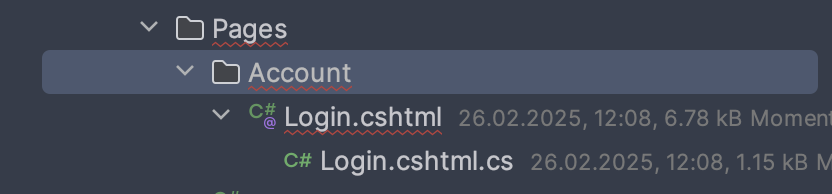
Login.cshtml
@page
@using Microsoft.AspNetCore.Mvc.Localization
@using Microsoft.AspNetCore.Mvc.TagHelpers
@using Microsoft.Extensions.Options
@using Owl.reCAPTCHA
@using Owl.reCAPTCHA.v2.TagHelpers
@using Owl.reCAPTCHA.v3.TagHelpers
@using Volo.Abp.Account.Localization
@using Volo.Abp.Account.Public.Web.Pages.Account;
@using Volo.Abp.Account.Public.Web.Security.Recaptcha
@using Volo.Abp.Account.Settings
@using Volo.Abp.AspNetCore.Mvc.UI.Bootstrap.TagHelpers.Alert
@using Volo.Abp.AspNetCore.Mvc.UI.Bootstrap.TagHelpers.Button
@using Volo.Abp.AspNetCore.Mvc.UI.Bootstrap.TagHelpers.Grid
@using Volo.Abp.AspNetCore.Mvc.UI.Bundling.TagHelpers
@using Volo.Abp.Settings
@model NonTieredApp.Web.Pages.Account.TappLoginModel

@inject IHtmlLocalizer<AccountResource> L
@inject Volo.Abp.AspNetCore.Mvc.UI.Layout.IPageLayout PageLayout
@inject ISettingProvider SettingProvider
@{
    PageLayout.Content.Title = L["Login"].Value;
    var reCaptchaVersion = await SettingProvider.GetAsync<int>(AccountSettingNames.Captcha.Version);
    if (Model.UseCaptcha)
    {
        await Model.ReCaptchaOptions.SetAsync(reCaptchaVersion == 3 ? reCAPTCHAConsts.V3 : reCAPTCHAConsts.V2);
    }

}

@section scripts
    {
    <abp-script-bundle name="@typeof(LoginModel).FullName">
        <abp-script src="/Pages/Account/Login.js" />
    </abp-script-bundle>

    @if (Model.UseCaptcha)
    {
        if (reCaptchaVersion == 3)
        {
            <recaptcha-script-v3 />
            <recaptcha-script-v3-js action="login" execute="false" />
        }
        else
        {
            <recaptcha-script-v2 />
        }
    }
}

@if (Model.IsLinkLogin)
{
    <abp-alert alert-type="Warning">
        @L["LinkAccountWarning", Url.PageLink()]
    </abp-alert>
}

@if (Model.BackToExternalLogins)
{
    <div class="d-grid gap-2">
        <a class="mb-3 btn btn-primary btn-block" href="@Url.Page("./ExternalLogins")">@L["Back"]</a>
    </div>
}
<div class="account-module-form">

    @if (Model.IsSelfRegistrationEnabled)
    {
        <h5 class="mb-2">@L["NotAMemberYet"] <a class="text-decoration-none" href="@Url.Page("./Register", new {returnUrl = Model.ReturnUrl, returnUrlHash = Model.ReturnUrlHash})">@L["Register"]</a></h5>
    }

    @if (Model.EnableLocalLogin)
    {
        <form method="post" id="loginForm">
            @if (Model.UseCaptcha)
            {
                <input class="mb-3" data-captcha="true" type="hidden" name="@RecaptchaValidatorBase.RecaptchaResponseKey" id="@RecaptchaValidatorBase.RecaptchaResponseKey"/>
            }
            <div>
                <div class="form-floating mb-2">
                    <input asp-for="LoginInput.UserNameOrEmailAddress" type="text" class="form-control" placeholder="name@example.com">
                    @Html.LabelFor(m => m.LoginInput.UserNameOrEmailAddress, "Email Address")
                    <span asp-validation-for="LoginInput.UserNameOrEmailAddress"/>
                </div>

                <div class="form-floating mb-2">
                    <input asp-for="LoginInput.Password" id="password-input" type="password" class="form-control" placeholder="Password">
                    @Html.LabelFor(m => m.LoginInput.Password)
                    <i id="PasswordVisibilityButton" class="bi bi-eye-slash show-pass-icon" data-bs-toggle="tooltip" data-bs-placement="top" data-bs-html="true" aria-label="@L["ShowPassword"]" data-bs-original-title="@L["ShowPassword"]"></i>
                    <i id="capslockicon" class="bi bi-capslock caps-lock-icon" style="display: none;" data-bs-toggle="tooltip" data-bs-placement="top" data-bs-html="true" aria-label="<i class='bi bi-exclamation-circle'></i> @L["CapsLockOn"]!" data-bs-original-title="<i class='bi bi-exclamation-circle'></i> @L["CapsLockOn"]!"></i>
                    <span asp-validation-for="LoginInput.Password"/>
                </div>
            </div>
            <abp-row>
                <abp-column>
                    <div class="form-switch ps-2">
                        <abp-input asp-for="LoginInput.RememberMe" class="mb-4"/>
                    </div>
                </abp-column>
                <abp-column class="text-end">
                    <a href="@Url.Page("./ForgotPassword", new {returnUrl = Model.ReturnUrl, returnUrlHash = Model.ReturnUrlHash})">@L["ForgotPassword"]</a>
                </abp-column>
            </abp-row>

            @if (reCaptchaVersion == 2)
            {
                <script>
                    recaptchaCallback = function (token) {
                        $('form button[type=submit]').removeAttr("disabled");
                        $('#@RecaptchaValidatorBase.RecaptchaResponseKey').val(token)
                    };
                </script>
                <div class="mb-3">
                    <recaptcha-div-v2 callback="recaptchaCallback"/>
                </div>
            }

            <div class="d-grid gap-2">
                <abp-button button-type="Primary" type="submit" class="mb-3" name="Action" value="Login" disabled="true">
                    <i class="bi bi-box-arrow-in-right me-1"></i>
                    @L["Login"]
                </abp-button>
            </div>

            @if (Model.ShowCancelButton)
            {
                <div class="d-grid gap-2">
                    <abp-button button-type="Secondary" type="submit" formnovalidate="formnovalidate" class="mb-3" name="Action" value="Cancel">@L["Cancel"]</abp-button>
                </div>
            }
        </form>
    }

    @if (Model.VisibleExternalProviders.Any() && false)
    {
        if(Model.EnableLocalLogin)
        {
            <hr/>
            @L["OrSignInWith"]
            <br/>
        }
        else
        {
            @L["SignInWithOneOfTheFollowingProviders"]
        }

        <form asp-page="./Login" asp-page-handler="ExternalLogin"
              asp-route-returnUrl="@Model.ReturnUrl"
              asp-route-returnUrlHash="@Model.ReturnUrlHash"
              asp-route-linkTenantId="@Model.LinkTenantId"
              asp-route-linkUserId="@Model.LinkUserId"
              asp-route-linkToken="@Model.LinkToken"
              method="post">
            @foreach (var provider in Model.VisibleExternalProviders)
            {
                <button type="submit"
                        class="mt-2 me-2 btn btn-outline-primary btn-sm"
                        name="provider"
                        value="@provider.AuthenticationScheme"
                        data-busy-text="@L["ProcessingWithThreeDot"]">
                    @if (provider.Icon != null)
                    {
                        <i class="@provider.Icon"></i>
                    }
                    <span>@provider.DisplayName</span>
                </button>
            }
        </form>
    }
</div>
Login.cshtml.cs
using Microsoft.AspNetCore.Authentication;
using Microsoft.AspNetCore.Identity;
using Microsoft.Extensions.Options;
using Owl.reCAPTCHA;
using Volo.Abp.Account.ExternalProviders;
using Volo.Abp.Account.Public.Web;
using Volo.Abp.Account.Public.Web.Pages.Account;
using Volo.Abp.Account.Security.Recaptcha;
using Volo.Abp.Auditing;
using Volo.Abp.Security.Claims;

namespace NonTieredApp.Web.Pages.Account;

[DisableAuditing]
public class TappLoginModel : LoginModel
{
    public TappLoginModel(
        IAuthenticationSchemeProvider schemeProvider,
        IOptions<AbpAccountOptions> accountOptions,
        IAbpRecaptchaValidatorFactory recaptchaValidatorFactory,
        IAccountExternalProviderAppService accountExternalProviderAppService,
        ICurrentPrincipalAccessor currentPrincipalAccessor,
        IOptions<IdentityOptions> identityOptions,
        IOptionsSnapshot<reCAPTCHAOptions> reCaptchaOptions) : base(
        schemeProvider,
        accountOptions,
        recaptchaValidatorFactory,
        accountExternalProviderAppService,
        currentPrincipalAccessor,
        identityOptions,
        reCaptchaOptions)
    {

    }
}
You can then customize it any way you want. If you have a specific question in the implementation, you can ask.
Hi,
It's entirely up to you. Since each service is independent, you can also update the packages that your services depend on to the latest version of ABP.
Also see more: https://abp.io/support/questions/8755/ABP-studio-not-able-to-add-new-micro-service-in-the-existing-solution
I need the template in the ReactJs framework for this.
I don't understand exactly what you mean, could you be a little more clear?
Can you elaborate on your example a bit more? Why do you suspect an XSS vulnerability? Because this does not seem to be a security issue because only the website can change cookies. 3rd parties cannot change the cookie value as the browser is responsible for the security of the cookies. The scenario of attacking the local machine and getting the cookie is another issue that the victim should care about because even if the attacker gets the cookie, there is no need to evaluate a script on it. They can log into your account with the cookie without any password and do whatever they want. In summary, this is not a real-world attack vector.
Hi,
I am opening an internal issue for this problem. First, we will test it and if there is really such a problem we will solve it. Sorry for the problem you are experiencing, as a workaround solution you can use the following command for projects that are not stopped by ABP Studio:
pkill -f abp-studio
If the pkill is not available I recommend installing it. See more: https://formulae.brew.sh/formula/proctools
Hi,
Can you send me the complete content of NotificationEventMessageQueueManager?
By the way, the domain project of your solution already has the Volo.Abp.Identity.Pro.Domain package reference. So you should not need to add a reference to the Volo.Abp.Identity.Domain project. Can you create a project from scratch and try to use IdentityUserRepository or IdentityUserManager there? You will see that it will work when you try. There is probably something wrong with your solution, but don't worry, together we can solve the problem.
I understand that you don't want to override only the model. If you want to override the complete login page, you can follow the steps below:
Login.cshtml
@page
@using Microsoft.AspNetCore.Mvc.Localization
@using Microsoft.AspNetCore.Mvc.TagHelpers
@using Microsoft.Extensions.Options
@using Owl.reCAPTCHA
@using Owl.reCAPTCHA.v2.TagHelpers
@using Owl.reCAPTCHA.v3.TagHelpers
@using Volo.Abp.Account.Localization
@using Volo.Abp.Account.Public.Web.Pages.Account;
@using Volo.Abp.Account.Public.Web.Security.Recaptcha
@using Volo.Abp.Account.Settings
@using Volo.Abp.AspNetCore.Mvc.UI.Bootstrap.TagHelpers.Alert
@using Volo.Abp.AspNetCore.Mvc.UI.Bootstrap.TagHelpers.Button
@using Volo.Abp.AspNetCore.Mvc.UI.Bootstrap.TagHelpers.Grid
@using Volo.Abp.AspNetCore.Mvc.UI.Bundling.TagHelpers
@using Volo.Abp.Settings
@model NonTieredApp.Web.Pages.Account.TappLoginModel

@inject IHtmlLocalizer<AccountResource> L
@inject Volo.Abp.AspNetCore.Mvc.UI.Layout.IPageLayout PageLayout
@inject ISettingProvider SettingProvider
@{
    PageLayout.Content.Title = L["Login"].Value;
    var reCaptchaVersion = await SettingProvider.GetAsync<int>(AccountSettingNames.Captcha.Version);
    if (Model.UseCaptcha)
    {
        await Model.ReCaptchaOptions.SetAsync(reCaptchaVersion == 3 ? reCAPTCHAConsts.V3 : reCAPTCHAConsts.V2);
    }

}

@section scripts
    {
    <abp-script-bundle name="@typeof(LoginModel).FullName">
        <abp-script src="/Pages/Account/Login.js" />
    </abp-script-bundle>

    @if (Model.UseCaptcha)
    {
        if (reCaptchaVersion == 3)
        {
            <recaptcha-script-v3 />
            <recaptcha-script-v3-js action="login" execute="false" />
        }
        else
        {
            <recaptcha-script-v2 />
        }
    }
}

@if (Model.IsLinkLogin)
{
    <abp-alert alert-type="Warning">
        @L["LinkAccountWarning", Url.PageLink()]
    </abp-alert>
}

@if (Model.BackToExternalLogins)
{
    <div class="d-grid gap-2">
        <a class="mb-3 btn btn-primary btn-block" href="@Url.Page("./ExternalLogins")">@L["Back"]</a>
    </div>
}
<div class="account-module-form">

    @if (Model.IsSelfRegistrationEnabled)
    {
        <h5 class="mb-2">@L["NotAMemberYet"] <a class="text-decoration-none" href="@Url.Page("./Register", new {returnUrl = Model.ReturnUrl, returnUrlHash = Model.ReturnUrlHash})">@L["Register"]</a></h5>
    }

    @if (Model.EnableLocalLogin)
    {
        <form method="post" id="loginForm">
            @if (Model.UseCaptcha)
            {
                <input class="mb-3" data-captcha="true" type="hidden" name="@RecaptchaValidatorBase.RecaptchaResponseKey" id="@RecaptchaValidatorBase.RecaptchaResponseKey"/>
            }
            <div>
                <div class="form-floating mb-2">
                    <input asp-for="LoginInput.UserNameOrEmailAddress" type="text" class="form-control" placeholder="name@example.com">
                    @Html.LabelFor(m => m.LoginInput.UserNameOrEmailAddress, "Email Address")
                    <span asp-validation-for="LoginInput.UserNameOrEmailAddress"/>
                </div>

                <div class="form-floating mb-2">
                    <input asp-for="LoginInput.Password" id="password-input" type="password" class="form-control" placeholder="Password">
                    @Html.LabelFor(m => m.LoginInput.Password)
                    <i id="PasswordVisibilityButton" class="bi bi-eye-slash show-pass-icon" data-bs-toggle="tooltip" data-bs-placement="top" data-bs-html="true" aria-label="@L["ShowPassword"]" data-bs-original-title="@L["ShowPassword"]"></i>
                    <i id="capslockicon" class="bi bi-capslock caps-lock-icon" style="display: none;" data-bs-toggle="tooltip" data-bs-placement="top" data-bs-html="true" aria-label="<i class='bi bi-exclamation-circle'></i> @L["CapsLockOn"]!" data-bs-original-title="<i class='bi bi-exclamation-circle'></i> @L["CapsLockOn"]!"></i>
                    <span asp-validation-for="LoginInput.Password"/>
                </div>
            </div>
            <abp-row>
                <abp-column>
                    <div class="form-switch ps-2">
                        <abp-input asp-for="LoginInput.RememberMe" class="mb-4"/>
                    </div>
                </abp-column>
                <abp-column class="text-end">
                    <a href="@Url.Page("./ForgotPassword", new {returnUrl = Model.ReturnUrl, returnUrlHash = Model.ReturnUrlHash})">@L["ForgotPassword"]</a>
                </abp-column>
            </abp-row>

            @if (reCaptchaVersion == 2)
            {
                <script>
                    recaptchaCallback = function (token) {
                        $('form button[type=submit]').removeAttr("disabled");
                        $('#@RecaptchaValidatorBase.RecaptchaResponseKey').val(token)
                    };
                </script>
                <div class="mb-3">
                    <recaptcha-div-v2 callback="recaptchaCallback"/>
                </div>
            }

            <div class="d-grid gap-2">
                <abp-button button-type="Primary" type="submit" class="mb-3" name="Action" value="Login" disabled="true">
                    <i class="bi bi-box-arrow-in-right me-1"></i>
                    @L["Login"]
                </abp-button>
            </div>

            @if (Model.ShowCancelButton)
            {
                <div class="d-grid gap-2">
                    <abp-button button-type="Secondary" type="submit" formnovalidate="formnovalidate" class="mb-3" name="Action" value="Cancel">@L["Cancel"]</abp-button>
                </div>
            }
        </form>
    }

    @if (Model.VisibleExternalProviders.Any() && false)
    {
        if(Model.EnableLocalLogin)
        {
            <hr/>
            @L["OrSignInWith"]
            <br/>
        }
        else
        {
            @L["SignInWithOneOfTheFollowingProviders"]
        }

        <form asp-page="./Login" asp-page-handler="ExternalLogin"
              asp-route-returnUrl="@Model.ReturnUrl"
              asp-route-returnUrlHash="@Model.ReturnUrlHash"
              asp-route-linkTenantId="@Model.LinkTenantId"
              asp-route-linkUserId="@Model.LinkUserId"
              asp-route-linkToken="@Model.LinkToken"
              method="post">
            @foreach (var provider in Model.VisibleExternalProviders)
            {
                <button type="submit"
                        class="mt-2 me-2 btn btn-outline-primary btn-sm"
                        name="provider"
                        value="@provider.AuthenticationScheme"
                        data-busy-text="@L["ProcessingWithThreeDot"]">
                    @if (provider.Icon != null)
                    {
                        <i class="@provider.Icon"></i>
                    }
                    <span>@provider.DisplayName</span>
                </button>
            }
        </form>
    }
</div>
Login.cshtml.cs
using Microsoft.AspNetCore.Authentication;
using Microsoft.AspNetCore.Identity;
using Microsoft.Extensions.Options;
using Owl.reCAPTCHA;
using Volo.Abp.Account.ExternalProviders;
using Volo.Abp.Account.Public.Web;
using Volo.Abp.Account.Public.Web.Pages.Account;
using Volo.Abp.Account.Security.Recaptcha;
using Volo.Abp.Auditing;
using Volo.Abp.Security.Claims;

namespace NonTieredApp.Web.Pages.Account;

[DisableAuditing]
public class TappLoginModel : LoginModel
{
    public TappLoginModel(
        IAuthenticationSchemeProvider schemeProvider,
        IOptions<AbpAccountOptions> accountOptions,
        IAbpRecaptchaValidatorFactory recaptchaValidatorFactory,
        IAccountExternalProviderAppService accountExternalProviderAppService,
        ICurrentPrincipalAccessor currentPrincipalAccessor,
        IOptions<IdentityOptions> identityOptions,
        IOptionsSnapshot<reCAPTCHAOptions> reCaptchaOptions) : base(
        schemeProvider,
        accountOptions,
        recaptchaValidatorFactory,
        accountExternalProviderAppService,
        currentPrincipalAccessor,
        identityOptions,
        reCaptchaOptions)
    {

    }
}
You can then customize it any way you want.
Hi,
UserManager uses IUserValidator to check user.
See more:
Super, thank you for your valuable contribution.
Closing the issue. Feel free to re-open or create a new issue if you have further questions.
Hello,
I sent a commit that solved the problem. Basically what we did was to call the following code block when SideMenuLayout loading.
leptonx.init.initializers.get('initLpxToolbar')();









