Hello,
We hold an ABP commercial license (organization: Tribulus Development AB) and run a production application on ABP 10.6.1 / .NET 10 with an Angular UI. We are evaluating whether to renew, and we want to understand exactly what we may and may not do after the license period ends, so that we stay within the terms. We would appreciate written answers to the questions below.
Context: we use these pro modules: SaaS, File Management, Payment, Identity Pro, Account Pro, OpenIddict Pro, Language Management, Text Template Management, GDPR, Audit Logging Pro, and the LeptonX theme. While our license is active we have downloaded their source code with "abp get-source" and the Angular package source with "abp add-package <name> --with-source-code", and confirmed the solution builds with the modules referenced as project/source references instead of NuGet/NPM packages.
License code after expiry The FAQ says the license is perpetual and that we can continue developing existing applications after it expires. Does our existing AbpLicenseCode continue to pass the license check indefinitely for version 10.6.1, both for the NuGet packages and for the modules built from downloaded source? Does this hold in development (debug) as well as in production, and on new developer machines and new servers?
Downloaded source after expiry May we keep using, modifying and maintaining the pro module source code we downloaded during the license period, inside our private repository, for this same application, after the license expires?
Upgrading the framework under our own maintained source The downloaded source references the package Volo.Abp.Commercial.Core and calls LicenseChecker.Check<TModule>() in each module class. If, after expiry, we upgrade the open-source ABP framework packages (for example to ABP 11 or a later .NET version) and maintain the pro module source ourselves: a) Is Volo.Abp.Commercial.Core 10.6.1 expected to keep working against newer Volo.Abp.Core versions, and will our license code still validate in that setup? b) If it does not, are we permitted to remove the LicenseChecker calls and the Volo.Abp.Commercial.Core reference from our own copy of the source? If this is not permitted, what is the supported path?
Package feed and registry access after expiry Will our private NuGet feed (nuget.abp.io) and the commercial NPM registry keep serving the versions released during our license period (10.6.x, LeptonX 5.6.x)? Our CI restores packages on every build. Are we allowed to mirror those package versions to an internal, private feed (for example Azure Artifacts) used only by our own team and build servers?
Remaining closed packages Is source code available for Volo.Abp.AspNetCore.Mvc.UI.Theme.Commercial and for Volo.Abp.Commercial.Core? If so, which CLI module or package name should we use?
Developers After expiry, does the developer-seat limit still apply to who may work on the application and on the downloaded source?
Is there anything else that stops working at expiry that is not listed in the FAQ (for example ABP Studio, the CLI login, or "abp update" within 10.6.x)?
We are asking so that we can make the renewal decision with a clear picture and remain compliant either way.
Thank you.
3.GetAsync(TKey id, Boolean includeDetails, CancellationToken cancellationToken) at Castle.DynamicProxy.AsyncInterceptorBase.ProceedAsynchronous[TResult](IInvocation invocation, IInvocationProceedInfo proceedInfo) at Volo.Abp.Castle.DynamicProxy.CastleAbpMethodInvocationAdapterWithReturnValue1.ProceedAsync()
at Volo.Abp.Uow.UnitOfWorkInterceptor.InterceptAsync(IAbpMethodInvocation invocation)
at Volo.Abp.Castle.DynamicProxy.CastleAsyncAbpInterceptorAdapter1.InterceptAsync[TResult](IInvocation invocation, IInvocationProceedInfo proceedInfo, Func3 proceed)
at Volo.Abp.Identity.Gdpr.IdentityGdprEventHandler.HandleEventAsync(GdprUserDataRequestedEto eventData)
at Castle.DynamicProxy.AsyncInterceptorBase.ProceedAsynchronous(IInvocation invocation, IInvocationProceedInfo proceedInfo)
at Volo.Abp.Castle.DynamicProxy.CastleAbpMethodInvocationAdapter.ProceedAsync()
at Volo.Abp.Uow.UnitOfWorkInterceptor.InterceptAsync(IAbpMethodInvocation invocation)
at Volo.Abp.Castle.DynamicProxy.CastleAsyncAbpInterceptorAdapter1.InterceptAsync(IInvocation invocation, IInvocationProceedInfo proceedInfo, Func3 proceed)
at Volo.Abp.EventBus.EventHandlerInvoker.InvokeAsync(IEventHandler eventHandler, Object eventData, Type eventType)
at Volo.Abp.EventBus.EventBusBase.TriggerHandlerAsync(IEventHandlerFactory asyncHandlerFactory, Type eventType, Object eventData, List1 exceptions, InboxConfig inboxConfig) at System.AbpExceptionExtensions.ReThrow(Exception exception) at Volo.Abp.EventBus.EventBusBase.ThrowOriginalExceptions(Type eventType, List1 exceptions)
at Volo.Abp.EventBus.EventBusBase.TriggerHandlersAsync(Type eventType, Object eventData)
at Volo.Abp.EventBus.Distributed.DistributedEventBusBase.TriggerHandlersDirectAsync(Type eventType, Object eventData)
at Volo.Abp.EventBus.RabbitMq.RabbitMqDistributedEventBus.ProcessEventAsync(IModel channel, BasicDeliverEventArgs ea)
at Volo.Abp.RabbitMQ.RabbitMqMessageConsumer.HandleIncomingMessageAsync(Object sender, BasicDeliverEventArgs basicDeliverEventArgs)Hello i have these users in my database.

whenever i click prepare button for gdpr it throws an error on the background. It couldn't find the user in the database and since rabbitmq is the distributed message handler it always retries again and again. So it is full of errors repeating again maybe in the modules that participates for the event it is better to use try catch instead of throwing error. Is it possible to change that? and why the identity module can not find the id that's kind of weird. is it a bug?

Hello, I want to add an extra property to organization units, i have managed to that in the backend with module extension. When i try to extend the angular side it does not seem i have an extension point there.
it seems like i can not extend the organization units when i look at this code.
export type IdentityCreateFormPropContributors = Partial<{
  [eIdentityComponents.Claims]: CreateFormPropContributorCallback<ClaimTypeDto>[];
  [eIdentityComponents.Roles]: CreateFormPropContributorCallback<IdentityRoleDto>[];
  [eIdentityComponents.Users]: CreateFormPropContributorCallback<IdentityUserDto>[];
}>;
here is what i have tried according to documentation https://abp.io/docs/latest/framework/ui/angular/dynamic-form-extensions#step-1-create-form-prop-contributors and here is my code. can you give some suggestions about how can i extend the organization units?
  import { ePropType, FormProp, FormPropList } from '@abp/ng.components/extensible';

import {  OrganizationUnitWithDetailsDto } from '@volo/abp.ng.identity/proxy';
import {
  eIdentityComponents,
  IdentityCreateFormPropContributors
} from '@volo/abp.ng.identity';


const shareOfVoiceProp = new FormProp<OrganizationUnitWithDetailsDto>({
    type: ePropType.Number,
    name: 'ShareOfVoice',
    displayName: '::DisplayName:ShareOfVoice'
  });

  export function shareOfVoicePropContributor(propList: FormPropList<OrganizationUnitWithDetailsDto>) {
    propList.addByIndex(shareOfVoiceProp, 1);
  }


  export const identityCreateFormPropContributors: IdentityCreateFormPropContributors = {
    // enum indicates the page to add contributors to
    [eIdentityComponents.OrganizationUnits]: [
      shareOfVoicePropContributor
      // You can add more contributors here
    ],
  };

  export const identityEditFormPropContributors = identityCreateFormPropContributors;
  // you may define different contributors for edit form if you like```
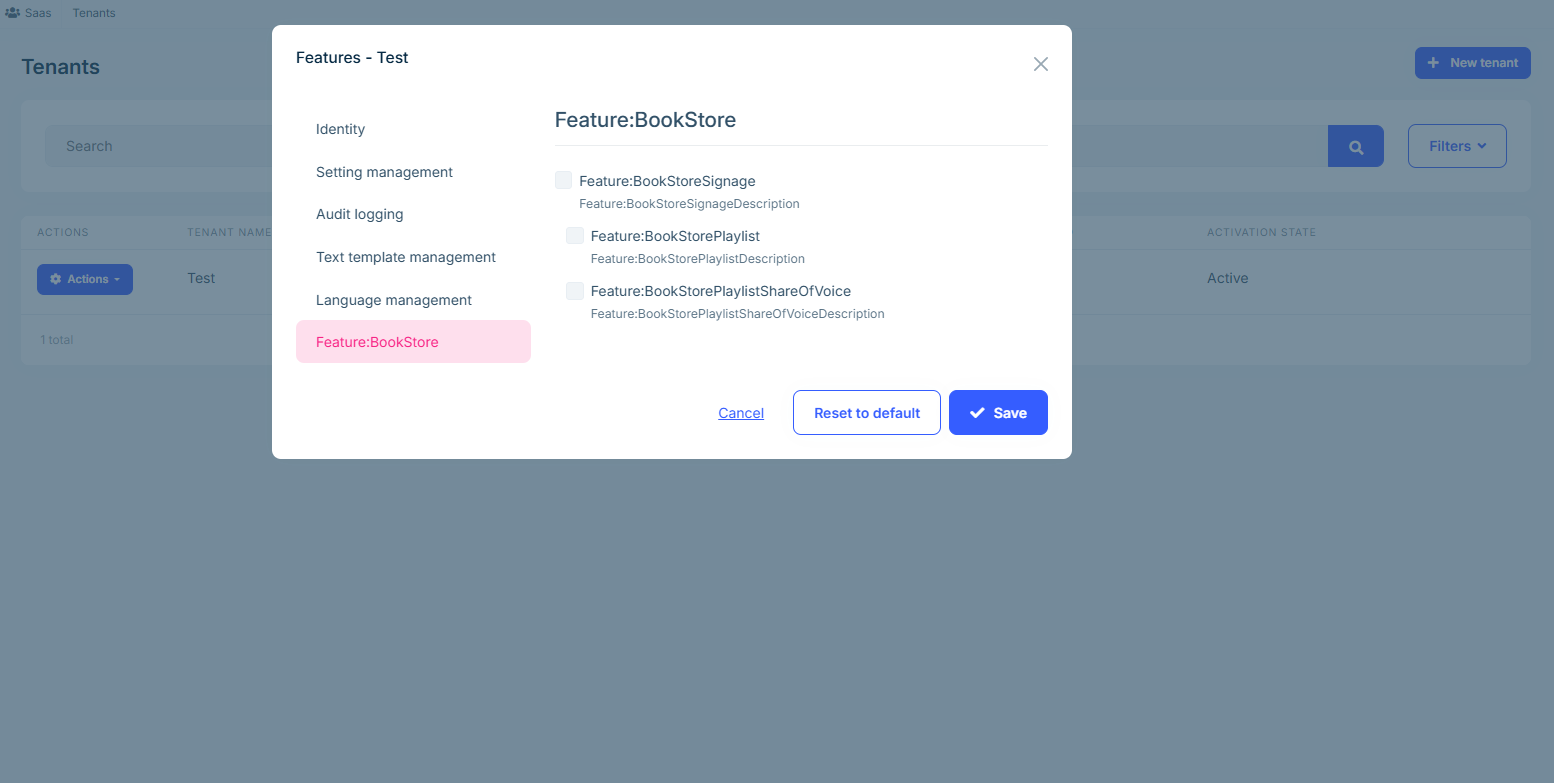
When you have a feature in 3 layers structure like
* Signage
    * Playlist
        * ShareOfVoice
in angular ui you can not see the branches in this order. it is always 2 layers. here is the sample code.
public class BookStoreFeatureDefinitionProvider : FeatureDefinitionProvider
{
    public override void Define(IFeatureDefinitionContext context)
    {
        var group = context.AddGroup(BookStoreFeatures.GroupName,
        L("Feature:BookStore"));


        var signageFeature = group.AddFeature(BookStoreFeatures.Signage.Default,
            "false",
            L("Feature:BookStoreSignage"),
            L("Feature:BookStoreSignageDescription"),
            new ToggleStringValueType());

        var playlistFeature = signageFeature.CreateChild(BookStoreFeatures.Signage.Playlist.Default,
            "false",
            L("Feature:BookStorePlaylist"),
            L("Feature:BookStorePlaylistDescription"),
            new ToggleStringValueType());
        var playlistShareOfVoiceFeature = playlistFeature.CreateChild(BookStoreFeatures.Signage.Playlist.ShareOfVoice,
            "false",
            L("Feature:BookStorePlaylistShareOfVoice"),
            L("Feature:BookStorePlaylistShareOfVoiceDescription"),
            new ToggleStringValueType());

    }
    private static LocalizableString L(string name)
    {
        return LocalizableString.Create<BookStoreResource>(name);
    }
}
here is the output for it.
Hello i am having a problem when i am trying to generate a proxy for my main module. When i try to run the command
abp generate-proxy -t ng -m doohlink -u https://localhost:44389
i am getting

[API Not Available] Request to https://localhost:44389/api/abp/api-definition is unsuccessful. Please double-check the URL in the source project environment and make sure your application is up and running. but the url is available
I can send you the api-definition file if you want. I am using kestrel to debug the application. And i tried dotnet run from the root also. Any assistance would be appreciated
Hello my question is about how to implement hangfire. I am using hangfire in my abp project. But i am having some weird behavior. To make the things simpler i can post some basic code for my module and hangfire implementation.
[DependsOn(
    typeof(AbpAspNetCoreMvcUiMultiTenancyModule),
    typeof(AbpAspNetCoreAuthenticationOpenIdConnectModule),
    typeof(PopManagementModule),
    typeof(AbpBlobStoringAzureModule),
    typeof(AbpBackgroundJobsHangfireModule),
    typeof(AbpBackgroundWorkersHangfireModule),
    typeof(AbpAspNetCoreMvcUiLeptonXThemeModule),
    typeof(DoohlinkSharedHostingMicroservicesModule)
)]
public class PopManagementHttpApiHostModule:AbpModule
{
    //etc...
and here is how i configure hangfire.
private void ConfigureHangfire(ServiceConfigurationContext context, IConfiguration configuration)
    {
        context.Services.AddHangfire(config =>
        {
            var options = new PostgreSqlStorageOptions
            {
                DistributedLockTimeout = TimeSpan.FromMinutes(1)
            };

            config.UsePostgreSqlStorage(postgresSqlStorageConfig =>
            {
                postgresSqlStorageConfig.UseNpgsqlConnection(configuration.GetConnectionString("PopManagement"));
            }, options);

        });
    }
and here is my project structure (part of my project)

so when i run the project everythings works fine. But the weird part is i don't see any background jobs enqueued in my hangfire dashboard with parameters.

what i mean by that is i have this background job.
public class PopJob : AsyncBackgroundJob<PopJobBto>, ITransientDependency
{
    private readonly IPopRepository _popRepository;
    private readonly IBlobContainer<PopCsvContainer> _popCsvContainer;
    private readonly IGuidGenerator _guidGenerator;

    public PopJob(IPopRepository popRepository, IBlobContainer<PopCsvContainer> popCsvContainer,
        IGuidGenerator guidGenerator)
    {
        _popRepository = popRepository;
        _popCsvContainer = popCsvContainer;
        _guidGenerator = guidGenerator;
    }

    public override async Task ExecuteAsync(PopJobBto args)
    {
        var file = await _popCsvContainer.GetOrNullAsync(args.FileName);
        if (file == null)
        {
            return;
        }

        var csvData = System.Text.Encoding.UTF8.GetString(GetBytesFromStream(file));
        var items= ConvertFromCsv(csvData);
        await _popRepository.InsertBulkAsync(items);
    }
public sealed record PopJobBto(string FileName);
public class PopAppService : PopManagementAppService, IPopAppService
{
    private readonly IBlobContainer<PopCsvContainer> _blobContainer;
    private readonly IClock _clock;
    private readonly IBackgroundJobManager _backgroundJobManager;
    private readonly IDistributedCache<PopCacheItem, PopCacheItemKey> _distributedCache;
    private readonly IPopRepository _popRepository;
    private readonly IScreenRepository _screenRepository;
    private readonly IFileRepository _fileRepository;

    public PopAppService(IBlobContainer<PopCsvContainer> blobContainer, IClock clock,
        IBackgroundJobManager backgroundJobManager, IDistributedCache<PopCacheItem, PopCacheItemKey> distributedCache,
        IPopRepository popRepository, IScreenRepository screenRepository, IFileRepository fileRepository)
    {
        _blobContainer = blobContainer;
        _clock = clock;
        _backgroundJobManager = backgroundJobManager;
        _distributedCache = distributedCache;
        _popRepository = popRepository;
        _screenRepository = screenRepository;
        _fileRepository = fileRepository;
    }
 public async Task CreateAsync(CreatePopDto input)
    {
        //create csv file from the input and send it to azure blob storage
        var csvData = ConvertToCsv(input.Items);
        var csvBytes = GetCsvBytes(csvData);
        // Generate the file name using the first item's DeviceId and the current date and time
        if (!input.Items.Any())
        {
            return;
        }

        var deviceId = input.Items.First().DeviceId;
        var dateTime = _clock.Now.ToString("yyyyMMdd_HHmmss");
        var fileName = $"{deviceId}_{dateTime}.csv";
        await _blobContainer.SaveAsync(fileName, csvBytes);
        await _backgroundJobManager.EnqueueAsync(new PopJobBto(fileName));
    }
so in hangfire i am expecting to see the file name and how it is serialized. But all i see is background workers.

I believe it still uses default fifo implementation cause i can see that it hits background job. But sometimes it hangs and never fire the background job, could be because of the distributed lock i suppose. What am i missing over here. Can you point me to the right direction?
Hello i have a very general question about how the unitofwork is working in Abp. If i use multiple db context with separate connection strings in my modular monolith app and if i want to do multiple operations with one unitofwork. Is it going to be a problem? since each of the modules are going to have different databases, i want to ask how does transaction is going to be handled. If i raise a domain event and as a side effect in the same scope i want to also insert a record on another database server? Or if the app has a separate databases for each module on one database server. Thank you for the assistance.
Hello, When i try to serve a file with chunks, i am getting an error from abp studio middleware. here is my code.
    [HttpGet]
    [Route("download")]
    public async Task DownloadAsync([FromQuery(Name = "id")]  Guid? id,[FromQuery(Name = "tenantId")]  Guid? tenantId)
    {
        Check.NotNull(id, nameof(id));
        Check.NotNull(tenantId, nameof(tenantId));
        var file = await _fileAppService.GetAsync(id.Value, tenantId.Value);
        HttpContext.Response.ContentType = file.MimeType;
        await HandleContentDownload(file, 0, file.Size);
    }

    private async Task HandleContentDownload(FileDto file, long startOffset, long length)
    {
        using (CurrentTenant.Change(file.TenantId))
        {
            var tempOffset = (int)startOffset;
            var tempLength = length;
            var chunkLength = 1024 * 1024; //1mb

            var outputStream = HttpContext.Response.Body;
            while (tempOffset < tempLength)
            {
                var remainingLength = tempLength - tempOffset;
                if (remainingLength < chunkLength)
                {
                    chunkLength = (int)(tempLength - tempOffset);
                }

                await using (var stream = await _fileAppService.DownloadAsync(file.Id, tempOffset, chunkLength))
                {
                    await outputStream.WriteAsync((stream as MemoryStream)?.ToArray());
                }

                tempOffset += chunkLength;
            }

            await outputStream.FlushAsync();
        }
    }
i am getting this error.
System.InvalidOperationException: Writing to the response body is invalid for responses with status code 204.
   at Microsoft.AspNetCore.Server.Kestrel.Core.Internal.Http.HttpProtocol.FirstWriteAsyncInternal(ReadOnlyMemory`1 data, CancellationToken cancellationToken)
   at Microsoft.AspNetCore.Server.Kestrel.Core.Internal.Http.HttpProtocol.WritePipeAsync(ReadOnlyMemory`1 data, CancellationToken cancellationToken)
   at Microsoft.AspNetCore.Server.Kestrel.Core.Internal.Http.HttpResponseStream.WriteAsync(Byte[] buffer, Int32 offset, Int32 count, CancellationToken cancellationToken)
   at System.IO.MemoryStream.CopyToAsync(Stream destination, Int32 bufferSize, CancellationToken cancellationToken)
   at System.IO.Stream.CopyToAsync(Stream destination)
   at Volo.Abp.Studio.Client.AspNetCore.AbpStudioMiddleware.InvokeAsync(HttpContext context, RequestDelegate next)
   at Volo.Abp.Studio.Client.AspNetCore.AbpStudioMiddleware.InvokeAsync(HttpContext context, RequestDelegate next)
   at Volo.Abp.Studio.Client.AspNetCore.AbpStudioMiddleware.InvokeAsync(HttpContext context, RequestDelegate next)
   at Microsoft.AspNetCore.Builder.UseMiddlewareExtensions.InterfaceMiddlewareBinder.<>c__DisplayClass2_0.<<CreateMiddleware>b__0>d.MoveNext()
--- End of stack trace from previous location ---
   at Volo.Abp.AspNetCore.Mvc.Libs.AbpMvcLibsService.<CheckLibs>b__1_0(HttpContext httpContext, RequestDelegate next)
   at Microsoft.AspNetCore.Diagnostics.DeveloperExceptionPageMiddlewareImpl.Invoke(HttpContext context)
   at Microsoft.AspNetCore.Diagnostics.DeveloperExceptionPageMiddlewareImpl.Invoke(HttpContext context)
   at Microsoft.AspNetCore.Server.Kestrel.Core.Internal.Http.HttpProtocol.ProcessRequests[TContext](IHttpApplication`1 application)
what can be done to fix the problem? any idea? somehow can i leave this method out of AbpStudioMiddleware?
Hello,
I realized that maui template is still using Microsoft.Windows.CsWin32 nuget package for msix. As i know you can debug it without msix by giving property
<WindowsPackageType>None</WindowsPackageType>
and if you do that with the startup project you are getting winrt exception. And you can not load the fonts that comes from UraniumUI.Icons package.
It throws an error. it can not load the fonts that comes with it.
To generate the error you can uncheck the "Create MSIX Package" and try to debug it.
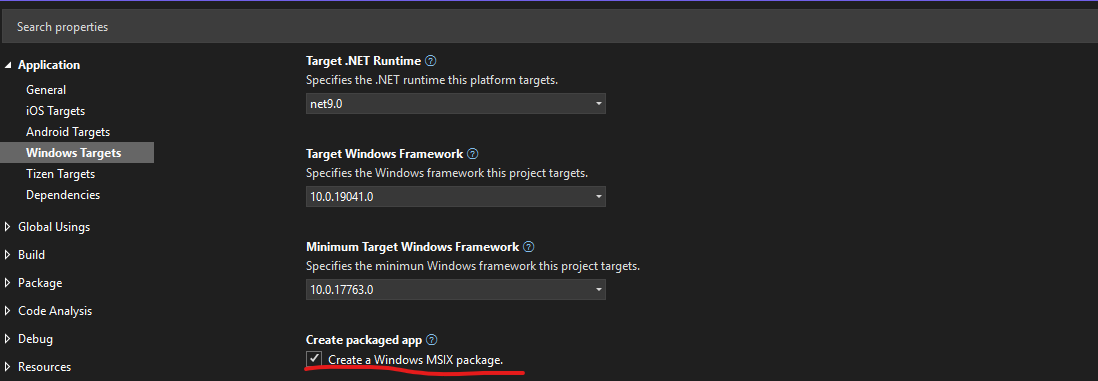
so to create msix packages you do not need to depend on Microsoft.Windows.CsWin32 anymore. Just giving <WindowsPackageType>None</WindowsPackageType> and changing launchsettings.json file is enough with the values here.
{
  "profiles": {
    "Windows Machine": {
      "commandName": "MsixPackage",
      "nativeDebugging": false
    }
  }
}
by the way do not try to debug with jetbrains rider ide for msix package. I suppose it has a bug when you try to debug it, it always throws an error.
Another thing i have found is. When i create mobile solution with abp studio. It saves wrong port and url for openiddict into the db while it seeds for mobile app. So you can not log in from mobile app since port was different.
initial values that i have tried with abp studio was mvc, efcore (postgresql) with mobile support tiered.
Hello,
I am trying to intercept my service from my aks cluster. Everything works fine, i can intercept the call and redirect it to my local machine.
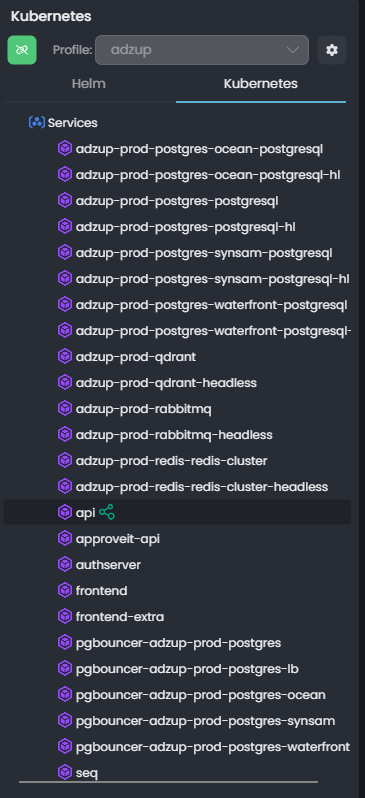
but when i debug the app from visual studio or jetbrains, environment variables are not overridden it gets the appsettings.json values. How does abp studio overriding the environment variables that is the same with the service? am i doing sth wrong? thank you for the help.









