Hi ABP Team, We have been experiencing the same issue across multiple ABP applications and several ABP versions (including the latest release) v10.5
When an authenticated user has multiple browser tabs open (for example, 5-10 tabs) and the access token expires, every tab detects that it needs to refresh the token. At that point, all tabs attempt to call the refresh token endpoint almost simultaneously.
One of the refresh requests succeeds, while the remaining requests fail with a DbConcurrencyException. The exception originates from the refresh token persistence/update process. As a consequence:
This seems to happen because every tab tries to use the same refresh token concurrently.
We would expect ABP to provide a built-in strategy to handle this scenario, since multiple browser tabs are a very common use case. Possible solutions could include:

<br> Raw Exception details:
Volo.Abp.Data.AbpDbConcurrencyException: The database operation was expected to affect 1 row(s), but actually affected 0 row(s); data may have been modified or deleted since entities were loaded. See https://go.microsoft.com/fwlink/?LinkId=527962 for information on understanding and handling optimistic concurrency exceptions.
 ---> Microsoft.EntityFrameworkCore.DbUpdateConcurrencyException: The database operation was expected to affect 1 row(s), but actually affected 0 row(s); data may have been modified or deleted since entities were loaded. See https://go.microsoft.com/fwlink/?LinkId=527962 for information on understanding and handling optimistic concurrency exceptions.
   at Microsoft.EntityFrameworkCore.Update.AffectedCountModificationCommandBatch.ThrowAggregateUpdateConcurrencyExceptionAsync(RelationalDataReader reader, Int32 commandIndex, Int32 expectedRowsAffected, Int32 rowsAffected, CancellationToken cancellationToken)
   at Microsoft.EntityFrameworkCore.Update.AffectedCountModificationCommandBatch.ConsumeResultSetWithRowsAffectedOnlyAsync(Int32 commandIndex, RelationalDataReader reader, CancellationToken cancellationToken)
   at Microsoft.EntityFrameworkCore.Update.AffectedCountModificationCommandBatch.ConsumeAsync(RelationalDataReader reader, CancellationToken cancellationToken)
   at Microsoft.EntityFrameworkCore.Update.ReaderModificationCommandBatch.ExecuteAsync(IRelationalConnection connection, CancellationToken cancellationToken)
   at Microsoft.EntityFrameworkCore.Update.ReaderModificationCommandBatch.ExecuteAsync(IRelationalConnection connection, CancellationToken cancellationToken)
   at Microsoft.EntityFrameworkCore.SqlServer.Update.Internal.SqlServerModificationCommandBatch.ExecuteAsync(IRelationalConnection connection, CancellationToken cancellationToken)
   at Microsoft.EntityFrameworkCore.Update.Internal.BatchExecutor.ExecuteAsync(IEnumerable`1 commandBatches, IRelationalConnection connection, CancellationToken cancellationToken)
   at Microsoft.EntityFrameworkCore.Update.Internal.BatchExecutor.ExecuteAsync(IEnumerable`1 commandBatches, IRelationalConnection connection, CancellationToken cancellationToken)
   at Microsoft.EntityFrameworkCore.Update.Internal.BatchExecutor.ExecuteAsync(IEnumerable`1 commandBatches, IRelationalConnection connection, CancellationToken cancellationToken)
   at Microsoft.EntityFrameworkCore.Storage.RelationalDatabase.SaveChangesAsync(IList`1 entries, CancellationToken cancellationToken)
   at Microsoft.EntityFrameworkCore.ChangeTracking.Internal.StateManager.SaveChangesAsync(IList`1 entriesToSave, CancellationToken cancellationToken)
   at Microsoft.EntityFrameworkCore.ChangeTracking.Internal.StateManager.SaveChangesAsync(StateManager stateManager, Boolean acceptAllChangesOnSuccess, CancellationToken cancellationToken)
   at Microsoft.EntityFrameworkCore.SqlServer.Storage.Internal.SqlServerExecutionStrategy.ExecuteAsync[TState,TResult](TState state, Func`4 operation, Func`4 verifySucceeded, CancellationToken cancellationToken)
   at Microsoft.EntityFrameworkCore.DbContext.SaveChangesAsync(Boolean acceptAllChangesOnSuccess, CancellationToken cancellationToken)
   at Volo.Abp.EntityFrameworkCore.AbpDbContext`1.SaveChangesAsync(Boolean acceptAllChangesOnSuccess, CancellationToken cancellationToken)
   --- End of inner exception stack trace ---
   at Volo.Abp.EntityFrameworkCore.AbpDbContext`1.SaveChangesAsync(Boolean acceptAllChangesOnSuccess, CancellationToken cancellationToken)
   at Volo.Abp.Domain.Repositories.EntityFrameworkCore.EfCoreRepository`2.InsertAsync(TEntity entity, Boolean autoSave, CancellationToken cancellationToken)
   at Castle.DynamicProxy.AsyncInterceptorBase.ProceedAsynchronous[TResult](IInvocation invocation, IInvocationProceedInfo proceedInfo)
   at Volo.Abp.Castle.DynamicProxy.CastleAbpMethodInvocationAdapterWithReturnValue`1.ProceedAsync()
   at Volo.Abp.Uow.UnitOfWorkInterceptor.InterceptAsync(IAbpMethodInvocation invocation)
   at Volo.Abp.Castle.DynamicProxy.CastleAsyncAbpInterceptorAdapter`1.InterceptAsync[TResult](IInvocation invocation, IInvocationProceedInfo proceedInfo, Func`3 proceed)
   at Volo.Abp.OpenIddict.Tokens.AbpOpenIddictTokenStore.CreateAsync(OpenIddictTokenModel token, CancellationToken cancellationToken)
   at OpenIddict.Core.OpenIddictTokenManager`1.CreateAsync(TToken token, CancellationToken cancellationToken)
   at OpenIddict.Core.OpenIddictTokenManager`1.CreateAsync(OpenIddictTokenDescriptor descriptor, CancellationToken cancellationToken)
   at OpenIddict.Core.OpenIddictTokenManager`1.OpenIddict.Abstractions.IOpenIddictTokenManager.CreateAsync(OpenIddictTokenDescriptor descriptor, CancellationToken cancellationToken)
   at OpenIddict.Server.OpenIddictServerHandlers.Protection.CreateTokenEntry.HandleAsync(GenerateTokenContext context)
   at OpenIddict.Server.OpenIddictServerDispatcher.DispatchAsync[TContext](TContext context)
   at OpenIddict.Server.OpenIddictServerDispatcher.DispatchAsync[TContext](TContext context)
   at OpenIddict.Server.OpenIddictServerHandlers.GenerateAuthorizationCode.HandleAsync(ProcessSignInContext context)
   at OpenIddict.Server.OpenIddictServerDispatcher.DispatchAsync[TContext](TContext context)
   at OpenIddict.Server.OpenIddictServerDispatcher.DispatchAsync[TContext](TContext context)
   at OpenIddict.Server.AspNetCore.OpenIddictServerAspNetCoreHandler.SignInAsync(ClaimsPrincipal user, AuthenticationProperties properties)
   at Microsoft.AspNetCore.Authentication.AuthenticationService.SignInAsync(HttpContext context, String scheme, ClaimsPrincipal principal, AuthenticationProperties properties)
   at Microsoft.AspNetCore.Authentication.AuthenticationServiceImpl.SignInAsync(HttpContext context, String scheme, ClaimsPrincipal principal, AuthenticationProperties properties)
   at Microsoft.AspNetCore.Mvc.Infrastructure.ResourceInvoker.<InvokeResultAsync>g__Logged|22_0(ResourceInvoker invoker, IActionResult result)
   at Microsoft.AspNetCore.Mvc.Infrastructure.ResourceInvoker.<InvokeNextResultFilterAsync>g__Awaited|30_0[TFilter,TFilterAsync](ResourceInvoker invoker, Task lastTask, State next, Scope scope, Object state, Boolean isCompleted)
   at Microsoft.AspNetCore.Mvc.Infrastructure.ResourceInvoker.Rethrow(ResultExecutedContextSealed context)
   at Microsoft.AspNetCore.Mvc.Infrastructure.ResourceInvoker.ResultNext[TFilter,TFilterAsync](State& next, Scope& scope, Object& state, Boolean& isCompleted)
   at Microsoft.AspNetCore.Mvc.Infrastructure.ResourceInvoker.<InvokeResultFilters>g__Awaited|28_0(ResourceInvoker invoker, Task lastTask, State next, Scope scope, Object state, Boolean isCompleted)
   at Microsoft.AspNetCore.Mvc.Infrastructure.ResourceInvoker.<InvokeNextResourceFilter>g__Awaited|25_0(ResourceInvoker invoker, Task lastTask, State next, Scope scope, Object state, Boolean isCompleted)
   at Microsoft.AspNetCore.Mvc.Infrastructure.ResourceInvoker.Rethrow(ResourceExecutedContextSealed context)
   at Microsoft.AspNetCore.Mvc.Infrastructure.ResourceInvoker.Next(State& next, Scope& scope, Object& state, Boolean& isCompleted)
   at Microsoft.AspNetCore.Mvc.Infrastructure.ResourceInvoker.<InvokeFilterPipelineAsync>g__Awaited|20_0(ResourceInvoker invoker, Task lastTask, State next, Scope scope, Object state, Boolean isCompleted)
   at Microsoft.AspNetCore.Mvc.Infrastructure.ResourceInvoker.<InvokeAsync>g__Logged|17_1(ResourceInvoker invoker)
   at Microsoft.AspNetCore.Mvc.Infrastructure.ResourceInvoker.<InvokeAsync>g__Logged|17_1(ResourceInvoker invoker)
   at Volo.Abp.AspNetCore.Serilog.AbpSerilogMiddleware.InvokeAsync(HttpContext context, RequestDelegate next)
   at Microsoft.AspNetCore.Builder.UseMiddlewareExtensions.InterfaceMiddlewareBinder.<>c__DisplayClass2_0.<<CreateMiddleware>b__0>d.MoveNext()
--- End of stack trace from previous location ---
   at Volo.Abp.AspNetCore.Auditing.AbpAuditingMiddleware.InvokeAsync(HttpContext context, RequestDelegate next)
   at Volo.Abp.AspNetCore.Auditing.AbpAuditingMiddleware.InvokeAsync(HttpContext context, RequestDelegate next)
   at Microsoft.AspNetCore.Builder.UseMiddlewareExtensions.InterfaceMiddlewareBinder.<>c__DisplayClass2_0.<<CreateMiddleware>b__0>d.MoveNext()
--- End of stack trace from previous location ---
   at Swashbuckle.AspNetCore.SwaggerUI.SwaggerUIMiddleware.Invoke(HttpContext httpContext)
   at Swashbuckle.AspNetCore.Swagger.SwaggerMiddleware.Invoke(HttpContext httpContext, ISwaggerProvider swaggerProvider)
   at Microsoft.AspNetCore.Authorization.AuthorizationMiddleware.Invoke(HttpContext context)
   at Volo.Abp.AspNetCore.Security.Claims.AbpDynamicClaimsMiddleware.InvokeAsync(HttpContext context, RequestDelegate next)
   at Microsoft.AspNetCore.Builder.UseMiddlewareExtensions.InterfaceMiddlewareBinder.<>c__DisplayClass2_0.<<CreateMiddleware>b__0>d.MoveNext()
--- End of stack trace from previous location ---
   at Volo.Abp.AspNetCore.Uow.AbpUnitOfWorkMiddleware.InvokeAsync(HttpContext context, RequestDelegate next)
   at Microsoft.AspNetCore.Builder.UseMiddlewareExtensions.InterfaceMiddlewareBinder.<>c__DisplayClass2_0.<<CreateMiddleware>b__0>d.MoveNext()
--- End of stack trace from previous location ---
   at Volo.Abp.AspNetCore.ExceptionHandling.AbpExceptionHandlingMiddleware.InvokeAsync(HttpContext context, RequestDelegate next)
   at Volo.Abp.AspNetCore.ExceptionHandling.AbpExceptionHandlingMiddleware.InvokeAsync(HttpContext context, RequestDelegate next)
   at Microsoft.AspNetCore.Builder.UseMiddlewareExtensions.InterfaceMiddlewareBinder.<>c__DisplayClass2_0.<<CreateMiddleware>b__0>d.MoveNext()
--- End of stack trace from previous location ---
   at Volo.Abp.AspNetCore.MultiTenancy.MultiTenancyMiddleware.InvokeAsync(HttpContext context, RequestDelegate next)
   at Microsoft.AspNetCore.Builder.UseMiddlewareExtensions.InterfaceMiddlewareBinder.<>c__DisplayClass2_0.<<CreateMiddleware>b__0>d.MoveNext()
--- End of stack trace from previous location ---
   at Microsoft.AspNetCore.Builder.ApplicationBuilderAbpOpenIddictMiddlewareExtension.<>c__DisplayClass0_0.<<UseAbpOpenIddictValidation>b__0>d.MoveNext()
--- End of stack trace from previous location ---
   at Microsoft.AspNetCore.Authentication.AuthenticationMiddleware.Invoke(HttpContext context)
   at Volo.Abp.AspNetCore.Security.AbpSecurityHeadersMiddleware.InvokeAsync(HttpContext context, RequestDelegate next)
   at Microsoft.AspNetCore.Builder.UseMiddlewareExtensions.InterfaceMiddlewareBinder.<>c__DisplayClass2_0.<<CreateMiddleware>b__0>d.MoveNext()
--- End of stack trace from previous location ---
   at Volo.Abp.Studio.Client.AspNetCore.AbpStudioMiddleware.InvokeAsync(HttpContext context, RequestDelegate next)
   at Volo.Abp.Studio.Client.AspNetCore.AbpStudioMiddleware.InvokeAsync(HttpContext context, RequestDelegate next)
   at Microsoft.AspNetCore.Builder.UseMiddlewareExtensions.InterfaceMiddlewareBinder.<>c__DisplayClass2_0.<<CreateMiddleware>b__0>d.MoveNext()
--- End of stack trace from previous location ---
   at Microsoft.AspNetCore.Localization.RequestLocalizationMiddleware.Invoke(HttpContext context)
   at Microsoft.AspNetCore.RequestLocalization.AbpRequestLocalizationMiddleware.InvokeAsync(HttpContext context, RequestDelegate next)
   at Microsoft.AspNetCore.Builder.UseMiddlewareExtensions.InterfaceMiddlewareBinder.<>c__DisplayClass2_0.<<CreateMiddleware>b__0>d.MoveNext()
--- End of stack trace from previous location ---
   at Microsoft.AspNetCore.Diagnostics.DeveloperExceptionPageMiddlewareImpl.Invoke(HttpContext context)
I’m migrating an existing Angular application from 7.4.0 to ABP 9.2.1 (from angular 16.2..8 to Angular 19. After completing the upgrade, I'm encountering issues related to localization)
On application startup, I see these runtime errors in the browser console: • Cannot find the en locale file.
 • Cannot find the es locale file

• And when switching the UI language to Spanish: NG0701: Missing locale data for the locale "es". (usually triggered by DatePipe)
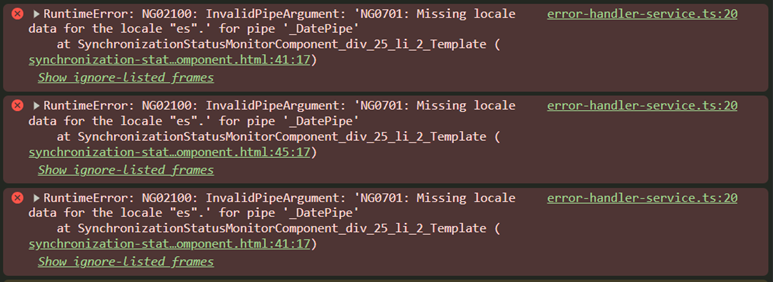
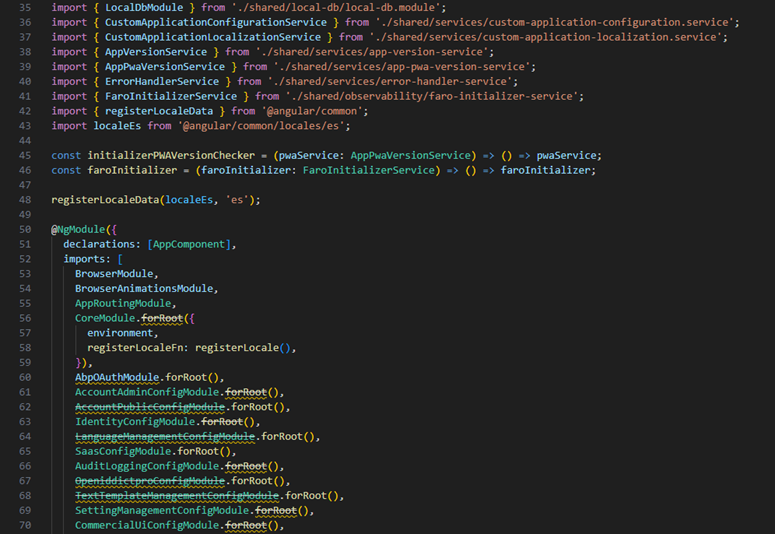
As a workaround, I tried manually registering the Spanish locale using registerLocaleData, which prevents the DatePipe error — but the console warnings like Cannot find the en locale file and Cannot find the es locale file still appear, so it doesn’t feel like a proper fix.
Current package.json file:
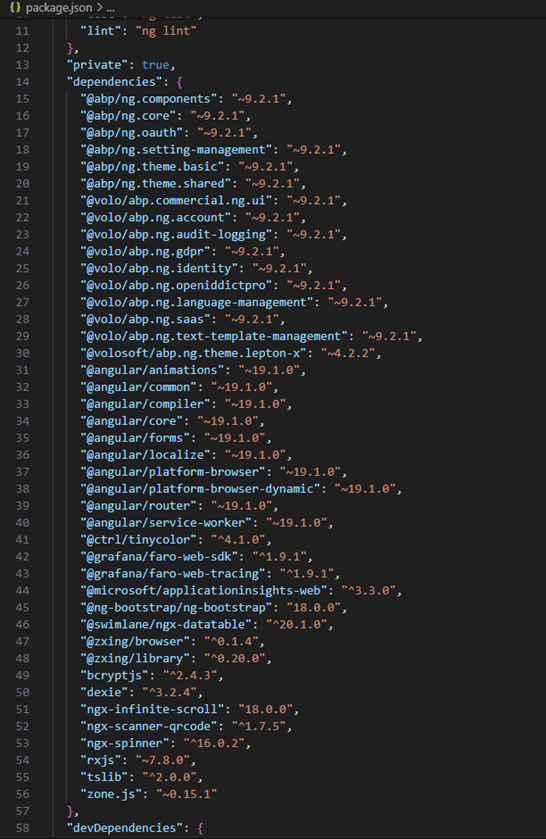
I create a new abp project and compare with my project and I can't find any differences..
A few days ago I created a github issue because our team detects severals errors in production environment (concurrency)
After migrating from version 5.1.3 to version 8.3.2, we are experimenting many concurrency control errors in our production environment (due to higher load). We noticed that when we retrieve an entity from database with IRepository... and its related data from the database (.Incude), saving the entity causes all the related entities retrieved from the database to also be modified (checked with LastModification property).
Since all of them have the "concurrency stamp" attribute, they are competing for priority when saving to the database.
99% of our entities has FullAuditedAggregateRoot inherits.
We think this is a bug introduced in version 8.2.0 because if an object is modified, its related classes should not be marked as modified when they have not been modified.
https://github.com/abpframework/abp/issues/21835
Today we execute a downgrade of nugets package version to 8.1.5 and ALL exceptions of type AbpDbConcurrencyException disappeared.









