Hi,
I am using Telerik components in my project and I am trying to use a Server Filtering. To be able to do that, I need to send a parameter from Blazor side to Application Service to filter/sort/group my records as per the grid parameters.
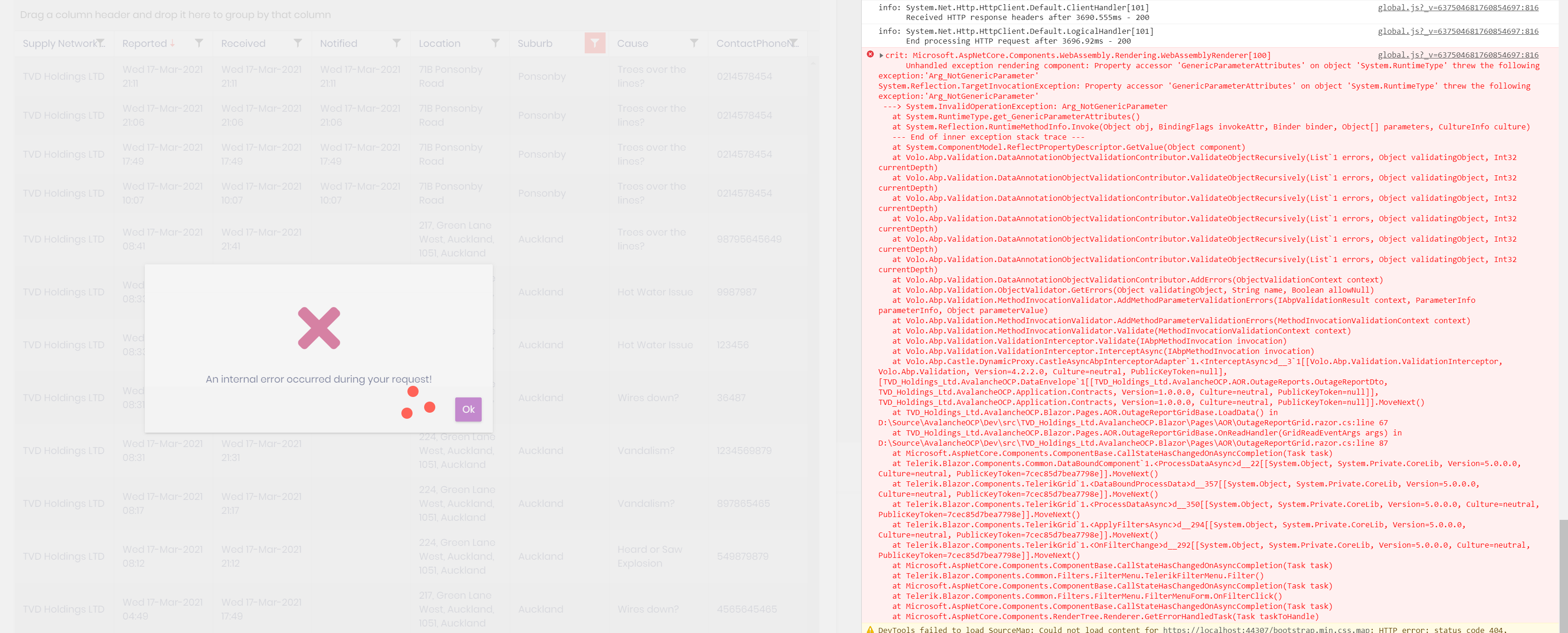
It is working fine, but, when I add some filter, it is raising an exception on Blazor side before calling the method in the Application Service. I am struggling to understand what is wrong with that.
Here is the error in the console:
My Application Service:
 [HttpPost]
public async Task<DataEnvelope<OutageReportDto>> GetOutageReportList([FromBody] DataSourceRequest request)
{
    try
    {
        var time = DateTime.UtcNow.AddDays(-1);
        var outageList = _outageReportRepository
            .Include(x => x.SupplyNetwork).Include(x => x.Cause)
            .Where(x => x.TenantId == CurrentTenant.Id.Value)
            .Where(x => x.RecordedTime >= time)
            .Select(x => ObjectMapper.Map<OutageReport, OutageReportDto>(x)).ToList();

        var output = await outageList.ToDataSourceResultAsync(request);

        DataEnvelope<OutageReportDto> dataToReturn;

        if (request.Groups != null && request.Groups.Count > 0)
        {
            // If there is grouping, use the field for grouped data
            // The app must be able to serialize and deserialize it
            // Example helper methods for this are available in this project
            // See the GroupDataHelper.DeserializeGroups and JsonExtensions.Deserialize methods
            dataToReturn = new DataEnvelope<OutageReportDto>
            {
                GroupedData = output.Data.Cast<AggregateFunctionsGroup>().ToList(),
                TotalItemCount = output.Total
            };
        }
        else
        {
            // When there is no grouping, the simplistic approach of
            // just serializing and deserializing the flat data is enough
            dataToReturn = new DataEnvelope<OutageReportDto>
            {
                CurrentPageData = output.Data.Cast<OutageReportDto>().ToList(),
                TotalItemCount = output.Total
            };
        }

        return dataToReturn;
    }
    catch (Exception ex)
    {
        Console.WriteLine("Error: ", ex.Message);
        Console.WriteLine(ex);
        throw;
    }
}
My Blazor page code behind code:
using Microsoft.AspNetCore.Components;
using Microsoft.AspNetCore.SignalR.Client;
using Microsoft.Extensions.Configuration;
using System;
using System.Collections.Generic;
using System.Linq;
using System.Net.Http;
using System.Net.Http.Json;
using System.Threading.Tasks;
using Telerik.Blazor.Components;
using Telerik.DataSource;
using TVD_Holdings_Ltd.AvalancheOCP.AOR.OutageReports;

namespace TVD_Holdings_Ltd.AvalancheOCP.Blazor.Pages.AOR
{
    public class OutageReportGridBase : ComponentBase
    {
        [Inject] IOutageReportAppService outageReportService { get; set; }

        [Inject] IConfiguration Configuration { get; set; }
        [Inject] HttpClient httpClient { get; set; }
        //
        protected TelerikGrid<object> MainGrid { get; set; }
        protected List<object> OutageReportList { get; set; }
        protected int Total { get; set; }
        //
        private HubConnection hubConnection;
        private DataSourceRequest LastRequest;


        protected override async Task OnInitializedAsync()
        {
            var baseUrl = Configuration.GetValue<string>("RemoteServices:Default:BaseUrl");
            hubConnection = new HubConnectionBuilder()
           .WithUrl(baseUrl + "/aor")
           .Build();

            hubConnection.On("OutagesUpdated", LoadData);

            await hubConnection.StartAsync();
        }

        protected override async Task OnAfterRenderAsync(bool firstRender)
        {
            if (firstRender)
            {
                await SetGridDefaultSort();
            }
            await base.OnAfterRenderAsync(firstRender);
        }

        private async Task SetGridDefaultSort()
        {
            GridState<object> desiredState = new GridState<object>()
            {
                SortDescriptors = new List<SortDescriptor>()
            {
                new SortDescriptor { Member = nameof(OutageReportDto.RecordedTime), SortDirection = ListSortDirection.Descending }
            }
            };

            await MainGrid.SetState(desiredState);
        }

        private async Task LoadData()
        {
            var result = await outageReportService.GetOutageReportList(LastRequest);

            if (LastRequest.Groups.Count > 0)
            {
                var data = GroupDataHelpers.DeserializeGroups<OutageReportDto>(result.GroupedData);
                OutageReportList = data.Cast<object>().ToList();
            }
            else
            {
                OutageReportList = result.CurrentPageData.Cast<object>().ToList();
            }

            Total = result.TotalItemCount;

            StateHasChanged();
        }

        protected async Task OnReadHandler(GridReadEventArgs args)
        {
            LastRequest = args.Request;
            await LoadData();
        }

    }
}
And my Blazor Page:
@page "/outagereports"

@attribute [Authorize(AvalancheOCPPermissions.OutageReportsGrid.Default)]
@using TVD_Holdings_Ltd.AvalancheOCP.Permissions
@using Microsoft.AspNetCore.Authorization
@using TVD_Holdings_Ltd.AvalancheOCP.Localization
@using Microsoft.Extensions.Localization
@using TVD_Holdings_Ltd.AvalancheOCP.AOR.OutageReports;
@inject IStringLocalizer<AvalancheOCPResource> L
@inject AbpBlazorMessageLocalizerHelper<AvalancheOCPResource> LH
@inherits OutageReportGridBase

<Card>
    <CardHeader>
        <Row Class="justify-content-between">
            <Column ColumnSize="ColumnSize.IsAuto">
                <h2>@L["OutageReportGrid"]</h2>
            </Column>
        </Row>
    </CardHeader>
    <CardBody>
        <TelerikRootComponent>
            <TelerikGrid Data=@OutageReportList @ref="@MainGrid"
                         OnRead="@OnReadHandler" TotalCount=@Total
                         Sortable="true"
                         Groupable="true"
                         FilterMode="@GridFilterMode.FilterMenu"
                         Pageable="true" PageSize="50">
                <GridColumns>
                    <GridColumn Field="@nameof(OutageReportDto.SupplyNetworkName)" FieldType="@(typeof(string))" Title="@L["OutageReportGrid.SupplyNetworkName"]"/>
                    <GridColumn Field="@nameof(OutageReportDto.RecordedTime)" FieldType="@(typeof(DateTime))" Title="@L["OutageReportGrid.RecordedTime"]" DisplayFormat="{0:ddd dd-MMM-yyyy HH:mm}" />
                    <GridColumn Field="@nameof(OutageReportDto.CreationTime)" FieldType="@(typeof(DateTime))" Title="@L["OutageReportGrid.CreationTime"]" DisplayFormat="{0:ddd dd-MMM-yyyy HH:mm}"/>
                    <GridColumn Field="@nameof(OutageReportDto.NotifiedTime)" FieldType="@(typeof(DateTime?))" Title="@L["OutageReportGrid.NotifiedTime"]" DisplayFormat="{0:ddd dd-MMM-yyyy HH:mm}" />
                    <GridColumn Field="Location" FieldType="@(typeof(string))" Title="@L["OutageReportGrid.Location"]" />
                    <GridColumn Field="@nameof(OutageReportDto.Suburb)" FieldType="@(typeof(string))" Title="@L["OutageReportGrid.Suburb"]" />
                    <GridColumn Field="@nameof(OutageReportDto.CauseName)" FieldType="@(typeof(string))" Title="@L["OutageReportGrid.CauseName"]" />
                    <GridColumn Field="@nameof(OutageReportDto.ContactPhoneNumber)" FieldType="@(typeof(string))" Title="@L["OutageReportGrid.ContactPhoneNumber"]" />
                </GridColumns>
            </TelerikGrid>
        </TelerikRootComponent>
    </CardBody>
</Card>
Hi,
I have removed WebDAVModule and not it is working. Also, I've done changes as image below:
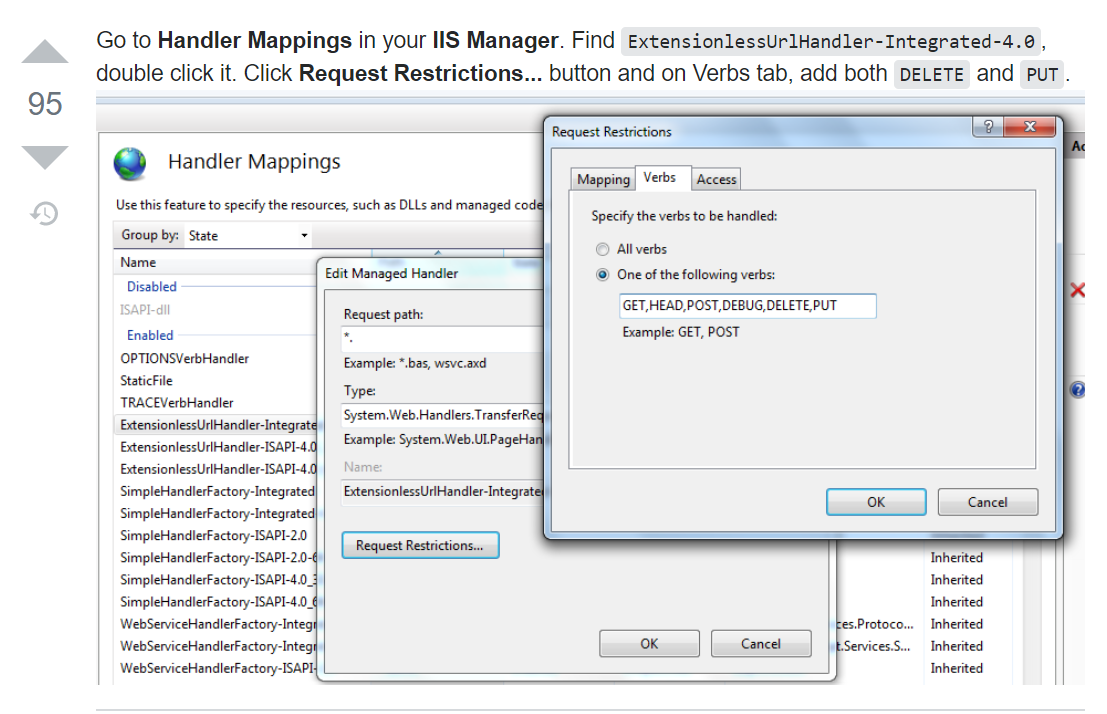 source: https://stackoverflow.com/questions/12440277/how-do-i-enable-http-put-and-delete-for-asp-net-mvc-in-iis
My new Web.Config:
<?xml version="1.0" encoding="utf-8"?>
<configuration>
  <location path="." inheritInChildApplications="false">
    <system.webServer>
			<modules>
				<remove name="WebDAVModule" />
			</modules>
      <handlers>
        <add name="aspNetCore" path="*" verb="*" modules="AspNetCoreModuleV2" resourceType="Unspecified" />
				<remove name="WebDAV" />
      </handlers>
      <aspNetCore processPath="dotnet" arguments=".\TVD_Holdings_Ltd.AvalancheOCP.HttpApi.Host.dll" stdoutLogEnabled="false" stdoutLogFile=".\logs\stdout" hostingModel="InProcess" />
    </system.webServer>
  </location>
</configuration>
<!--ProjectGuid: 96e5259e-59a3-4faf-bcd1-5bf8e74ef82c-->
Hi,
In my local machine all CRUD operations work fine. But, when I deploy to IIS Server the Update and Delete don't work.
I've tried to remove WebDAV in the Web.Config, but still getting errors. My Web.Config:
<?xml version="1.0" encoding="utf-8"?>
<configuration>
  <location path="." inheritInChildApplications="false">
    <system.webServer>
      <handlers>
        <add name="aspNetCore" path="*" verb="*" modules="AspNetCoreModuleV2" resourceType="Unspecified" />
				<remove name="WebDAV" />
      </handlers>
      <aspNetCore processPath="dotnet" arguments=".\TVD_Holdings_Ltd.AvalancheOCP.HttpApi.Host.dll" stdoutLogEnabled="false" stdoutLogFile=".\logs\stdout" hostingModel="InProcess" />
    </system.webServer>
  </location>
</configuration>
<!--ProjectGuid: 96e5259e-59a3-4faf-bcd1-5bf8e74ef82c-->
In the console I am getting these messages:
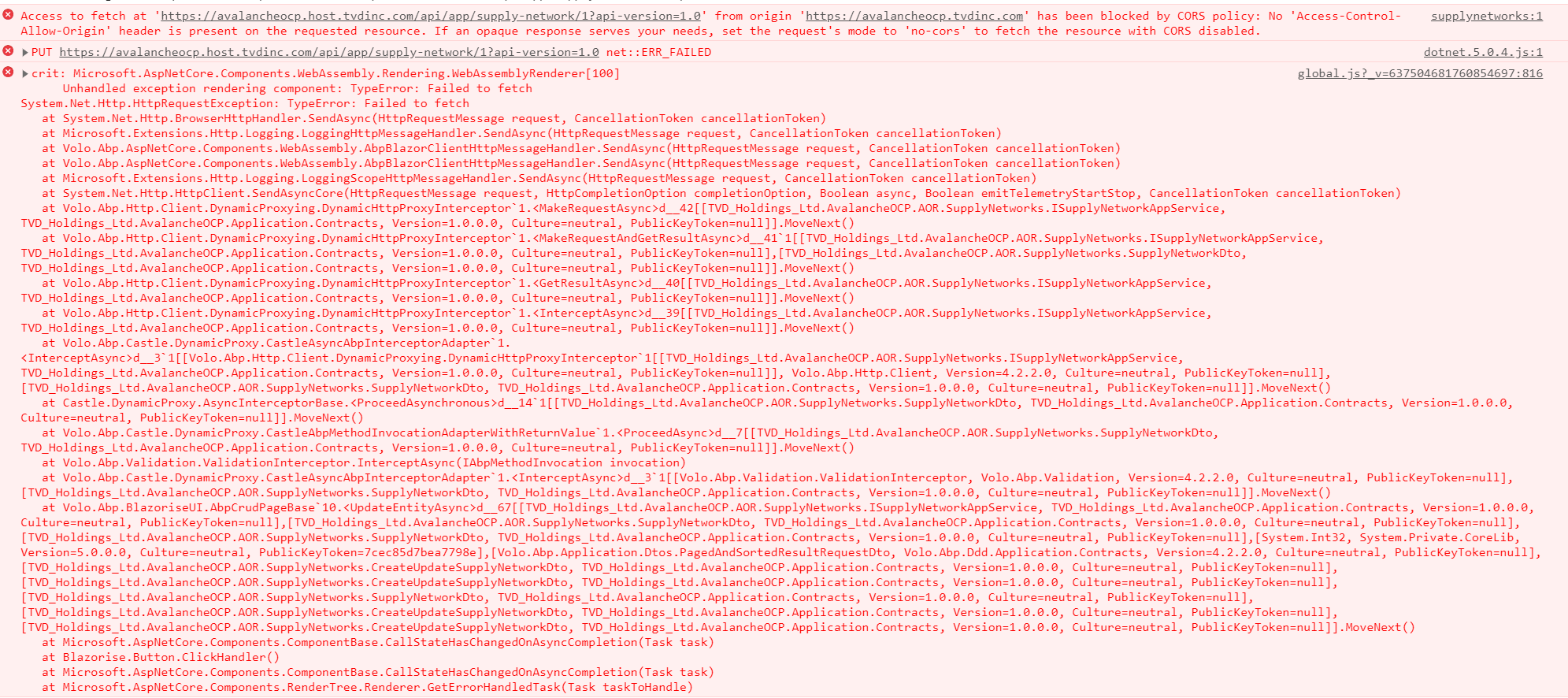
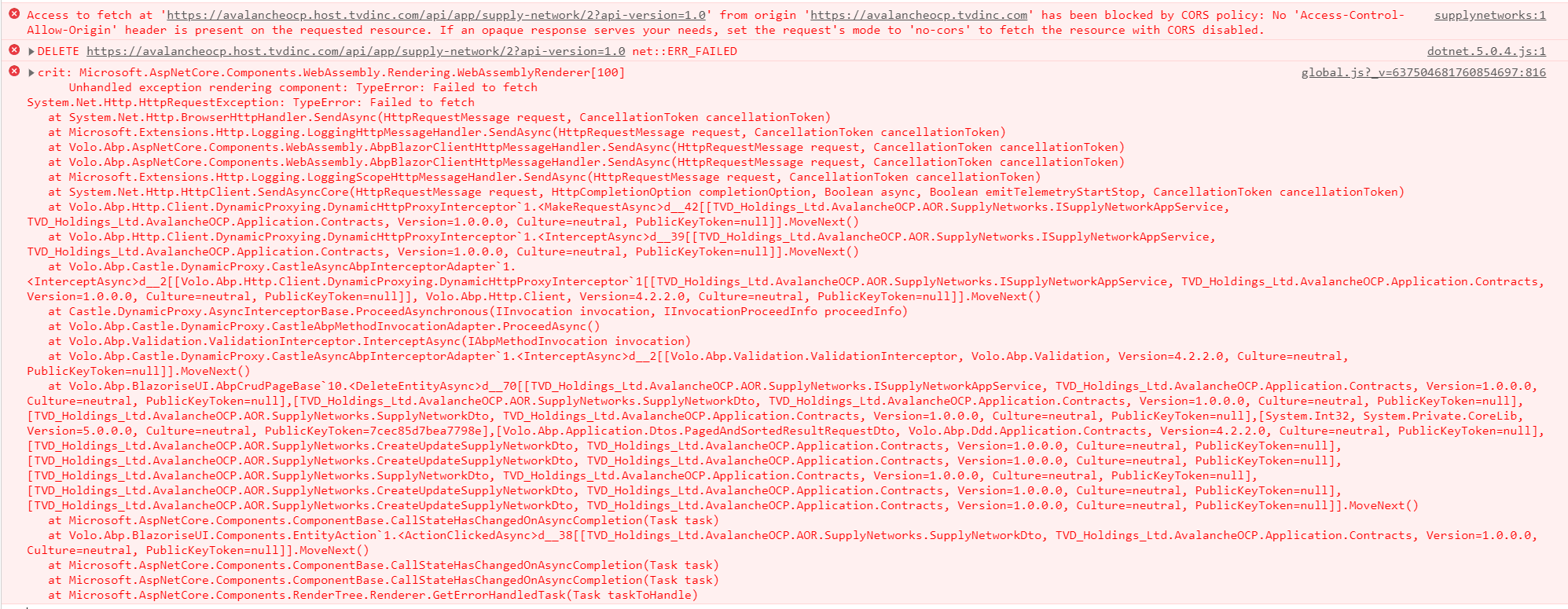
What should I change in my config to make it work?
Hi,
I'd like to know how to perform orderby passing a string as parameter when I have two tables connect by join in the method GetListAsync in a CrudAppService class.
In the Tutorial, Item 10. Book and Author Relation, in the method GetListAsync we have this comment:
orderby input.Sorting //TODO: Can not sort like that!
In AspNetZero project I have an extension for OrderBy and PageBy that make life easy. But, I haven't found those extensions for Abp.IO Blazor UI project.
Here is my code:
public override async Task<PagedResultDto<SupplyNetworkDto>> GetListAsync(PagedAndSortedResultRequestDto input)
{
    //Set a default sorting, if not provided
    if (input.Sorting.IsNullOrEmpty())
    {
        input.Sorting = nameof(SupplyNetworkDto.Name);
    }

    //Get the IQueryable<Book> from the repository
    var queryable = await Repository.GetQueryableAsync();

    //Prepare a query to join books and authors
    var query = from supplyNetwork in queryable
                join networkType in _networkTypeRepository on supplyNetwork.NetworkTypeId equals networkType.Id
                orderby input.Sorting // It is not working as per example in ABP.IO Documentation Example
                select new { supplyNetwork, networkType };

    query = query
        .Skip(input.SkipCount)
        .Take(input.MaxResultCount);

    //Execute the query and get a list
    var queryResult = await AsyncExecuter.ToListAsync(query);

    //Convert the query result to a list of BookDto objects
    var dtos = queryResult.Select(x =>
    {
        var dto = ObjectMapper.Map<SupplyNetwork, SupplyNetworkDto>(x.supplyNetwork);
        dto.NetworkTypeName = x.networkType.Name;
        return dto;
    }).ToList();

    //Get the total count with another query
    var totalCount = await Repository.GetCountAsync();

    return new PagedResultDto<SupplyNetworkDto>(
        totalCount,
        dtos
    );
}
Hi,
I've found in the class PermissionDefinitionProvider a parameter for each permission that defines the multiTenancySide. Does that mean to define the menu as well?
public class AvalancheOCPPermissionDefinitionProvider : PermissionDefinitionProvider
    {
        public override void Define(IPermissionDefinitionContext context)
        {
            var myGroup = context.AddGroup(AvalancheOCPPermissions.GroupName);

            myGroup.AddPermission(AvalancheOCPPermissions.Dashboard.Host, L("Permission:Dashboard"), MultiTenancySides.Host);
            myGroup.AddPermission(AvalancheOCPPermissions.Dashboard.Tenant, L("Permission:Dashboard"), MultiTenancySides.Tenant);

            var settings = context.AddGroup(AvalancheOCPPermissions.AvalancheOCPSettings, L("Menu:AvalancheOCPSettings"), MultiTenancySides.Tenant);

            var causes = settings.AddPermission(AvalancheOCPPermissions.Causes.Default, L("Menu:Causes"), MultiTenancySides.Tenant);
            causes.AddChild(AvalancheOCPPermissions.Causes.Create, L("Permission:Causes.Create"), MultiTenancySides.Tenant);
            causes.AddChild(AvalancheOCPPermissions.Causes.Edit, L("Permission:Causes.Edit"), MultiTenancySides.Tenant);
            causes.AddChild(AvalancheOCPPermissions.Causes.Delete, L("Permission:Causes.Delete"), MultiTenancySides.Tenant);

            var supplyNetworks = settings.AddPermission(AvalancheOCPPermissions.SupplyNetworks.Default, L("Menu:SupplyNetworks"), MultiTenancySides.Tenant);
            supplyNetworks.AddChild(AvalancheOCPPermissions.SupplyNetworks.Create, L("Permission:SupplyNetworks.Create"), MultiTenancySides.Tenant);
            supplyNetworks.AddChild(AvalancheOCPPermissions.SupplyNetworks.Edit, L("Permission:SupplyNetworks.Edit"), MultiTenancySides.Tenant);
            supplyNetworks.AddChild(AvalancheOCPPermissions.SupplyNetworks.Delete, L("Permission:SupplyNetworks.Delete"), MultiTenancySides.Tenant);

            myGroup.AddPermission(AvalancheOCPPermissions.OutageReportsGrid.Default, L("Permission:OutageReportGrid"), MultiTenancySides.Tenant);

            //Define your own permissions here. Example:
            //myGroup.AddPermission(AvalancheOCPPermissions.MyPermission1, L("Permission:MyPermission1"));
        }

        private static LocalizableString L(string name)
        {
            return LocalizableString.Create<AvalancheOCPResource>(name);
        }
    }
Hi, I have added two menus that should be visible only in the Tenant Side. I don't want then on the Host side. How can I do that?
I tried to inject CurrentTenant and check the property IsAvailable, but, the class is instanced manually and dependency injection doesn't work. See my code below:
public class AvalancheOCPMenuContributor : IMenuContributor
    {
        private readonly IConfiguration _configuration;

        public AvalancheOCPMenuContributor(IConfiguration configuration)
        {
            _configuration = configuration;
        }

        public async Task ConfigureMenuAsync(MenuConfigurationContext context)
        {
            if (context.Menu.Name == StandardMenus.Main)
            {
                await ConfigureMainMenuAsync(context);
            }
            else if (context.Menu.Name == StandardMenus.User)
            {
                await ConfigureUserMenuAsync(context);
            }
        }

        //This method was intentionally "async" because ABP Suite will generate asnyc method calls here.
        private static async Task ConfigureMainMenuAsync(MenuConfigurationContext context)
        {
            var l = context.GetLocalizer<AvalancheOCPResource>();

            context.Menu.AddItem(new ApplicationMenuItem(
                AvalancheOCPMenus.Home,
                l["Menu:Home"],
                "/",
                icon: "fas fa-home",
                order: 1
            ));

            // Tenant Side
            **//if (_currentTenant.IsAvailable) // How to do it? Or what is the best way to do that?**
            {
                var settings = new ApplicationMenuItem(
                    "Settings",
                    l["Menu:AvalancheOCPSettings"],
                    icon: "fa fa-sliders",
                    order: 2
                );
                context.Menu.AddItem(settings);

                if (await context.IsGrantedAsync(AvalancheOCPPermissions.Causes.Default))
                {
                    settings.AddItem(new ApplicationMenuItem(
                        "Settings.Causes",
                        l["Menu:Causes"],
                        url: "/causes"
                    ));
                }

                if (await context.IsGrantedAsync(AvalancheOCPPermissions.SupplyNetworks.Default))
                {
                    settings.AddItem(new ApplicationMenuItem(
                        "Settings.SupplyNetworks",
                        l["Menu:SupplyNetworks"],
                        url: "/supplynetworks"
                    ));
                }
            }
Ok, I got it. Thank you!
Thank you for your answer.
That works fine when I am adding a new entity. When editing, it doesn't work, the Save button is disabled by default. I just have created a new OnStatusChanged method for editing adding the option None. See below the new method:
protected Task OnStatusChangedEditing(ValidationsStatusChangedEventArgs eventArgs)
{
    saveDisabled = eventArgs.Status != ValidationStatus.None && eventArgs.Status != ValidationStatus.Success;
    return Task.CompletedTask;
}
Hi, I am implemeting my first CRUD using AbpCrudPageBase class. I have two questions about that:
Is it allways required having two MODAL markup and repeat the fields? If the Create and Edit modal are exactly the same, do I need to repeat that?
In events onChange, I have two variables, NewEntity and EditingEntity. How I know if I am editing or creating a new record? The only way that I've found to resolve that was creating two different events and then duplicating code or creating a third method and pass the EntityDto as parameter.
For example, to load an image in the event <FileEdit Changed="">, I did the code below. Is there a better way to do that?
protected async Task OnChangedLogoNew(FileChangedEventArgs e)
{
    await ChangedLogo(e, NewEntity);
}

protected async Task OnChangedLogoEditing(FileChangedEventArgs e)
{
    await ChangedLogo(e, EditingEntity);
}

protected async Task ChangedLogo(FileChangedEventArgs e, CreateUpdateSupplyNetworkDto currentDto)
{
    try
    {
        foreach (var file in e.Files)
        {
            // A stream is going to be the destination stream we're writing to.
            using (var stream = new MemoryStream())
            {
                await file.WriteToStreamAsync(stream);
                stream.Seek(0, SeekOrigin.Begin);
                currentDto.Logo = stream.ToArray();
            }
        }
    }
    catch (Exception exc)
    {
        Console.WriteLine(exc.Message);
    }
    finally
    {
        this.StateHasChanged();
    }
}
Thank you very much! That works fine for me. I didn't notice that part of documents for ABP Framework > UI > Blazor before.









