hi,
first of all I advice you to do this long lasting operation in a background job. https://docs.abp.io/en/abp/latest/Background-Jobs For example you can use HangFire ...
your first approach is not feasible. working with bulk data needs to be going out of the rutin rules. in this point, you can run a Stored Procedure or run a custom executable or you can completely write a new console app with Dapper to run your bulk operation.
In your 1st approach you can disable transaction. see this document . but it's not practical to iterate over 40K records.
 [UnitOfWork(IsDisabled = true)]
        public virtual async Task FooAsync()
        {
            //...
        }
my advice can be Stored Procedure, pass the parameters to Stored Procedure and you can make it transactional in your Stored Procedure. see this stored procedure sample.
@developer1 thanks for your feedback. yoru reported issue has been already fixed in 4.1.1.
there are 3 database providers (EF Core, MongoDB, Dapper) * 3 Front-Ends (Angular, MVC, Blazor) * Tier/Seperated IDS4 structures. Maybe you are working on one project type, but there these different projects ( cartesian of these options ) it's hard to test all the variants.
On the other hand, the team is setting up a UI testing devops line now with Playwright We are very close to finish this testing environment. We'll be testing different variants of ABP after each preview. So I hope these issues will be less or zero. Thank you for your understanding.
if you get "You are not granted permission to ....." then means your token has been expired. Try to login again.
run this to update
dotnet tool update -g Volo.Abp.Cli && abp suite update
also you need to update your packages to 4.1.0
@trendline do you still get license error?
If this tool is alternate what process i should follow to create ui?
In this document, you can follow how to create CRUD pages step by step. https://docs.abp.io/en/commercial/latest/tutorials/book-store/part-1?UI=MVC&DB=EF
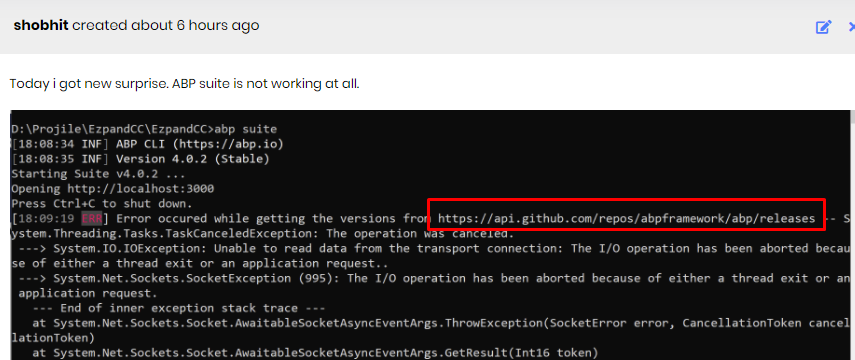
I see that you can successfully browse https://api.github.com/repos/abpframework/abp/releases . So do you still get the following error right now?
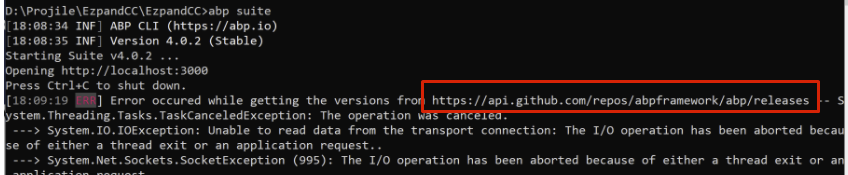
Regarding point 1: 1- Open ABP suite from my project folder 2- Go to ABP suite module 3- Download Code 4- Wola you got error in ABP suite console
Can you write the error log and attach your error screenshot.
can you pls show a screenshot that you can succesfully and navigate to https://api.github.com/repos/abpframework/abp/releases also can you try again to create the entity via Suite.
PS: Suite is not a blocker. It's a complementary tool that helps you to generate a CRUD page. You can always create entity manually.
Sorry for the inconvenience. Suite is a complementary tool that helps you to create a CRUD page. But it will never block you. You can continue to manually create your entity. On the other way we are working on the reported issues.
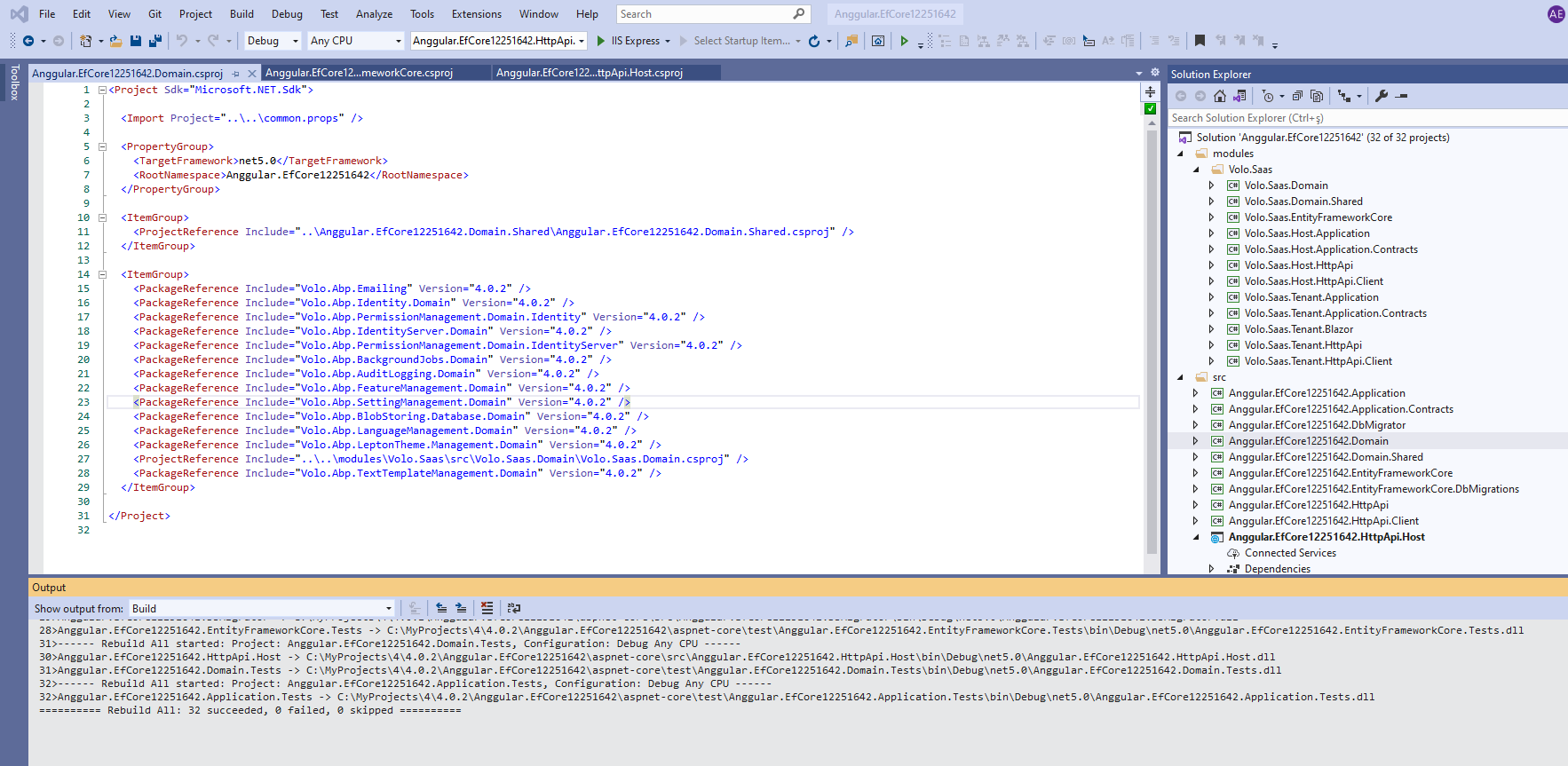
I couldn't reproduce your problem. Added SaS module and no compile errors.
can you check you can go to the highlighted URL in your browser? sometimes network problems prevent reaching GitHub.