@tony after v4.0 we started to use code flow. that's why the login screen moved to MVC project. you can customize the MVC login screen.see https://gist.github.com/ebicoglu/ce0f0425bab806d0ee1a87d0073af96b
besides I suggest you to check out the following doc. You can copy the Lepton Theme and create your own theme. If you choose this option, let me know to discuss this https://community.abp.io/articles/creating-a-new-ui-theme-by-copying-the-basic-theme-for-blazor-ui-qaf5ho1b
what is your version?
@bbertechini your question credit has been refunded.
for the question 2 check out => https://support.abp.io/QA/Questions/306/Custom-Login-Page-For-Angular
When you see this error update your EF Core CLI with the below command
dotnet tool update --global dotnet-ef
Windows:
%UserProfile%\.abp\suite\appsettings.json
MAC:
~/.abp/suite/appsettings.json
The solutions and paths are written in this file. If this is corrupted, you can manually fix the json file. Or you can delete it. And add your solutions again.
NuGet.Config must be like this
<?xml version="1.0" encoding="utf-8"?>
<configuration>
    <packageSources>
        <add key="nuget.org" value="https://api.nuget.org/v3/index.json" />
        <add key="BlazoriseMyGet" value="https://www.myget.org/F/blazorise/api/v3/index.json" />
        <add key="ABP Commercial NuGet Source" value="https://nuget.abp.io/***-your-api-key-***/v3/index.json" />
    </packageSources>
</configuration>
Guys I realized that the below package is used in the Blazor project
Microsoft.AspNetCore.Components.WebAssembly.DevServer
Before you publish your project, change this package to the below one
Microsoft.AspNetCore.Components.WebAssembly.Server
I guess the second one provides more performance, the first one is for development (hot reload, rebuild on change, etc...)
We were using Resource Owner Password flow. And it's not being used in modern web apps anymore. For more information you can check out https://www.scottbrady91.com/OAuth/Why-the-Resource-Owner-Password-Credentials-Grant-Type-is-not-Authentication-nor-Suitable-for-Modern-Applications or https://auth0.com/docs/flows/resource-owner-password-flow
And this is same for Google. If you want to change your profile pic, you leave from Gmail and do it in Google Account website...
Or Yandex Passport or Microsoft Account etc.. This is how it's done in modern web apps.
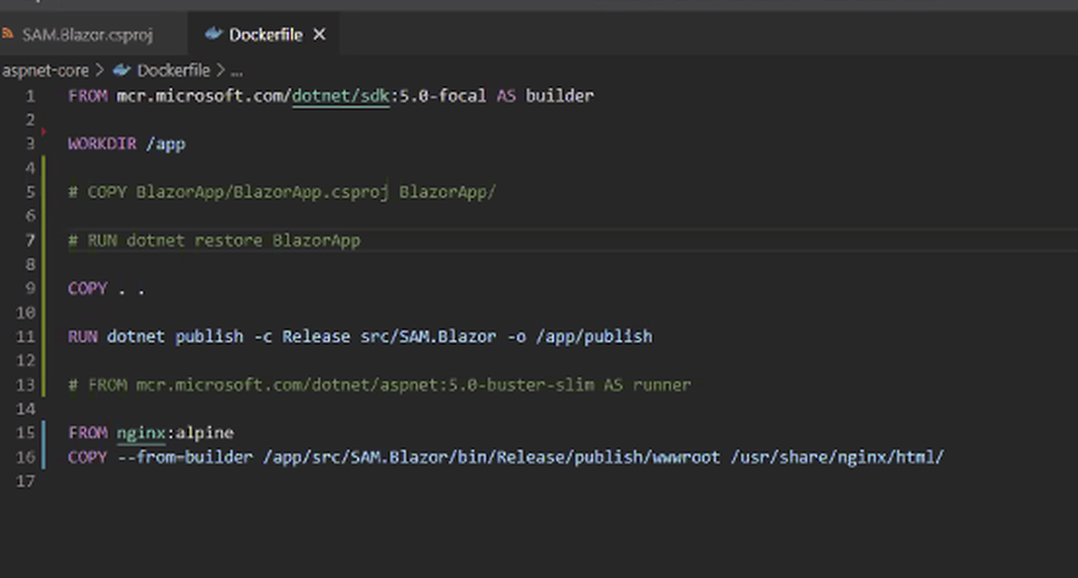
https://docs.microsoft.com/en-us/aspnet/core/blazor/host-and-deploy/webassembly?view=aspnetcore-5.0#nginx-in-docker









