Thanks alot @liangshiwei It worked
Hi,
As you said I tried implementing AudtingStore.
But I was not able to log the data like AbpAuditLog.I think I missed out something
I got reference from the source code
Below is my code , Please help if something is wrong in the implementation
[Dependency(TryRegister = true)]
public class AWSAuditingStore: IAuditingStore, ISingletonDependency
    {
        public ILogger<AWSAuditingStore> Logger { get; set; }

        public AWSAuditingStore()
        {
            Logger = NullLogger<AWSAuditingStore>.Instance;
        }

        public Task SaveAsync(AuditLogInfo auditInfo)
        {
            Logger.LogInformation("AWSAuditingStore : {0}", auditInfo.ToString());
            return Task.FromResult(0);
        }
    }
Thanks @liangshiwei
It will be very helpfull if u can provide some sample code to demonstrate implementation of custom AudtingStore
Hi,
I have implemented Serilog.Sinks.AwsCloudWatch to log my data to AWS-CloudWatch
But the problem is according to the documentations of SeriLog I can log data as per LogEventLevel to the CloudWatch which creates huge amout of unnecessary data
What if I want to log only the data which get logged into AuditLog and AuditLogAction table from database to AWS-CloudWatch.
Is this possible and how to implement it ?
I want to create user by providing chinese character as input but came accross this error
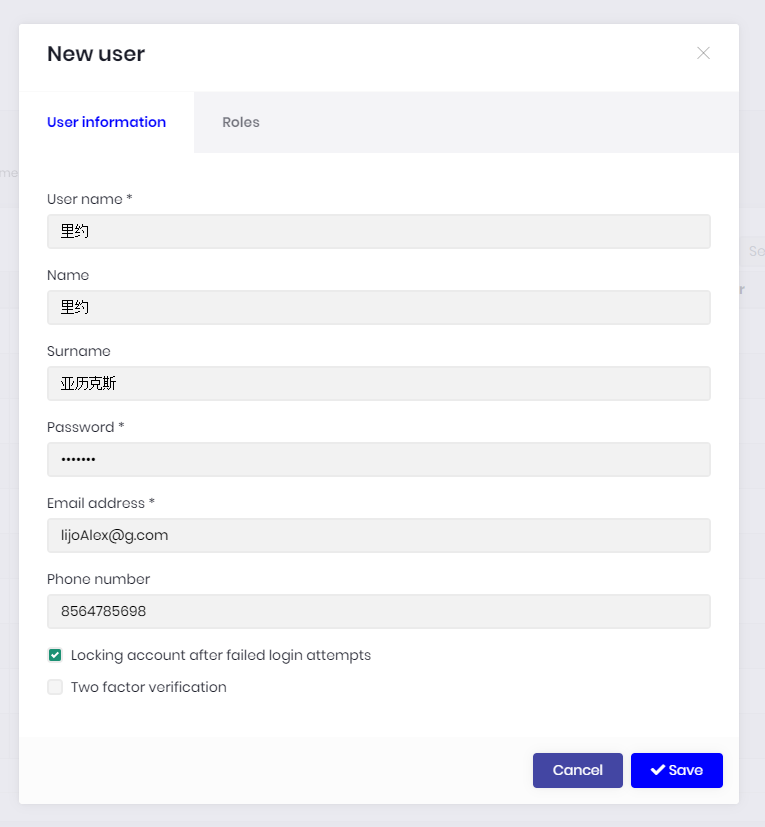
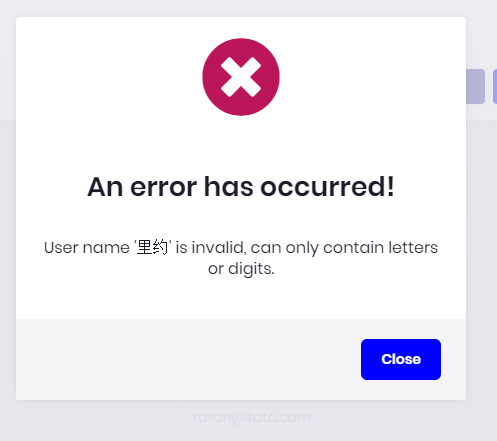
How do I set rule to allow chinese letters ?
Check the docs before asking a question: https://docs.abp.io/en/commercial/latest/ Check the samples, to see the basic tasks: https://docs.abp.io/en/commercial/latest/samples/index The exact solution to your question may have been answered before, please use the search on the homepage.
Hi,
I need to know how the record get inserted into AbpAuditLogs and AbpAuditLogActions as I want to implement a bit customized logging of my own.
How can I implement the same for my own tables or you can say I just want to insert only few Http Status code related data to my own custom table.
How can I do it ?
Thanks @liangshiwei
It worked, Just last question which remained unanswered before
How do we Check Duplicate Entities in Fluent Validators ?
I want to cross check from my Address table whether this record is already present in my table ( i.e duplicate address )
Is it possible in Fluent Validator ?
And how do I do it ?
Thanks @liangshiwei
My DTO's are as below :
CustomerDto
public class CustomerDto : AuditedEntityDto<Guid>
{
    ....
}
AddressDto
public class AddressDto : AuditedEntityDto<Guid>
{
    ....
}
OrderDto
public class OrderDto : AuditedEntityDto<Guid>
{
    public CustomerDto Customer { get; set; }

    public AddressDto Address { get; set; }
}
As per your above solution I tried injecting IStringLocalizer<MyProjectResource> localizer as below
CustomerDtoValidator
public class CustomerDtoValidator : AbstractValidator<CustomerDto>
    {
        public CustomerDtoValidator(IStringLocalizer<MyProjectResource> _localizer)
        {
            ....
        }
    }
AddressDtoValidator
public class AddressDtoValidator : AbstractValidator<AddressDto>
    {
        public AddressDtoValidator(IStringLocalizer<MyProjectResource> _localizer)
        {
            ....
        }
    }
But I am not able to Implement below code for OrderDto :
public class OrderDtoValidator:AbstractValidator<SupplierCombinedDto>
    {
        public OrderDtoValidator()
        {
            RuleFor(x => x.Customer).SetValidator(new CustomerDtoValidator()); <-- ERROR
            RuleFor(x => x.Address).SetValidator(new AddressDtoValidator()); <-- ERROR

        }
    }
ERROR: There is no argument given that corresponds to the required formal parameter '_localizer' of CustomerDtoValidator(IStringLocalizer
What should I pass as argument ?
How do we Check Duplicate Entities in Fluent Validators ?
Where this duplicate check should be done? Contract/Domain/Application project ?
Cause I have my Validator's in Application.Contracts project. Is this the right way to do it?
Hi
Suppose this is my DTO
public class AnyDto
{
    [Required(ErrorMessage="Name is required")]
    public string Name { get; set;}
}
Or suppose this is my Validator Class
public class AnyDtoValidator : AbstractValidator<AnyDto>
    {
        public AnyDtoValidator()
        {
            RuleFor(x => x.Name).NotNull().WithMessage("Name is required");
        }
    }
I want to localize my errror message which is Name is required.
How do I do it ?
Kindly provide solution in both cases DTO/Fluent Validators









