Abp Studio Solution Configuration
When I open Abp Studio I get this message: Some pre-requirements are missing. If you want the application to work as expected, you need to install the following tool(s):
- PowerShell as a dotnet global tool. (Installation link: https://devblogs.microsoft.com/powershell/introducing-powershell-as-net-global-tool)

- node. (Installation link: https://nodejs.org/en)

- Volo.Abp.Studio.Cli as a dotnet global tool. (Installation link: https://abp.io/docs/latest/cli)

- dotnet-ef as a dotnet global tool. (Installation link: https://learn.microsoft.com/en-us/ef/core/cli/dotnet)

- mkcert. (Installation link: https://github.com/FiloSottile/mkcert)
If you have already installed the tool(s), please check the PATH environment variable.
Unfortunately your documentation doesn't list the prerequisites for Mac or how to install if they're missing.
The second issue shows up in the logs 4:33:44.349 Information Trying to connect to ABP Studio Backend: "http://localhost:38271"14:33:49.385 Information Trying to connect to ABP Studio Backend: "http://localhost:38271" 14:33:54.420 Information Trying to connect to ABP Studio Backend: "http://localhost:38271" 14:33:54.422 Warning Could not connect to ABP Studio Backend! Detail: "Failed to connect to StreamingHub 'IStudioBackendHub'. (Status(StatusCode="Unavailable", Detail="Error connecting to subchannel.", DebugException="System.Net.Sockets.SocketException: Connection refused"))"
Upgraded abp cli and .net to v9.0
Installed abp Studio for Mac
uninstalled abp cli dotnet tool uninstall -g Volo.Abp.Cli
Installed Abp studio as a global dotnet tool install -g Volo.Abp.Studio.Cli
Opened Studio
Got the pre-requisites error
Viewed the logs and saw the Backend connection error
Verified verified that each pre-requisite installed via the terminal command line:
rogerhopkins@MacBookPro ~ % node -v
v18.19.0
rogerhopkins@MacBookPro ~ % dotnet-ef --version
Entity Framework Core .NET Command-line Tools
7.0.3
rogerhopkins@MacBookPro ~ % mkcert --version
v1.4.4
rogerhopkins@MacBookPro ~ % pwsh
PowerShell 7.4.6
PS /Users/rogerhopkins>
We're following the microservices architecture with the Abp Commercial microservices template.
We have a complex reporting requirement where we need to pull data from multiple domains, which means multiple databases. We tried to follow this article: https://abp.io/community/articles/how-to-use-multiple-dbcontexts-in-a-single-query-execution-488bxj4q but it didn't work.
How do we accomplish this within one microsercie without having to make service to service api calls?
Thanks
I made some changes to the MemberConfigService, tested the service on localhost successfully but when I deploy to Kubernetes I get the following error that's just running in an infinite loop until I kill the pod. I deployed the previous image that was running in in AKS and it too is getting he same error.
An exception was thrown while activating CprOnAbp.MemberConfigService.DbMigrations.MemberConfigServiceDatabaseMigrationEventHandler.
Autofac.Core.DependencyResolutionException: An exception was thrown while activating CprOnAbp.MemberConfigService.DbMigrations.MemberConfigServiceDatabaseMigrationEventHandler.
---> Autofac.Core.DependencyResolutionException: None of the constructors found on type 'CprOnAbp.MemberConfigService.DbMigrations.MemberConfigServiceDatabaseMigrationEventHandler' can be invoked with the available services and parameters:
Cannot resolve parameter 'System.String databaseName' of constructor 'Void .ctor(Volo.Abp.MultiTenancy.ICurrentTenant, Volo.Abp.Uow.IUnitOfWorkManager, Volo.Abp.MultiTenancy.ITenantStore, Volo.Saas.Tenants.ITenantRepository, Volo.Abp.EventBus.Distributed.IDistributedEventBus, System.String, System.IServiceProvider)'.
See https://autofac.rtfd.io/help/no-constructors-bindable for more info.
at Autofac.Core.Activators.Reflection.ReflectionActivator.<>c__DisplayClass14_0.<UseSingleConstructorActivation>b__0(ResolveRequestContext ctxt, Action`1 next)
at Autofac.Core.Resolving.Middleware.DelegateMiddleware.Execute(ResolveRequestContext context, Action`1 next)
at Autofac.Core.Resolving.Pipeline.ResolvePipelineBuilder.<>c__DisplayClass14_0.<BuildPipeline>b__1(ResolveRequestContext ctxt)
at Autofac.Core.Resolving.Middleware.DisposalTrackingMiddleware.Execute(ResolveRequestContext context, Action`1 next)
at Autofac.Core.Resolving.Pipeline.ResolvePipelineBuilder.<>c__DisplayClass14_0.<BuildPipeline>b__1(ResolveRequestContext ctxt)
at Autofac.Builder.RegistrationBuilder`3.<>c__DisplayClass41_0.<PropertiesAutowired>b__0(ResolveRequestContext ctxt, Action`1 next)
at Autofac.Core.Resolving.Middleware.DelegateMiddleware.Execute(ResolveRequestContext context, Action`1 next)
at Autofac.Core.Resolving.Pipeline.ResolvePipelineBuilder.<>c__DisplayClass14_0.<BuildPipeline>b__1(ResolveRequestContext ctxt)
at Autofac.Core.Resolving.Middleware.ActivatorErrorHandlingMiddleware.Execute(ResolveRequestContext context, Action`1 next)
--- End of inner exception stack trace ---
at Autofac.Core.Resolving.Middleware.ActivatorErrorHandlingMiddleware.Execute(ResolveRequestContext context, Action`1 next)
at Autofac.Core.Resolving.Pipeline.ResolvePipelineBuilder.<>c__DisplayClass14_0.<BuildPipeline>b__1(ResolveRequestContext ctxt)
at Autofac.Core.Pipeline.ResolvePipeline.Invoke(ResolveRequestContext ctxt)
at Autofac.Core.Resolving.Middleware.RegistrationPipelineInvokeMiddleware.Execute(ResolveRequestContext context, Action`1 next)
at Autofac.Core.Resolving.Pipeline.ResolvePipelineBuilder.<>c__DisplayClass14_0.<BuildPipeline>b__1(ResolveRequestContext ctxt)
at Autofac.Core.Resolving.Middleware.SharingMiddleware.Execute(ResolveRequestContext context, Action`1 next)
at Autofac.Core.Resolving.Pipeline.ResolvePipelineBuilder.<>c__DisplayClass14_0.<BuildPipeline>b__1(ResolveRequestContext ctxt)
at Autofac.Core.Resolving.Pipeline.ResolvePipelineBuilder.<>c__DisplayClass14_0.<BuildPipeline>b__1(ResolveRequestContext ctxt)
at Autofac.Core.Resolving.Middleware.CircularDependencyDetectorMiddleware.Execute(ResolveRequestContext context, Action`1 next)
at Autofac.Core.Resolving.Pipeline.ResolvePipelineBuilder.<>c__DisplayClass14_0.<BuildPipeline>b__1(ResolveRequestContext ctxt)
at Autofac.Core.Pipeline.ResolvePipeline.Invoke(ResolveRequestContext ctxt)
at Autofac.Core.Resolving.ResolveOperation.GetOrCreateInstance(ISharingLifetimeScope currentOperationScope, ResolveRequest request)
at Autofac.Core.Resolving.ResolveOperation.ExecuteOperation(ResolveRequest request)
at Autofac.Core.Resolving.ResolveOperation.Execute(ResolveRequest request)
at Autofac.Core.Lifetime.LifetimeScope.ResolveComponent(ResolveRequest request)
at Autofac.ResolutionExtensions.TryResolveService(IComponentContext context, Service service, IEnumerable`1 parameters, Object& instance)
at Autofac.ResolutionExtensions.ResolveService(IComponentContext context, Service service, IEnumerable`1 parameters)
at Autofac.ResolutionExtensions.Resolve(IComponentContext context, Type serviceType, IEnumerable`1 parameters)
at Autofac.ResolutionExtensions.Resolve(IComponentContext context, Type serviceType)
at Autofac.Extensions.DependencyInjection.AutofacServiceProvider.GetRequiredService(Type serviceType)
at Volo.Abp.EventBus.IocEventHandlerFactory.GetHandler()
at Volo.Abp.EventBus.EventBusBase.TriggerHandlerAsync(IEventHandlerFactory asyncHandlerFactory, Type eventType, Object eventData, List`1 exceptions, InboxConfig inboxConfig)
at Volo.Abp.EventBus.EventBusBase.TriggerHandlersAsync(Type eventType, Object eventData, List`1 exceptions, InboxConfig inboxConfig)
at Volo.Abp.EventBus.EventBusBase.TriggerHandlersAsync(Type eventType, Object eventData)
at Volo.Abp.EventBus.RabbitMq.RabbitMqDistributedEventBus.ProcessEventAsync(IModel channel, BasicDeliverEventArgs ea)
at Volo.Abp.RabbitMQ.RabbitMqMessageConsumer.HandleIncomingMessageAsync(Object sender, BasicDeliverEventArgs basicDeliverEventArgs)
[20:56:07 ERR] ---------- Exception Data ----------
ActivatorChain = CprOnAbp.MemberConfigService.DbMigrations.MemberConfigServiceDatabaseMigrationEventHandler
I can give whoever access to our GitHub repository if necessary.
Please see closed quest #7304 which is now closed and locked.
We applied the suggested code changes to the ClientServiceHttpApiHostModule class in the ClientService.HttpApi.Host project but the IP address in the audit logs is still showing the IP address of the web gateway.
This is pretty important to us as a SaaS provider for audit and training purposes.
Thank you.
Check the docs before asking a question: https://docs.abp.io/en/commercial/latest/ Check the samples to see the basic tasks: https://docs.abp.io/en/commercial/latest/samples/index The exact solution to your question may have been answered before, and please first use the search on the homepage. Provide us with the following info:
We have a microservices solution created from the Microservice Template and have deployed it to AKS test environment. We're getting this error in the MVC web application created from the template in what appears to be an infinite loop. We haven't modified the web application from the template. I don't know how long this error has been occurring since I just happened to be viewing the pod logs for a different reason when I saw this. I had to delete the MVC application.
I'm not seeing this error when the application is run via Tye on localhost against the same databases.
[16:57:49 ERR] An exception was thrown while activating Volo.Abp.Identity.UserPasswordChangeRequestedEventHandler.
Autofac.Core.DependencyResolutionException: An exception was thrown while activating Volo.Abp.Identity.UserPasswordChangeRequestedEventHandler.
\-\-\-\> Autofac\.Core\.DependencyResolutionException: None of the constructors found on type 'Volo\.Abp\.Identity\.UserPasswordChangeRequestedEventHandler' can be invoked with the available services and parameters:
Cannot resolve parameter 'Volo.Abp.Identity.IIdentityUserRepository userRepository' of constructor 'Void .ctor(Volo.Abp.Identity.IIdentityUserRepository, Volo.Abp.Identity.IdentityUserManager)'.
See [https://autofac.rtfd.io/help/no-constructors-bindable](https://autofac.rtfd.io/help/no-constructors-bindable) for more info.
at Autofac.Core.Activators.Reflection.ReflectionActivator.<>c\_\_DisplayClass14\_0.b\_\_0(ResolveRequestContext ctxt, Action`1 next) at Autofac.Core.Resolving.Middleware.DelegateMiddleware.Execute(ResolveRequestContext context, Action`1 next)
at Autofac.Core.Resolving.Pipeline.ResolvePipelineBuilder.<>c\_\_DisplayClass14\_0.b\_\_1(ResolveRequestContext ctxt)
at Autofac.Core.Resolving.Middleware.DisposalTrackingMiddleware.Execute(ResolveRequestContext context, Action`1 next) at Autofac.Core.Resolving.Pipeline.ResolvePipelineBuilder.<>c__DisplayClass14_0.<BuildPipeline>b__1(ResolveRequestContext ctxt) at Autofac.Builder.RegistrationBuilder`3.<>c\_\_DisplayClass41\_0.b\_\_0(ResolveRequestContext ctxt, Action`1 next) at Autofac.Core.Resolving.Middleware.DelegateMiddleware.Execute(ResolveRequestContext context, Action`1 next)
at Autofac.Core.Resolving.Pipeline.ResolvePipelineBuilder.<>c\_\_DisplayClass14\_0.b\_\_1(ResolveRequestContext ctxt)
at Autofac.Core.Resolving.Middleware.ActivatorErrorHandlingMiddleware.Execute(ResolveRequestContext context, Action`1 next) --- End of inner exception stack trace --- at Autofac.Core.Resolving.Middleware.ActivatorErrorHandlingMiddleware.Execute(ResolveRequestContext context, Action`1 next)
at Autofac.Core.Resolving.Pipeline.ResolvePipelineBuilder.<>c\_\_DisplayClass14\_0.b\_\_1(ResolveRequestContext ctxt)
at Autofac.Core.Pipeline.ResolvePipeline.Invoke(ResolveRequestContext ctxt)
at Autofac.Core.Resolving.Middleware.RegistrationPipelineInvokeMiddleware.Execute(ResolveRequestContext context, Action`1 next) at Autofac.Core.Resolving.Pipeline.ResolvePipelineBuilder.<>c__DisplayClass14_0.<BuildPipeline>b__1(ResolveRequestContext ctxt) at Autofac.Core.Resolving.Middleware.SharingMiddleware.Execute(ResolveRequestContext context, Action`1 next)
at Autofac.Core.Resolving.Pipeline.ResolvePipelineBuilder.<>c\_\_DisplayClass14\_0.b\_\_1(ResolveRequestContext ctxt)
at Autofac.Core.Resolving.Pipeline.ResolvePipelineBuilder.<>c\_\_DisplayClass14\_0.b\_\_1(ResolveRequestContext ctxt)
at Autofac.Core.Resolving.Middleware.CircularDependencyDetectorMiddleware.Execute(ResolveRequestContext context, Action`1 next) at Autofac.Core.Resolving.Pipeline.ResolvePipelineBuilder.<>c__DisplayClass14_0.<BuildPipeline>b__1(ResolveRequestContext ctxt) at Autofac.Core.Pipeline.ResolvePipeline.Invoke(ResolveRequestContext ctxt) at Autofac.Core.Resolving.ResolveOperation.GetOrCreateInstance(ISharingLifetimeScope currentOperationScope, ResolveRequest request) at Autofac.Core.Resolving.ResolveOperation.ExecuteOperation(ResolveRequest request) at Autofac.Core.Resolving.ResolveOperation.Execute(ResolveRequest request) at Autofac.Core.Lifetime.LifetimeScope.ResolveComponent(ResolveRequest request) at Autofac.ResolutionExtensions.TryResolveService(IComponentContext context, Service service, IEnumerable`1 parameters, Object& instance)
at Autofac.ResolutionExtensions.ResolveService(IComponentContext context, Service service, IEnumerable`1 parameters) at Autofac.ResolutionExtensions.Resolve(IComponentContext context, Type serviceType, IEnumerable`1 parameters)
at Autofac.ResolutionExtensions.Resolve(IComponentContext context, Type serviceType)
at Autofac.Extensions.DependencyInjection.AutofacServiceProvider.GetRequiredService(Type serviceType)
at Volo.Abp.EventBus.IocEventHandlerFactory.GetHandler()
at Volo.Abp.EventBus.EventBusBase.TriggerHandlerAsync(IEventHandlerFactory asyncHandlerFactory, Type eventType, Object eventData, List`1 exceptions, InboxConfig inboxConfig) at Volo.Abp.EventBus.EventBusBase.TriggerHandlersAsync(Type eventType, Object eventData, List`1 exceptions, InboxConfig inboxConfig)
at Volo.Abp.EventBus.EventBusBase.TriggerHandlersAsync(Type eventType, Object eventData)
at Volo.Abp.EventBus.RabbitMq.RabbitMqDistributedEventBus.ProcessEventAsync(IModel channel, BasicDeliverEventArgs ea)
at Volo.Abp.RabbitMQ.RabbitMqMessageConsumer.HandleIncomingMessageAsync(Object sender, BasicDeliverEventArgs basicDeliverEventArgs)
[16:57:49 ERR] ---------- Exception Data ----------
We have implemented a microservices architecture using the ABP Commercial Microservice template. The architecture is pretty close to the Abp diagram here https://docs.abp.io/en/commercial/7.2/startup-templates/microservice/index with a few notable exceptions.
The backend applications and gateway are running in a single Azure Kubernetes cluster. The IP address of the gateway pod is 10.1.1.21.
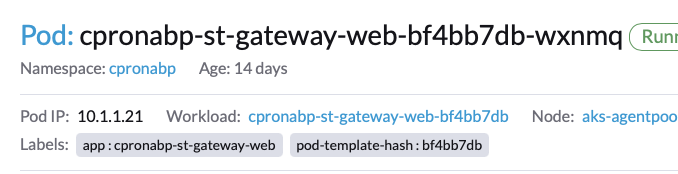
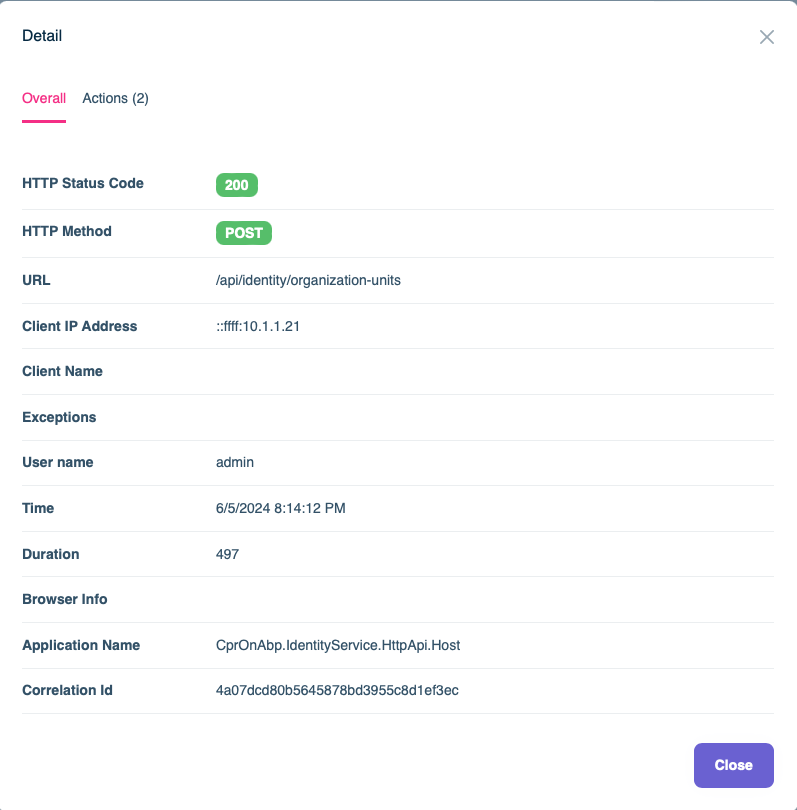
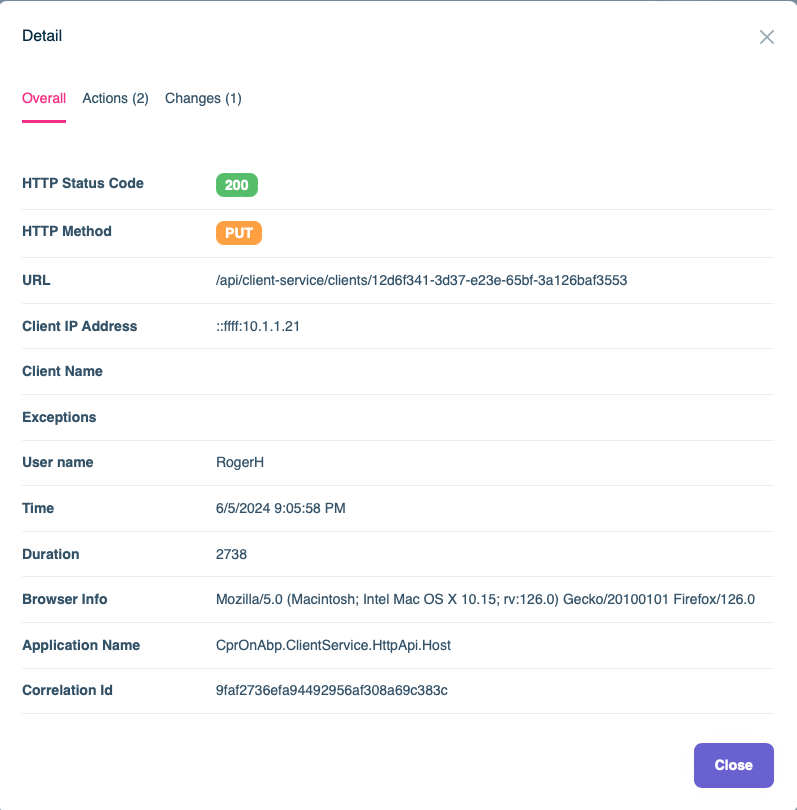
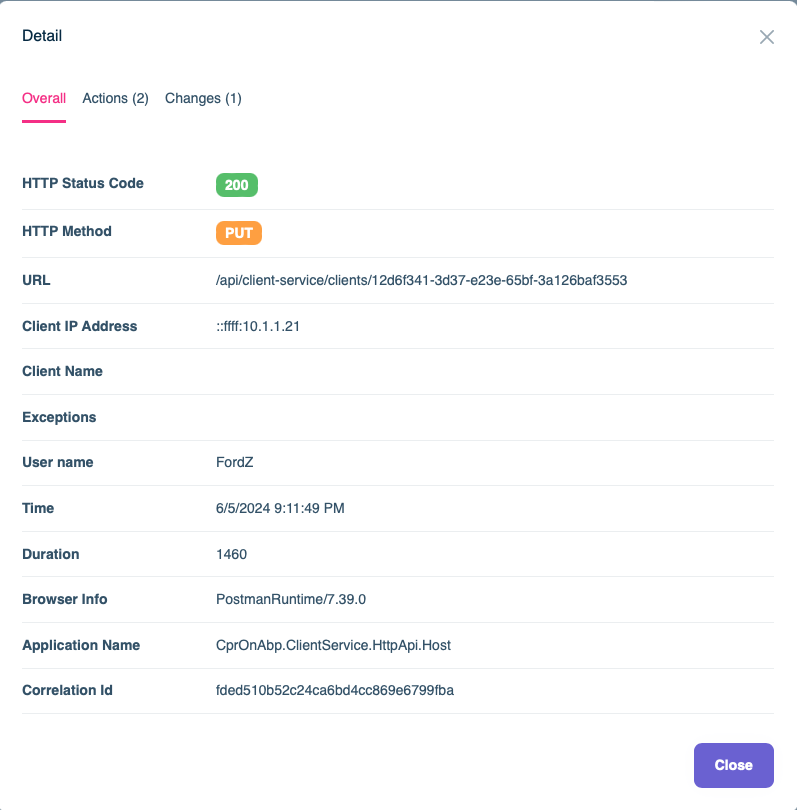
Regardless of which application is executing the microservice method, it appears that the IP address is address for the gateway AKS pod. The expected result would be for the IP Address to be the external IP from the user's machine. (See screenshots from the audit log below). Is this a defect or is there something we need to configure on our end?
Web MVC app
Vue App
Postman calling microservice API via gateway
We have a number of use cases where it would be ideal to utilize the Azure Service Bus message scheduling feature https://learn.microsoft.com/en-us/azure/service-bus-messaging/message-sequencing, but I can't find anything in the documentation, samples, blog posts or anywhere that shows how to do that.
For example when a client schedules an appointment we'd like to send reminders via SMS and/or email at various intervals (e.g. one week prior, 2 days prior to scheduled date).
Is this possible using AzureDistributedEventBus and if so, what are the detailed steps to implement?
Thank you.
Our solution is built on the Microervice template. We want to create a microservice using MongoDb instead of EF Core for SQL Server. Note this is not for all microservices.
The documentation for changing the database from EF Core to MongoDb is out of date: https://docs.abp.io/en/commercial/7.2/guides/microservice-mongodb
For example: Some of the changes appear to be in the EntityFrameworkCore project and some in the domain project but it's not clear. Making changes in the EntityFrameworkCore project doesn't make sense since it's being replaced by MongDb.
Also, these dont' exist: Remove Migrations folder. Update BookStoreDbMigrationService class to the following: (substitute BookStore with the microservice name)
Since Abp Suite doesn't support selecting the database for the Microservice template I created a project using Abp Suite and the Application template for MongDb. Now I'm trying to translate into the Microservice project structure and am struggling.
Please update the documentation, point me to an accurate solution or tell me I'm mistaken.
Thank you.
I submitted a question 6452.
Mailiming gave us something to try. I asked that the question not be closed because we had not had a chance to test out the solution. Now that we have and it doesn't work we need a different solution.
I don't want this to be charged against our annual support question total since I specifically asked that it not be closed.
Thank you
When an entity in the database is updated through an API call to the repository UpdateAsync method, I would expect it to return the concurrencyStamp that's updated in the database in the response. However it's returning the concurrencyStamp that was sent in the request. It returns the updated lastModificationTime and lastModifierId so I'm not sure why it doesn't return the updated concurrencyStamp
I've only found similar problems to this in Discord and the Abp support questions but no resolution.
Steps to reproduce the issue:
public string ConcurrencyStamp { get; set; }note.SetConcurrencyStampIfNotNull(concurrencyStamp);
return await _noteRepository.UpdateAsync(note);
Here's the PUT request payload: { clientId: "6df04165-acd7-18dd-7ccd-3a0d2bc61b4a" clientName: "Peyton Floris" concurrencyStamp : "dbca526c0d9f4b69b49a4cf992fc0079" text: "Something something" }
Here's the response payload { "clientId": "6df04165-acd7-18dd-7ccd-3a0d2bc61b4a", "clientName": "Peyton Floris", "text": "Something something", "concurrencyStamp": "dbca526c0d9f4b69b49a4cf992fc0079", "isDeleted": false, "deleterId": null, "deletionTime": null, "lastModificationTime": "2024-01-25T11:17:09.740494-06:00", "lastModifierId": "9bb21ac9-d3ac-887e-b521-3a0c9c5d08d6", "creationTime": "2023-11-27T09:40:40.03589", "creatorId": "9bb21ac9-d3ac-887e-b521-3a0c9c5d08d6", "id": "b5a37273-6cfc-3a7f-f4f3-3a0f239d6c90" } Here's the concurrency stamp showing in the database. Please note, I'm the only one hitting this database in test 75aeaf08163242128737360e611e1496









