






We’re using the OpenIdDict module for authentication in our Auth Server. We’ve encountered an issue where the redirect URI is being double‑encoded, and this is causing requests to be blocked in our client environment. This has left us completely stuck. Could you please assist us in resolving this?

11 Answer(s)
-
0
- Solution
Root cause
- Double-encoding of redirect_uri (e.g., https%253A%252F%252F...) typically happens when the ReturnUrl you pass to the Account/Login endpoint is already URL-encoded and then encoded again by the login page/pipeline.
- In ABP’s OpenIddict flow, the ReturnUrl (which wraps the original /connect/authorize request) must be a plain string. ABP/ASP.NET Core will encode it when constructing links.
What to check and fix
Ensure you don’t pre-encode ReturnUrl
- When redirecting to the Auth Server login page, pass the ReturnUrl value as-is, not encoded.
- Examples of correct and incorrect use:
- Correct: https://<auth-server>/Account/Login?ReturnUrl=/connect/authorize?client_id=BlazorServer&redirect_uri=https://localhost:44314/signin-oidc&response_type=code&scope=openid%20profile
- Incorrect (double-encoded redirect_uri inside ReturnUrl): https://<auth-server>/Account/Login?ReturnUrl=%2Fconnect%2Fauthorize%3Fclient_id%3DBlazorServer%26redirect_uri%3Dhttps%253A%252F%252Flocalhost%253A44314%252Fsignin-oidc...
- If you build this URL in your client, remove manual encoding for the entire ReturnUrl. Only the inner query string should be raw; ASP.NET Core will properly encode it on redirect.
Don’t re-wrap or re-encode in custom middleware
- If you added middleware or custom logic that captures ReturnUrl and re-encodes it, remove that step. Only forward the original ReturnUrl string.
Validate RedirectAllowedUrls on the Auth Server
- In the Auth Server’s appsettings.json, set App:RedirectAllowedUrls to include your client URLs (Blazor Server, etc.). This prevents OpenIddict from rejecting valid redirects and avoids custom workarounds that often cause double encoding: { "App": { "RedirectAllowedUrls": "https://localhost:44314,https://yourclient.example.com" } }
- Restart after changes.
Verify client OpenIddict/OIDC handler configuration
- For Blazor Server (or MVC) clients using Microsoft.AspNetCore.Authentication.OpenIdConnect, do not manually encode redirect_uri. The handler will send it correctly.
- Ensure CallbackPath/signin-oidc matches the redirect URI registered in the OpenIddict client application.
Quick detection pattern
- If you see https%253A within the redirect_uri (note “%25” which is the percent sign encoded), your code has encoded an already encoded URL. Fix by removing your first encoding step.
Optional safeguard (only if you can’t quickly remove pre-encoding at source)
- As a temporary mitigation in your Auth Server login action, you could detect and decode once if the redirect_uri contains “%253A”, but this is not recommended as a long-term fix. The correct solution is to stop pre-encoding on the caller side.
- Sources
- ABP OpenIddict deployment note (RedirectAllowedUrls) — validated:
- https://abp.io/docs/latest/solution-templates/layered-web-application/deployment/openiddict-deployment
- ABP Framework GitHub (reference for module/flow behavior):
- https://github.com/abpframework/abp
This response was generated by AI. If it didn’t solve your problem, feel free to post a new answer — our support team will jump in to help you soon.
-
0
We have not encoded it in our code. It is getting encoded from the package.
-
0
hi
How can I reproduce it in a new template project?
Can you share the
harfile of all requests?https://abp.io/support/questions/8622/How-to-enable-Debug-logs-for-troubleshoot-problems#answer-3a1a1c4b-691e-3403-98b9-5f23fa024759
liming.ma@volosoft.com
Thanks,.
-
0
hi
The request in the
harfile seems to have no problem.How can I reproduce it in a new template project?
Thanks.
-
0
Hi,
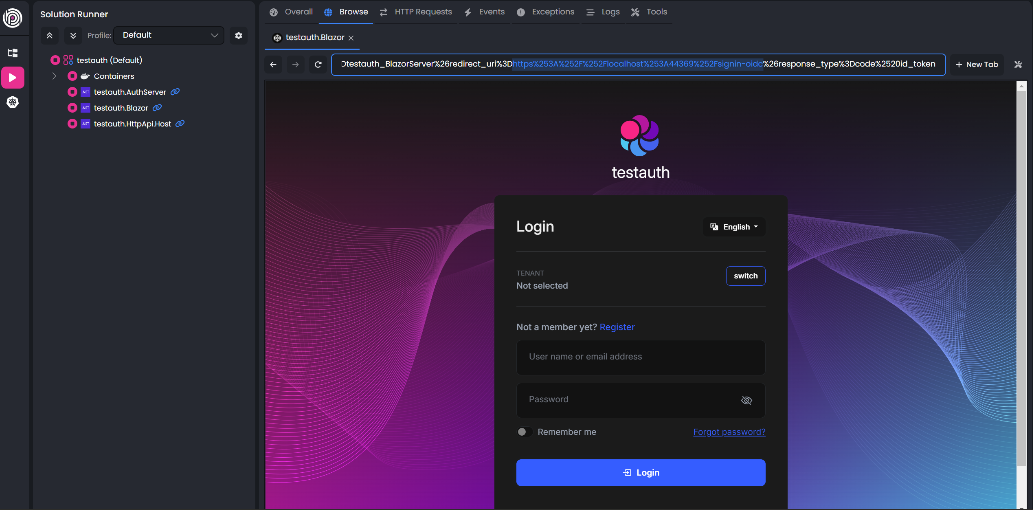
This should be reproducible in a sample project created from abp studio, with separate auth server. We are using blazor server for front end. Just need to click on the login button in blazor and it should redirect to the auth server, with the double encoded redirect uri.
-
0
hi
Can Blazor server log in successfully via the auth server website?
If not what is the error screenshot?
Thanks.
-
0
Hi,
It is blocked from Azure Front Door in our client environment with the following error.

-
0
Thanks, I will check this case.
-
0
hi
This is not an AuthServer problem.
Can you change your Azure Front Door rule?
https://learn.microsoft.com/en-us/answers/questions/1273296/waf-exclusion-rules-alternatives

-
0
Hi, We currently don’t have access to the environment and are awaiting their response on whether it can be excluded.
-
0
Thanks. 👍



