






ABP Support Request: Intermittent GrantedPolicies = 0 for authenticated admin user (ABP 10.0.2)
Hi ABP team,
We are investigating an intermittent production issue where an authenticated user suddenly loses effective permissions (menus/actions disappear) without logging out.
Environment
- ABP version:
10.0.2 - App type: ABP commercial-style modular app (
Web+HttpApi.Host) - Cache stack:
IDistributedCache(Redis) + custom in-memory L1 decorator overIDistributedCache - Redis: Azure Cache for Redis
- Hosting: Azure App Service
Context
We already implemented an L1 cache decorator around IDistributedCache to handle the previously observed Redis transient/cancellation path.
That fix helped for Redis outages, but we are now seeing a different failure mode where cache is healthy, user is authenticated, yet GrantedPolicies becomes zero.
What we observed (latest incident)
Incident window (UTC): 2026-02-27 19:33:10Z to 19:35:53Z.
1) User is authenticated and claims look valid
Claims diagnostic: User=admin, UserId=e82af67f-ecf7-4559-8140-c9596aa9f91a, TotalClaims=11, Roles=[admin], AllKeyClaimsPresent=true
2) App config reports zero policies for that same authenticated user
Multiple requests in the same window show:
AppConfig diagnostic: User=admin has 0 grantedPolicies. Auth IsAuthenticated=true, CurrentUser set=true
Seen on:
//HostDashboard/Abp/ApplicationConfigurationScript/Abp/ApplicationLocalizationScript/Abp/ServiceProxyScript
3) Authorization failures follow immediately
Many permission checks fail for the same request/user after the zero-policy state appears.
4) Redis appears healthy during this exact window
Redis status check ... IsConnected=true(periodic checks around the incident)- No corresponding Redis outage signature in this incident window
5) No classic application-configuration 500 chain this time
For this window we did not see the older pattern (API 500 + remote call exception/cancellation) that we saw in a separate earlier incident.
Why this is confusing
It looks like a valid, authenticated principal can occasionally resolve to an application configuration with GrantedPolicies = 0, and that value then appears to be reused by cache for a short period.
Questions for ABP team
- Are there known scenarios in ABP
10.0.2whereApplicationConfigurationcan be successfully generated with an emptyGrantedPoliciesdictionary for an authenticated user that otherwise has roles/claims? - Is there any known race condition around dynamic claims/permission value providers that could yield transient empty results without exceptions?
- Is ABP expected to cache an empty
GrantedPoliciesresult the same way as a normal one, and is there a recommended guard to avoid caching suspiciously empty results for authenticated users? - Is there a recommended extension point to validate/reject an
ApplicationConfigurationDtowhenIsAuthenticated=trueandGrantedPolicies.Count==0? - Are there patches after
10.0.2related to intermittent empty permission resolution inRemotePermissionChecker/ application configuration generation?
Notes
- We can share anonymized log snippets with trace IDs if needed.
- We already have diagnostics proving this is not always tied to Redis transport failures.
Thanks in advance. Any guidance on whether this is a known issue or recommended mitigation pattern would be very helpful.
31 Answer(s)
-
0
以下信息可能有用: 不正常时: 在MVC前端访问:https://manage.domain.com/Abp/ApplicationConfigurationScript 时,currentUser包含用户信息。但在redis缓存中,键 c:Volo.Abp.AspNetCore.Mvc.ApplicationConfigurations.ApplicationConfigurationDto,k:AppName1:ApplicationConfiguration_1d5fa0de27ae42a8a24f5f46ea0793fb_7ad543414c677529e7243a1f648d059c_zh-Hans 中currentUser不包含用户信息。
The following information may be helpful:
When incorrect: When accessing https://manage.domain.com/Abp/ApplicationConfigurationScript in the MVC frontend, currentUser contains user information. However, in the Redis cache, currentUser in the key c:Volo.Abp.AspNetCore.Mvc.ApplicationConfigurations.ApplicationConfigurationDto,k:SmartBus:ApplicationConfiguration_1d5fa0de27ae42a8a24f5f46ea0793fb_7ad543414c677529e7243a1f648d059c_zh-Hans does not contain user information.
Markdown supported.Copy, paste, or drag & drop images and files (max 100 MB per file, 100 MB total per post) -
0
hi
We already implemented an L1 cache decorator around IDistributedCache to handle the previously observed Redis transient/cancellation path.
If you remove this feature, does the problem still exist? I just want to confirm whether they're related.
Thanks.
Markdown supported.Copy, paste, or drag & drop images and files (max 100 MB per file, 100 MB total per post) -
0
hi lanpin
This might be because your access token has expired or is invalid. We have a
CheckTokenExpirationextension method to check it.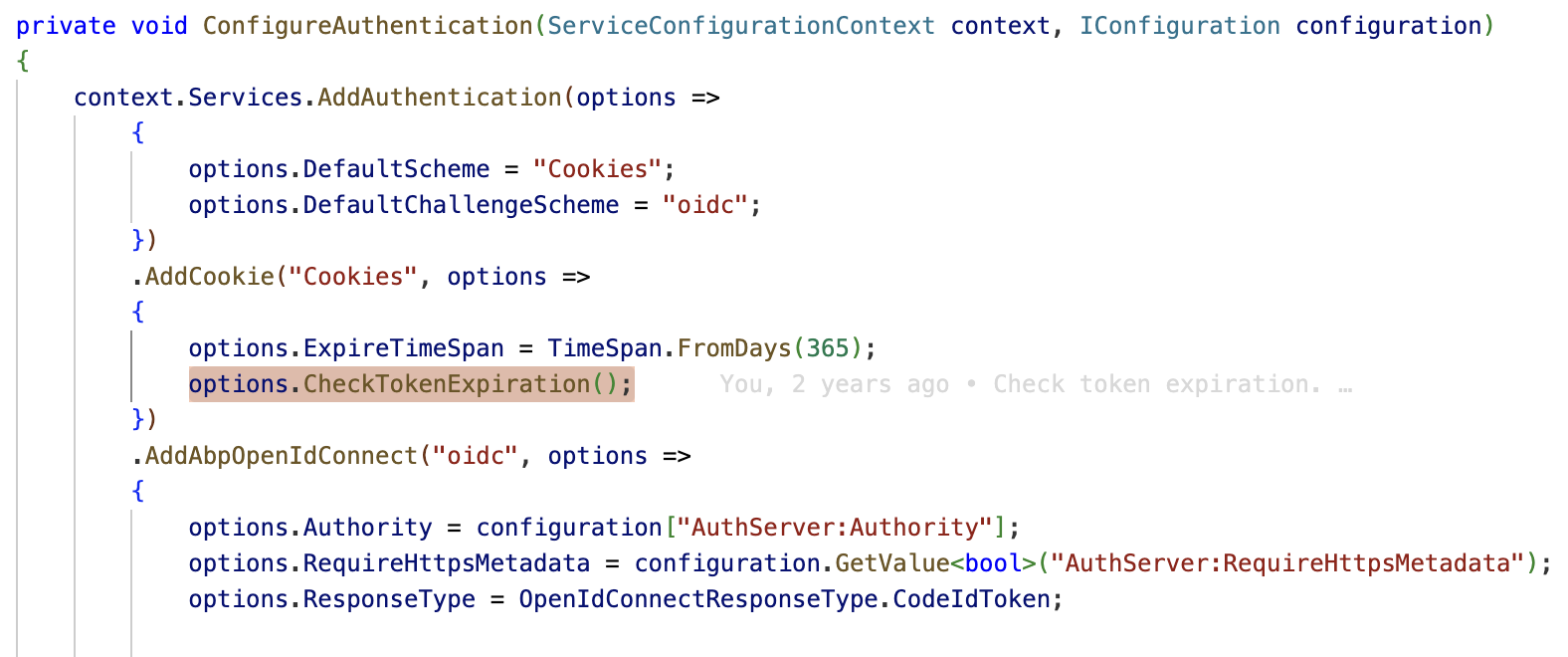
Thanks.
Markdown supported.Copy, paste, or drag & drop images and files (max 100 MB per file, 100 MB total per post) -
0
BTW, you can test with this sultion: https://abp.io/support/questions/10483/v1010-Tiered-Empty-grantedPolicies-in-WebPublic-MVC-when-CmsKit-is-enabled#answer-3a1fbf3e-08f2-5b12-1295-acf09d5eb112
Thanks.
Markdown supported.Copy, paste, or drag & drop images and files (max 100 MB per file, 100 MB total per post) -
0
[maliming] said: hi
We already implemented an L1 cache decorator around IDistributedCache to handle the previously observed Redis transient/cancellation path.
If you remove this feature, does the problem still exist? I just want to confirm whether they're related.
Thanks.
No, we had to add this to work around the issue though it sounds like it's still an issue (user report now): https://gist.github.com/kfrancis/0064c960832458254dcca9591948a103
We've deployed that change you mentioned. Can you explain why the additional authenticate call is needed?
Markdown supported.Copy, paste, or drag & drop images and files (max 100 MB per file, 100 MB total per post) -
0
No, no change in function. Still an issue.
Markdown supported.Copy, paste, or drag & drop images and files (max 100 MB per file, 100 MB total per post) -
0
hi
Can you try this? https://abp.io/support/questions/10483/v1010-Tiered-Empty-grantedPolicies-in-WebPublic-MVC-when-CmsKit-is-enabled#answer-3a1fc36a-b259-117e-907a-2687f3b22102
Can you remove the CMS module to see if this is fixed?
//typeof(CmsKitProPublicWebModule)Thanks.
Markdown supported.Copy, paste, or drag & drop images and files (max 100 MB per file, 100 MB total per post) -
0
@maliming 我需要的是用户在登录管理后台之后可以一直保持在线。在添加checkTokenExpiration之后,ManageHost确实可以在出错之前检测,但这并不是我的要求。我想最佳方案应该是Web(MVC)Host可以检查accesstoken是否过期,如果过期则自动使用refreshToken重新获取accessToken并继续完全用户的后续请求,并将新的令牌返回给用户cookies。这整个过程对用户是无感知的。
What I need is for users to remain online after logging into the admin panel. While adding
checkTokenExpirationdoes allow ManageHost to detect errors before they occur, this isn't what I require. I think the best solution would be for the Web (MVC) Host to check if the access token has expired. If it has, it should automatically obtain a new access token using arefreshToken, continue processing all subsequent user requests, and return the new token to the user's cookies. This entire process should be seamless for the user.
补充一下: 在未添加CheckTokenExpiration之前,用户登录一段时间后会失去所有权限和菜单,保持不注销并继续等待一段时间,用户权限和菜单会自行恢复。在用户失去权限和菜单时,通过redis-cli flushall强制清空所有缓存,可以立即恢复用户权限和菜单。
To add to the above: Before adding CheckTokenExpiration, users would lose all permissions and menu access after logging in for a period of time. If they remained logged in and waited for a while, their permissions and menu access would be automatically restored. When a user loses permissions and menu access, a forced clear of all cache using
redis-cli flushallcan immediately restore their permissions and menu access.Markdown supported.Copy, paste, or drag & drop images and files (max 100 MB per file, 100 MB total per post) -
0
[maliming] said: hi
Can you try this?
https://abp.io/support/questions/10483/v1010-Tiered-Empty-grantedPolicies-in-WebPublic-MVC-when-CmsKit-is-enabled#answer-3a1fc36a-b259-117e-907a-2687f3b22102
Can you remove the CMS module to see if this is fixed?
//typeof(CmsKitProPublicWebModule)Thanks.
I also did that, no change.
Markdown supported.Copy, paste, or drag & drop images and files (max 100 MB per file, 100 MB total per post) -
0
hi kfrancis
Another customer says this fixed their problem.
https://abp.io/support/questions/10483/v1010-Tiered-Empty-grantedPolicies-in-WebPublic-MVC-when-CmsKit-is-enabled#answer-3a1fc36a-b259-117e-907a-2687f3b22102
Can you try that?
If it's still not working, can you share your code? I will check and try to reproduce it locally.
liming.ma@volosoft.com
Thanks.
Markdown supported.Copy, paste, or drag & drop images and files (max 100 MB per file, 100 MB total per post) -
0
@maliming 我以为我们遇到的是同一个问题,我已经尝试解决并提交了一个PR:https://github.com/abpframework/abp/pull/25011 。 之后我将不再在此主题回复。
I thought we were having the same problem. I've already tried to solve it and submitted a PR: https://github.com/abpframework/abp/pull/25011 I will no longer reply to this thread.
Markdown supported.Copy, paste, or drag & drop images and files (max 100 MB per file, 100 MB total per post) -
0
@mailming No, still an issue.
Markdown supported.Copy, paste, or drag & drop images and files (max 100 MB per file, 100 MB total per post) -
0
hi kfrancis
If it's still not working, can you share your code? I will check and try to reproduce it locally.
liming.ma@volosoft.com
Thanks.
Markdown supported.Copy, paste, or drag & drop images and files (max 100 MB per file, 100 MB total per post) -
0
So, I'm just packing up the source to send - along with a summary and some recent logs showing the issues.
We basically have been dealing with the same issue, and all I've been able to do is move the issue so that users weren't getting stuck on login - to - users get in but don't have the correct permissions for some amount of time.
When we initially encountered major issues related to this, it was in the form of users getting stuck on the login page for about 4 minutes in a redirect loop until the system would finally allow them in. Over time, we've changed it so that users don't get weirdly stuck but now we are seeing more directly that it's all permissions related, in our current case the users login no problem but then randomly they won't have any permissions (grants=0) for some amount of time (shorter than 4 minutes), before they will start coming back gradually.
I'm sending the source with a folder \volosoft-logs for you, which includes recent related logs (web and auth) and a summary of the issue.
Markdown supported.Copy, paste, or drag & drop images and files (max 100 MB per file, 100 MB total per post) -
0
Hi kfrancis,
I went through your source code and logs. I couldn't build the project locally (missing NuGet feeds/dependencies), but I've pushed some diagnostic changes here: https://github.com/maliming/source/pull/1
What I changed:
- Disabled the L1 cache decorator in Web, Web.Public, and HttpApi.Host (since you said it made things worse, let's take it out for now)
- Added logging in
MvcCachedApplicationConfigurationClientandAbpApplicationConfigurationAppServiceto capture token status, user identity, cache state, etc. when GrantedPolicies=0 happens - All diagnostic log entries start with
ABP_DIAG:so they're easy to find
Can you:
- Merge these changes and build locally
- Check that
ABP_DIAG:entries show up in both Web and API output when you log in - Deploy to Azure and wait for the issue to occur
- Search logs for
ABP_DIAG:and share what you find
Is https://github.com/kfrancis your GitHub? I can add you to the repo so you can review the PR.
Thanks
Markdown supported.Copy, paste, or drag & drop images and files (max 100 MB per file, 100 MB total per post) -
0
Yes, that's me.
Markdown supported.Copy, paste, or drag & drop images and files (max 100 MB per file, 100 MB total per post) -
0
What Changed Since Last Update
We deployed custom diagnostic instrumentation on 2026-03-19 ~16:00 UTC to trace the exact request flow between the Web and API tiers. Three components were added:
DiagnosticApplicationConfigurationClientDecorator(Web tier) — decoratesIAbpApplicationConfigurationClientProxy, logs every outbound AppConfig request with user identity, token presence/size, tenant, and culture.DiagnosticApplicationConfigurationAppService(API tier) — wraps the AppConfig response, logs inbound token status, resolvedPolicyCount, and elapsed time.AccessTokenDiagnosticMiddleware(Web tier) — warns when the access token is within 30 seconds of expiry.
All diagnostic entries are tagged with
ABP_DIAGin the message template for easy filtering.
Findings (3-hour window, 2026-03-19 16:00–19:45 UTC)
Web Tier → API Tier: Token IS Being Sent ✅
66 outbound AppConfig requests logged. Every single one shows:
IsAuthenticated = trueTokenStatus = Present(1450–1550 chars)— a valid-sized JWT- Correct
UserId,UserName, andTenantIdvalues
Example (Web tier, outbound):
{
  "@t": "2026-03-19T19:45:58.286Z",
  "@mt": "ABP_DIAG: AppConfig fetching from RemoteAPI. User={UserName}, UserId={UserId}, Auth={IsAuthenticated}, TenantId={TenantId}, AccessToken={TokenStatus}, Culture={Culture}",
  "UserName": "admin",
  "UserId": "e82af67f-ecf7-4559-8140-c9596aa9f91a",
  "IsAuthenticated": true,
  "TenantId": null,
  "TokenStatus": "Present(1550chars)",
  "Culture": "en",
  "SourceContext": "CabMD.Web.Diagnostics.DiagnosticApplicationConfigurationClientDecorator",
  "RequestPath": "/HostDashboard"
}
API Tier: Token Received But Resolved as Anonymous, PolicyCount=0 ❌
14 API-side entries logged. Every single one shows:
TokenStatus = Bearer(825chars)— the Bearer token arrives in the requestPolicyCount = 0— 100% failure rate- Logged as Warning:
"API AppConfig anonymous request"— despite having a Bearer token
Example (API tier, inbound):
{
  "@t": "2026-03-19T16:26:54.796Z",
  "@mt": "ABP_DIAG: API AppConfig anonymous request. Token={TokenStatus}, Policies={PolicyCount}, Elapsed={ElapsedMs}ms, ClientIp={ClientIp}",
  "@l": "Warning",
  "TokenStatus": "Bearer(825chars)",
  "PolicyCount": 0,
  "ElapsedMs": 247.15,
  "ClientIp": "20.220.247.162",
  "SourceContext": "CabMD.Diagnostics.DiagnosticApplicationConfigurationAppService",
  "RequestPath": "/api/abp/application-configuration"
}
Full API-Side Timeline
| Timestamp (UTC) | Token | PolicyCount | Elapsed | Source IP | |---|---|---|---|---| | 16:26:54 | Bearer(825chars) | 0 | 247ms | 20.220.247.162 | | 16:36:57 | Bearer(825chars) | 0 | 9,336ms | 10.0.0.253 | | 16:37:16 | Bearer(825chars) | 0 | 236ms | 10.0.0.253 | | 17:09:47 | Bearer(825chars) | 0 | 210ms | 10.0.0.253 | | 17:30:30 | Bearer(825chars) | 0 | 194ms | 10.0.0.253 | | 18:02:33 | Bearer(825chars) | 0 | 197ms | 10.0.0.253 | | 18:11:39 | Bearer(825chars) | 0 | 195ms | 10.0.0.253 | | 18:13:03 | Bearer(825chars) | 0 | 202ms | 10.0.0.253 | | 18:22:25 | Bearer(825chars) | 0 | 209ms | 10.0.0.253 | | 18:36:20 | Bearer(825chars) | 0 | 195ms | 10.0.0.253 | | 18:42:34 | Bearer(825chars) | 0 | 201ms | 10.0.0.253 | | 18:49:31 | Bearer(825chars) | 0 | 197ms | 10.0.0.253 | | 19:22:24 | Bearer(825chars) | 0 | 50ms | 10.0.0.253 | | 19:28:53 | Bearer(825chars) | 0 | 208ms | 10.0.0.253 |
Notes:
10.0.0.253= internal VNet traffic (web tier → API tier)20.220.247.162= external client- The 9,336ms outlier at 16:36 suggests contention in the permission resolution pipeline
Token Expiry (Minor, Separate Observation)
5 warnings for user
wlahayeshowing token within 15–27 seconds of expiry at ~17:41 UTC. This is a natural edge case from rapid page loads near token expiry — not the root cause, since PolicyCount=0 occurs with tokens that have plenty of remaining lifetime.
Root Cause Isolation
The diagnostic data narrows the problem to a specific gap:
Web Tier API Tier ───────── ──────── User authenticated ✅ Token attached (1550 chars) ✅ ──── HTTP ────→ Token received (825 chars) ✅ CurrentUser resolved? ❌ (anonymous) PolicyCount resolved? ❌ (0) ←── Response ──── grantedPolicies = {} ❌- Web tier correctly authenticates and attaches a valid access token.
- API tier receives the token — it's present in the Authorization header.
- API tier does NOT resolve CurrentUser from the token — it treats the request as anonymous.
- PolicyCount = 0 on 100% of observed requests — this is not intermittent during this window; it's a consistent failure.
The problem is inside ABP's Bearer token validation / CurrentUser population pipeline on the API tier, somewhere between receiving the Authorization header and evaluating
IPermissionChecker.
Questions for ABP Team
Is there a known issue where the API tier's
AbpApplicationConfigurationAppService.GetAsync()fails to populateICurrentUserfrom a valid Bearer token? Our evidence shows the token arrives but the user is treated as anonymous.Could
IdentitySessionDynamicClaimsPrincipalContributorbe interfering? We've observed this contributor causing multi-second delays (the "four minute problem"). Could it be failing silently and stripping claims, resulting in an anonymous-looking principal?What populates
CurrentUseron the API tier for Bearer-authenticated requests? Is there a middleware ordering requirement we might be missing, or a DI registration that could be silently failing?The token shrinks from ~1550 chars (Web tier) to ~825 chars (API tier) — is this expected? The Web tier logs the full access token size; the API tier logs the Authorization header value. Could the token be getting truncated or replaced in transit?
Is there a way to inspect
HttpContext.User.ClaimsinsideAbpApplicationConfigurationAppService.GetAsync()to determine whether the Bearer middleware ran but produced an empty principal vs. didn't run at all?
Markdown supported.Copy, paste, or drag & drop images and files (max 100 MB per file, 100 MB total per post) -
0
Hey, thanks for the detailed logs — super helpful.
So we dug into the diagnostic output and your source code, and here's where we landed:
The Bearer token is definitely reaching the API tier (825 chars every time), but the API is treating every request as anonymous. We checked your
HttpApiHostModuleand noticed you've disabled dynamic claims:options.IsDynamicClaimsEnabled = false; options.DynamicContributors.Clear();So
IdentitySessionDynamicClaimsPrincipalContributorisn't even in the picture. The problem is happening earlier — the JwtBearer handler itself is failing to validate the token. When that happens,HttpContext.Userstays anonymous, and you get emptyGrantedPolicieson every cache-miss request.Your API uses
AddAbpJwtBearerwithAuthorityfrom config andAudience = "CabMD". Your AuthServer sets the issuer viaserverBuilder.SetIssuer(configuration["AuthServer:Authority"]). ABP callsDisableAccessTokenEncryption()unconditionally — we checked your entire codebase, nothing re-enables it — so the token should be a plain JWT. But 100% of validations are failing, and we can't tell why from the source code alone because both sides readAuthServer:Authorityfrom their own config, and the production values come from Azure env vars (not in appsettings).We've pushed a bunch of updates to the PR:
New diagnostic hooks — we added a
DiagnosticJwtBearerPostConfigurethat taps directly into the JwtBearer handler events. After deploying, look for these in your API logs:ABP_DIAG: JwtBearer OnAuthenticationFailed— this is the big one. It'll show the exact exception (signature key not found? issuer mismatch? audience mismatch?), plus the JWT's decoded issuer, audience, expiry, the configured Authority, and the raw token itself.ABP_DIAG: JwtBearer OnTokenValidated SUCCESS— if you see this, validation is actually working and we need to look elsewhere.ABP_DIAG: JwtBearer OnMessageReceived— confirms the handler is receiving the token and whether it's actually a JWT.
IdentityModel verbose logging — we enabled
ShowPII = trueandEventLevel.VerboseinProgram.cs. This writes the full JWT validation pipeline toLogs/identitymodel.txtin the API host's working directory — every step of key lookup, signature check, issuer/audience validation, with nothing masked.Log levels bumped to Debug — across HttpApi.Host, Web, and AuthServer, both dev and production configs. Serilog
MinimumLevelandMicrosoft.AspNetCore.Authenticationare both set to Debug now.Could you pull the latest, deploy, and then share the following after reproducing the issue?
Logs/identitymodel.txtfrom the API host- Complete log files from all three projects — HttpApi.Host, Web, and AuthServer
The
identitymodel.txtalone should tell us exactly what's going wrong with the JWT validation. The full logs from all projects might also reveal something we haven't thought of yet.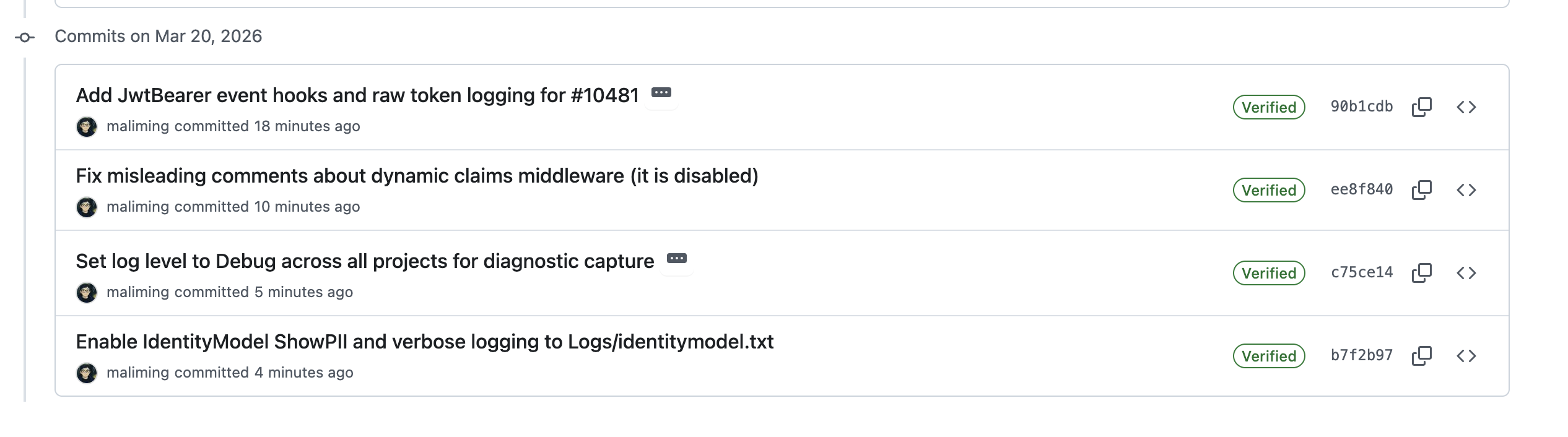 Markdown supported.Copy, paste, or drag & drop images and files (max 100 MB per file, 100 MB total per post)
 -
0
Ok, all deployed. I'll collect logs and get back to you.
Markdown supported.Copy, paste, or drag & drop images and files (max 100 MB per file, 100 MB total per post) -
0
Possible Root Cause Found — Client Credentials Token Sent Instead of User Token
Summary
On 2026-03-24, with enhanced diagnostics running in production, we captured 3 instances of the GrantedPolicies=0 bug and can now identify the root cause: the web tier intermittently sends its own client credentials token (machine-to-machine) instead of the current user's access token when calling the API tier's
/api/abp/application-configurationendpoint.The client credentials token is technically valid (JwtBearer validates it successfully), but it contains no
subclaim, no user identity, and no session — so ABP correctly treats it as anonymous and returns zero granted policies.
Evidence
The 3 Captured Instances
All three occurred today (2026-03-24) on the API tier, logged by
DiagnosticApplicationConfigurationAppService:| Timestamp (UTC) | TraceId | Token | Sub | Session | HttpAuth | AbpAuth | Claims | |---|---|---|---|---|---|---|---| | 12:47:22.156 |
cc351f9f..| Bearer(825chars) | MISSING | MISSING | true | false | 9 | | 12:47:22.552 |9094f1c0..| Bearer(825chars) | MISSING | MISSING | true | false | 9 | | 14:37:06.730 |dbbbbfb9..| Bearer(825chars) | MISSING | MISSING | true | false | 9 |For comparison, a normal authenticated request from the same day:
| Timestamp (UTC) | TraceId | Token | Sub | Session | HttpAuth | AbpAuth | Claims | |---|---|---|---|---|---|---|---| | 13:29:23.716 |
2ba53cb6..| Bearer(1470chars) |03a8635e..|cc5ab677..| true | true | 22 |Key Differences: Client Credentials Token vs User Token
| Field | Client Credentials (Bug) | User Token (Normal) | |-------|--------------------------|---------------------| | Token size | 825 chars | 1470–1765 chars | |
subclaim | MISSING | Present (user GUID) | |session_idclaim | MISSING | Present | |scope|CabMD(single) |openid profile roles email phone CabMD offline_access| |preferred_username| MISSING | Present | |role| MISSING | Present | | Claim count | 9 | 22 | |client_id|CabMD_Web|CabMD_Web| |AbpIsAuthenticated| false | true | | PolicyCount result | 0 | 204–265 |Full Claims of the Client Credentials Token
iss=https://next-identity.cab.md/
exp=1774359029
iat=1774355429
aud=CabMD
scope=CabMD
jti=adb20e1b-294c-4661-8157-93878190d2f2
oi_prst=CabMD_Web
client_id=CabMD_Web
oi_tkn_id=fd869ac8-699d-201e-91fc-3a2032000f7d
This is a standard OAuth2 client credentials grant token — no user identity, just the application itself authenticating.
Overall Traffic Context (2026-03-24)
Today had significantly higher activity than previous days, making it the first day with enough concurrent usage to trigger the race condition:
| Metric | Count | |--------|-------| | Total AppConfig OK (Web tier) | 16,178 | | JwtBearer OnMessageReceived (API) | 3,662 | | JwtBearer OnTokenValidated SUCCESS (API) | 2,673 | | API AppConfig requests with user token | 136 | | API AppConfig requests with client credentials token | 3 | | API AppConfig truly anonymous (no token) | 3 | | Auth failures | 0 | | Active users | 5 |
Failure rate: 3 out of 139 API AppConfig requests (2.2%) used the wrong token.
Root Cause Analysis
What Is Happening
Web Tier                                    API Tier
─────────                                   ────────
User "CS" authenticated ✅
  Cookie valid, AccessToken in store

AppConfig cache miss → need RemoteAPI call
  HttpClient resolves token...
  ❌ PICKS UP CLIENT CREDENTIALS TOKEN
     instead of CS's user token
        ──── HTTP (Bearer 825chars) ────→
                                            JwtBearer validates: ✅ (valid JWT)
                                            HttpContext.User.Identity.IsAuthenticated = true
                                            Claims: 9 (no sub, no session, no role)
                                            ABP CurrentUser: anonymous (no sub claim)
                                            PolicyCount = 0
        ←── Response (grantedPolicies={}) ──
AppConfig cached with 0 policies
User sees no menu items / permissions ❌
Why It Happens
In ABP's tiered architecture, the web tier uses
AbpApplicationConfigurationClientProxyto call the API tier. This proxy uses anHttpClientconfigured with ABP'sIdentityModelAuthenticationServiceto acquire a Bearer token.The
IdentityModelAuthenticationServicecan obtain tokens in two ways:- User token: The current user's access token from the OIDC authentication session
- Client credentials token: A machine-to-machine token using the
CabMD_Webclient ID/secret
Under certain conditions — potentially during token refresh, session transitions, or when the user's access token is not yet available in the
IHttpContextAccessor— the service falls back to the client credentials flow, which produces a valid but user-less token.Why It's Intermittent
- Load-dependent: Only 2.2% failure rate, and only triggered today with 5 concurrent users (vs 1–2 on previous days)
- Timing-sensitive: The 2 failures at 12:47:22 occurred 400ms apart — likely two near-simultaneous requests for different users that both hit the same race window
- Cache amplification: Once a bad AppConfig response is cached (in Redis or HttpContext), subsequent requests for that user may serve the stale zero-policy response until the cache expires
Why Disabling L1 Cache Reduced (But Didn't Eliminate) the Issue
The L1 in-memory cache previously amplified the problem: a single bad response would be served from L1 to all users until it expired. With L1 disabled, bad responses only affect the specific user whose request triggered them, and only until the per-request or Redis cache expires.
Questions for ABP Team
How does
IdentityModelAuthenticationServicedecide whether to use the user's access token vs client credentials? Is there a documented fallback behaviour where it uses client credentials when the user's token is unavailable?Is there a race condition in
IHttpContextAccessorduringAbpApplicationConfigurationClientProxy.GetAsync()? TheHttpContextmay not have the user's access token available when:- The request is very early in the middleware pipeline
- The OIDC token refresh is in progress
- The request is on a background/non-request thread
Should
AbpApplicationConfigurationClientProxyexplicitly reject client credentials tokens? Since it's fetching user-specific configuration, it should only proceed with a token that contains asubclaim. Falling back to client credentials produces a valid but useless response.Is there a configuration to force
IdentityModelAuthenticationServiceto always require a user token (i.e., never fall back to client credentials) for the AppConfig endpoint?Could the
oi_prst(OpenIddict presenter) claim be used to distinguish? Both token types haveoi_prst=CabMD_Web, so the presenter alone can't discriminate — but the absence ofsubis a clear signal.
Recommended Fix
We believe the correct fix is one of:
Option A (Client-side, Web tier): Before calling the API, validate that the token contains a
subclaim. If not, skip the remote call and return an anonymous AppConfig locally — this is faster and produces the correct result without a round-trip.Option B (Server-side, API tier): In the AppConfig endpoint, detect tokens without
suband treat them as anonymous immediately, rather than running the full permission resolution pipeline.Option C (Framework-level):
IdentityModelAuthenticationServiceshould not fall back to client credentials for endpoints that require user context. The proxy should throw or return a clear error rather than silently using the wrong token type.We prefer Option C as the most correct fix, but Options A or B can serve as workarounds - we might need help determining how to do A or more likely B temporarily.
Secure Information
If the ABP team needs the raw token (identitymodel.txt) for analysis, we can provide it securely via direct message.
Markdown supported.Copy, paste, or drag & drop images and files (max 100 MB per file, 100 MB total per post)



