how add one row in this page
Hi, in the Language Texts page, you can't create a new localization entry, instead it's used to dynamically change an existing localization entry from a single point.
Fecha de creación Min Fecha de creación máx. Payment type Status Plz suggest how do localization
If you want to localize these you can filter through the PaymentResource, find the localization key, and update its value:
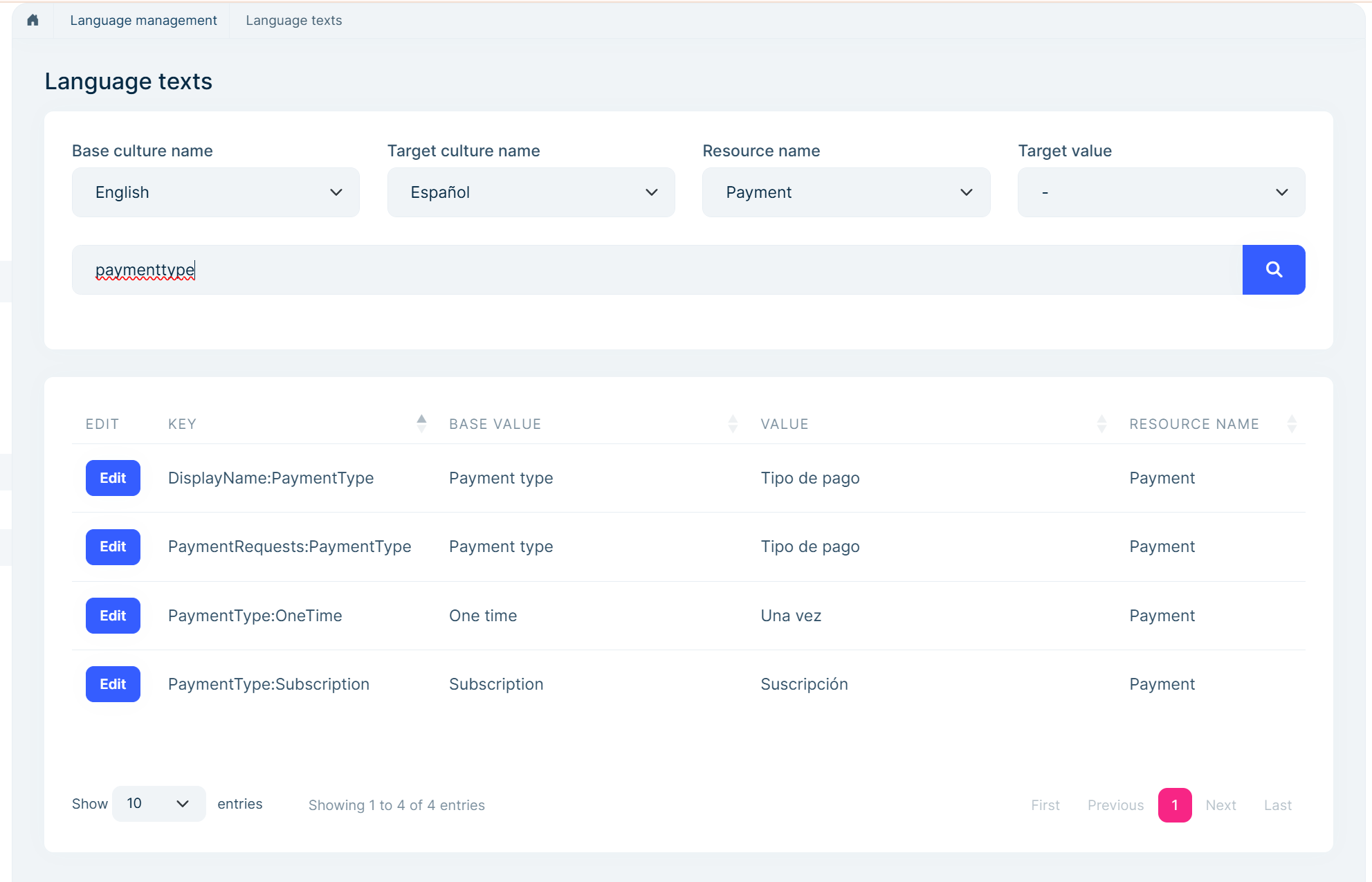
If you want to localize it from English to Espanol, then select English as the base culture and Esponal as the target culture as the figure above. Please refer to the documentation for further info: https://abp.io/docs/latest/modules/language-management#language-texts / It's explained in here.
Closing this question, because it seems you created a new one and we can continue on that question: https://abp.io/support/questions/9368/How-do-Localization-for-abpio
Hi, if you are using the Language Management module, then you can dynamically update localization entries in the "LanguageTexts" page. See the documentation for more info: https://abp.io/docs/latest/modules/language-management#language-texts
On the page, you can select the base and target language and then update the text and localize it.
Regards.
[nguyenngoc.son] said: Hi, When user access the site the first time, the endpoint application-configuration take 1.6 second to complete. After login, it take 5.7 seconds
It is common for the first call to application-configuration to take longer because the server builds and caches the configuration. Subsequent calls should be significantly faster. If not (and it seems it's not in your case), can you share your solution via email to support@abp.io with the ticket number, so I can deeply investigate the potential reason?
❓ What I need help with: How can I generate the Angular UI (CRUD pages, routing, menu) for entities created inside modular projects using ABP Suite?
Hi, we will create the angular version for our Modular Monolith Tutorial documentation series, but in the meantime, can you check https://github.com/abpframework/abp/issues/20827#issuecomment-2624232973 these steps and apply them?
Regards.
[blepo] said: I'm not sure that this is the case. Even in the thread you mentioned, https://abp.io/support/questions/8767/Lagging-and-loading-time-of-Blazor-Web-App-Template-Application, it can be seen that this stuff does not happen. The lag in loading, yes, but not the other issues.,
I appreciate your reluctance to jump into such a vague problem, but this is a critical issue for us. I would very much like to use my support token on this problem. I can provide the project, the har file from the network inspector, etc.
Hi, thanks for the update. I'll create a new Blazor Web App to try and reproduce the issue on my end. Once I’ve had a chance to investigate it in detail, I’ll get back to you with my findings as soon as possible.
Regards.
Hi, by default, when you create a document project, you need to pass the project name, the document name, and also the version. For example, https://abp.io/docs/latest/modules/docs#single-project-mode is the structure of our documentation. (docs -> single project name, latest -> is the version, docs -> this is document docs.md)
In your case, you should pass the version, and also pass the project name. If you need the single project mode, like we use in our documentation site, you can follow: https://abp.io/docs/latest/modules/docs#single-project-mode
Regards.
[JanneHarju] said: I'm returning this later
Hi, is there any update?
[improwise] said: Seems not even ABP staff can control the service bot :)
Reopened again
Yes, indeed it automatically closes, unfortunately :(
We will add an option to our support platform, so it will not close in the future.
Hi, currently the latest ABP Studio version is 0.9.26 and it uses v9.1.1 of ABP. You can see all the version information from here.
Regards.









