ABP Commercial 7.0.1 / Blazor Server / EF / Non tiered / Separate Host DB, Separate Tenant DBs
Hi,
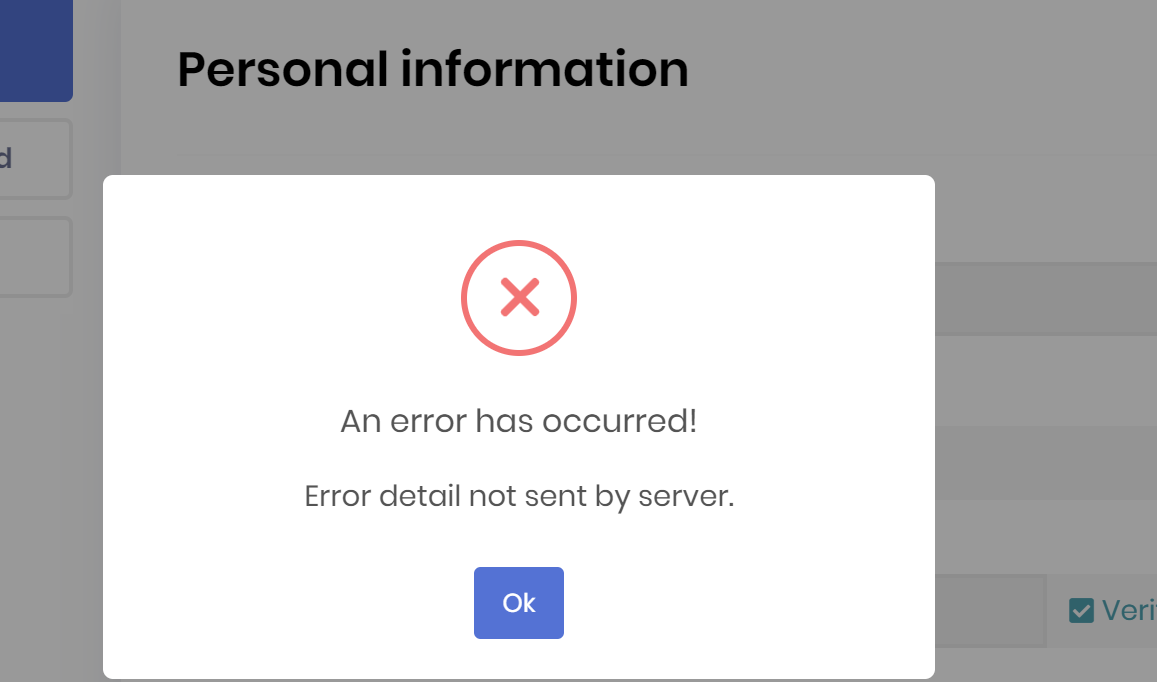
We are receiving the ABP error "An error has occurred! Error detail not sent by server" whenever something is saved on the user profile / my account area. Everything works fine in local development, but the error occurs when we deploy the app (Azure App Service).
No exception is logged when the error occurs, but we see a ERR_TOO_MANY_REDIRECTS in the browser console. I've included the log when saving 'Personal Info' on the 'My Account' screen below.
We see the following in the log
The required antiforgery header value "RequestVerificationToken" is not present.
Authorization failed for the request at filter 'Volo.Abp.AspNetCore.Mvc.AntiForgery.AbpAutoValidateAntiforgeryTokenAuthorizationFilter'.
We are using the Lepton theme.
Please advise as to what might be causing this issue when the app is deployed.

2023-04-22 15:58:30.105 +00:00 [INF] Request starting HTTP/1.1 PUT http://dev.nvisiononline.net/api/account/my-profile application/json 340
2023-04-22 15:58:30.216 +00:00 [INF] Executing endpoint 'Volo.Abp.Account.ProfileController.UpdateAsync (Volo.Abp.Account.Pro.Public.HttpApi)'
2023-04-22 15:58:30.216 +00:00 [INF] Route matched with {area = "account", controller = "Profile", action = "Update", page = ""}. Executing controller action with signature System.Threading.Tasks.Task`1[Volo.Abp.Account.ProfileDto] UpdateAsync(Volo.Abp.Account.UpdateProfileDto) on controller Volo.Abp.Account.ProfileController (Volo.Abp.Account.Pro.Public.HttpApi).
2023-04-22 15:58:30.216 +00:00 [WRN] The required antiforgery header value "RequestVerificationToken" is not present.
2023-04-22 15:58:30.216 +00:00 [INF] Authorization failed for the request at filter 'Volo.Abp.AspNetCore.Mvc.AntiForgery.AbpAutoValidateAntiforgeryTokenAuthorizationFilter'.
2023-04-22 15:58:30.217 +00:00 [INF] Executing StatusCodeResult, setting HTTP status code 400
2023-04-22 15:58:30.217 +00:00 [INF] Executed action Volo.Abp.Account.ProfileController.UpdateAsync (Volo.Abp.Account.Pro.Public.HttpApi) in 0.536ms
2023-04-22 15:58:30.217 +00:00 [INF] Executed endpoint 'Volo.Abp.Account.ProfileController.UpdateAsync (Volo.Abp.Account.Pro.Public.HttpApi)'
2023-04-22 15:58:30.225 +00:00 [INF] Request finished HTTP/1.1 PUT http://dev.nvisiononline.net/api/account/my-profile application/json 340 - 302 - - 119.6890ms
2023-04-22 15:58:30.251 +00:00 [INF] Request starting HTTP/1.1 PUT http://dev.nvisiononline.net/Error?httpStatusCode=400 application/json 340
2023-04-22 15:58:30.255 +00:00 [INF] Executing endpoint 'Volo.Abp.AspNetCore.Mvc.UI.Theme.Shared.Controllers.ErrorController.Index (Volo.Abp.AspNetCore.Mvc.UI.Theme.Shared)'
2023-04-22 15:58:30.256 +00:00 [INF] Route matched with {action = "Index", controller = "Error", area = "", page = ""}. Executing controller action with signature System.Threading.Tasks.Task`1[Microsoft.AspNetCore.Mvc.IActionResult] Index(Int32) on controller Volo.Abp.AspNetCore.Mvc.UI.Theme.Shared.Controllers.ErrorController (Volo.Abp.AspNetCore.Mvc.UI.Theme.Shared).
2023-04-22 15:58:30.256 +00:00 [WRN] The required antiforgery header value "RequestVerificationToken" is not present.
2023-04-22 15:58:30.256 +00:00 [INF] Authorization failed for the request at filter 'Volo.Abp.AspNetCore.Mvc.AntiForgery.AbpAutoValidateAntiforgeryTokenAuthorizationFilter'.
2023-04-22 15:58:30.256 +00:00 [INF] Executing StatusCodeResult, setting HTTP status code 400
ABP Commercial 7.0.1 / Blazor Server / EF / Non tiered / Separate Host DB, Separate Tenant DBs
Hi,
I see how we can easily change the initially seeded admin's email and password, but is there also a way to change the initially seeded admin's user name? Or does the framework require this account to be named "admin"?
ABP Commercial 7.0.1 / Blazor Server / EF / Non tiered / Separate Host DB, Separate Tenant DBs
What is the transactional behavior when the migrator is migrating multiple tenant databases?
If a particular tenant exceptions out, does just that tenant's migration roll back or will all tenants that have already been migrated in the process also roll back?
Thanks in advance!
Hi @liangshiwei
Thank you for taking the time to setup the scenario!
The problem was that I didn't override the obsolete non-async version of the Resolve method.
I'll close the issue.
ABP Commercial 7.0.1 / Blazor Server / EF / Non tiered / Separate Host DB, Separate Tenant DBs
For security reasons, we are currently saving the tenant connection strings to the database without a user name and password
We then overrode the MultiTenantConnectionStringResolver so that we can fill in the user name and password at run time based on values we have stored in Azure Key Vault.
The problem we are having is that at certain point, when logging into a tenant, the method below in our MultiTenantConnectionStringResolver is called by ABP with _currentTenant.Id == null and the framework returns the host connection string, but immediately after that there is an exception occurring because, in the tenant database, there is no user name or password in the connection string.
There must be somewhere else in the frame work that we need to override, but we can't seem to figure it out from the stack trace.
I've included the stack trace below...
    public override async Task<string> ResolveAsync(string connectionStringName = null)
    {

        if (_currentTenant.Id == null)
        {
            //No current tenant, fallback to default logic
            return await base.ResolveAsync(connectionStringName);
        }

        // we have logic below here to update the connection string when _currentTenant.Id is a tenant and not the host....
        ....
        //return our custom connection string
        ....
Microsoft.Data.SqlClient.SqlException (0x80131904): Login failed for user ''.
   at Microsoft.Data.SqlClient.SqlInternalConnection.OnError(SqlException exception, Boolean breakConnection, Action`1 wrapCloseInAction)
   at Microsoft.Data.SqlClient.TdsParser.ThrowExceptionAndWarning(TdsParserStateObject stateObj, Boolean callerHasConnectionLock, Boolean asyncClose)
   at Microsoft.Data.SqlClient.TdsParser.TryRun(RunBehavior runBehavior, SqlCommand cmdHandler, SqlDataReader dataStream, BulkCopySimpleResultSet bulkCopyHandler, TdsParserStateObject stateObj, Boolean& dataReady)
   at Microsoft.Data.SqlClient.TdsParser.Run(RunBehavior runBehavior, SqlCommand cmdHandler, SqlDataReader dataStream, BulkCopySimpleResultSet bulkCopyHandler, TdsParserStateObject stateObj)
   at Microsoft.Data.SqlClient.SqlInternalConnectionTds.CompleteLogin(Boolean enlistOK)
   at Microsoft.Data.SqlClient.SqlInternalConnectionTds.AttemptOneLogin(ServerInfo serverInfo, String newPassword, SecureString newSecurePassword, Boolean ignoreSniOpenTimeout, TimeoutTimer timeout, Boolean withFailover)
   at Microsoft.Data.SqlClient.SqlInternalConnectionTds.LoginNoFailover(ServerInfo serverInfo, String newPassword, SecureString newSecurePassword, Boolean redirectedUserInstance, SqlConnectionString connectionOptions, SqlCredential credential, TimeoutTimer timeout)
   at Microsoft.Data.SqlClient.SqlInternalConnectionTds.OpenLoginEnlist(TimeoutTimer timeout, SqlConnectionString connectionOptions, SqlCredential credential, String newPassword, SecureString newSecurePassword, Boolean redirectedUserInstance)
   at Microsoft.Data.SqlClient.SqlInternalConnectionTds..ctor(DbConnectionPoolIdentity identity, SqlConnectionString connectionOptions, SqlCredential credential, Object providerInfo, String newPassword, SecureString newSecurePassword, Boolean redirectedUserInstance, SqlConnectionString userConnectionOptions, SessionData reconnectSessionData, Boolean applyTransientFaultHandling, String accessToken, DbConnectionPool pool)
   at Microsoft.Data.SqlClient.SqlConnectionFactory.CreateConnection(DbConnectionOptions options, DbConnectionPoolKey poolKey, Object poolGroupProviderInfo, DbConnectionPool pool, DbConnection owningConnection, DbConnectionOptions userOptions)
   at Microsoft.Data.ProviderBase.DbConnectionFactory.CreatePooledConnection(DbConnectionPool pool, DbConnection owningObject, DbConnectionOptions options, DbConnectionPoolKey poolKey, DbConnectionOptions userOptions)
   at Microsoft.Data.ProviderBase.DbConnectionPool.CreateObject(DbConnection owningObject, DbConnectionOptions userOptions, DbConnectionInternal oldConnection)
   at Microsoft.Data.ProviderBase.DbConnectionPool.UserCreateRequest(DbConnection owningObject, DbConnectionOptions userOptions, DbConnectionInternal oldConnection)
   at Microsoft.Data.ProviderBase.DbConnectionPool.TryGetConnection(DbConnection owningObject, UInt32 waitForMultipleObjectsTimeout, Boolean allowCreate, Boolean onlyOneCheckConnection, DbConnectionOptions userOptions, DbConnectionInternal& connection)
   at Microsoft.Data.ProviderBase.DbConnectionPool.TryGetConnection(DbConnection owningObject, TaskCompletionSource`1 retry, DbConnectionOptions userOptions, DbConnectionInternal& connection)
   at Microsoft.Data.ProviderBase.DbConnectionFactory.TryGetConnection(DbConnection owningConnection, TaskCompletionSource`1 retry, DbConnectionOptions userOptions, DbConnectionInternal oldConnection, DbConnectionInternal& connection)
   at Microsoft.Data.ProviderBase.DbConnectionInternal.TryOpenConnectionInternal(DbConnection outerConnection, DbConnectionFactory connectionFactory, TaskCompletionSource`1 retry, DbConnectionOptions userOptions)
   at Microsoft.Data.SqlClient.SqlConnection.TryOpen(TaskCompletionSource`1 retry, SqlConnectionOverrides overrides)
   at Microsoft.Data.SqlClient.SqlConnection.Open(SqlConnectionOverrides overrides)
   at Microsoft.Data.SqlClient.SqlConnection.Open()
   at Microsoft.EntityFrameworkCore.SqlServer.Storage.Internal.SqlServerConnection.OpenDbConnection(Boolean errorsExpected)
   at Microsoft.EntityFrameworkCore.Storage.RelationalConnection.OpenInternal(Boolean errorsExpected)
   at Microsoft.EntityFrameworkCore.Storage.RelationalConnection.Open(Boolean errorsExpected)
   at Microsoft.EntityFrameworkCore.Storage.RelationalCommand.ExecuteReader(RelationalCommandParameterObject parameterObject)
   at Microsoft.EntityFrameworkCore.Query.Internal.SplitQueryingEnumerable`1.Enumerator.InitializeReader(Enumerator enumerator)
   at Microsoft.EntityFrameworkCore.Query.Internal.SplitQueryingEnumerable`1.Enumerator.<>c.<MoveNext>b__22_0(DbContext _, Enumerator enumerator)
   at Microsoft.EntityFrameworkCore.SqlServer.Storage.Internal.SqlServerExecutionStrategy.Execute[TState,TResult](TState state, Func`3 operation, Func`3 verifySucceeded)
   at Microsoft.EntityFrameworkCore.Query.Internal.SplitQueryingEnumerable`1.Enumerator.MoveNext()
   at System.Collections.Generic.List`1..ctor(IEnumerable`1 collection)
   at System.Linq.Enumerable.ToList[TSource](IEnumerable`1 source)
   at Volo.Abp.LanguageManagement.EntityFrameworkCore.EfCoreLanguageTextRepository.GetList(String resourceName, String cultureName)
   at Castle.Proxies.Invocations.ILanguageTextRepository_GetList.InvokeMethodOnTarget()
   at Castle.DynamicProxy.AbstractInvocation.Proceed()
   at Castle.DynamicProxy.AbstractInvocation.ProceedInfo.Invoke()
   at Castle.DynamicProxy.AsyncInterceptorBase.ProceedSynchronous[TResult](IInvocation invocation, IInvocationProceedInfo proceedInfo)
--- End of stack trace from previous location ---
   at Volo.Abp.Castle.DynamicProxy.CastleAbpMethodInvocationAdapterWithReturnValue`1.ProceedAsync()
   at Volo.Abp.Uow.UnitOfWorkInterceptor.InterceptAsync(IAbpMethodInvocation invocation)
   at Volo.Abp.Castle.DynamicProxy.CastleAsyncAbpInterceptorAdapter`1.InterceptAsync[TResult](IInvocation invocation, IInvocationProceedInfo proceedInfo, Func`3 proceed)
   at Castle.DynamicProxy.NoCoverage.RethrowHelper.Rethrow(Exception exception)
   at Castle.DynamicProxy.NoCoverage.RethrowHelper.RethrowInnerIfAggregate(Exception exception)
   at Castle.DynamicProxy.AsyncInterceptorBase.InterceptSynchronousResult[TResult](AsyncInterceptorBase me, IInvocation invocation)
   at Castle.DynamicProxy.AbstractInvocation.Proceed()
   at Castle.Proxies.IBasicRepository`1Proxy_20.GetList(String resourceName, String cultureName)
   at Volo.Abp.LanguageManagement.DynamicResourceLocalizer.CreateCacheItem(LocalizationResourceBase resource, String cultureName)
   at Volo.Abp.LanguageManagement.DynamicResourceLocalizer.<>c__DisplayClass10_0.RDyaMGpmi()
   at Volo.Abp.Caching.DistributedCache`2.GetOrAdd(TCacheKey key, Func`1 factory, Func`1 optionsFactory, Nullable`1 hideErrors, Boolean considerUow)
   at Volo.Abp.LanguageManagement.DynamicResourceLocalizer.GetCacheItem(LocalizationResourceBase resource, String cultureName)
   at Volo.Abp.LanguageManagement.DynamicResourceLocalizer.GetOrNull(LocalizationResourceBase resource, String cultureName, String name)
   at Volo.Abp.Localization.LocalizationResourceContributorList.GetOrNull(String cultureName, String name, Boolean includeDynamicContributors)
   at Volo.Abp.Localization.AbpDictionaryBasedStringLocalizer.GetLocalizedStringOrNull(String name, String cultureName, Boolean tryDefaults)
   at Volo.Abp.Localization.AbpDictionaryBasedStringLocalizer.GetLocalizedString(String name, String cultureName)
   at Volo.Abp.Localization.AbpDictionaryBasedStringLocalizer.GetLocalizedString(String name)
   at Volo.Abp.Localization.AbpDictionaryBasedStringLocalizer.get_Item(String name)
   at Microsoft.AspNetCore.Mvc.Localization.HtmlLocalizer.get_Item(String name)
   at AspNetCoreGeneratedDocument.Pages_Account_Login.ExecuteAsync()
   at Microsoft.AspNetCore.Mvc.Razor.RazorView.RenderPageCoreAsync(IRazorPage page, ViewContext context)
   at Microsoft.AspNetCore.Mvc.Razor.RazorView.RenderPageAsync(IRazorPage page, ViewContext context, Boolean invokeViewStarts)
   at Microsoft.AspNetCore.Mvc.Razor.RazorView.RenderAsync(ViewContext context)
   at Microsoft.AspNetCore.Mvc.ViewFeatures.ViewExecutor.ExecuteAsync(ViewContext viewContext, String contentType, Nullable`1 statusCode)
   at Microsoft.AspNetCore.Mvc.ViewFeatures.ViewExecutor.ExecuteAsync(ViewContext viewContext, String contentType, Nullable`1 statusCode)
   at Microsoft.AspNetCore.Mvc.Infrastructure.ResourceInvoker.<InvokeResultAsync>g__Logged|22_0(ResourceInvoker invoker, IActionResult result)
   at Microsoft.AspNetCore.Mvc.Infrastructure.ResourceInvoker.<InvokeNextResultFilterAsync>g__Awaited|30_0[TFilter,TFilterAsync](ResourceInvoker invoker, Task lastTask, State next, Scope scope, Object state, Boolean isCompleted)
   at Microsoft.AspNetCore.Mvc.Infrastructure.ResourceInvoker.Rethrow(ResultExecutedContextSealed context)
   at Microsoft.AspNetCore.Mvc.Infrastructure.ResourceInvoker.ResultNext[TFilter,TFilterAsync](State& next, Scope& scope, Object& state, Boolean& isCompleted)
   at Microsoft.AspNetCore.Mvc.Infrastructure.ResourceInvoker.InvokeResultFilters()
--- End of stack trace from previous location ---
   at Microsoft.AspNetCore.Mvc.Infrastructure.ResourceInvoker.<InvokeNextResourceFilter>g__Awaited|25_0(ResourceInvoker invoker, Task lastTask, State next, Scope scope, Object state, Boolean isCompleted)
   at Microsoft.AspNetCore.Mvc.Infrastructure.ResourceInvoker.Rethrow(ResourceExecutedContextSealed context)
   at Microsoft.AspNetCore.Mvc.Infrastructure.ResourceInvoker.Next(State& next, Scope& scope, Object& state, Boolean& isCompleted)
   at Microsoft.AspNetCore.Mvc.Infrastructure.ResourceInvoker.InvokeFilterPipelineAsync()
--- End of stack trace from previous location ---
   at Microsoft.AspNetCore.Mvc.Infrastructure.ResourceInvoker.<InvokeAsync>g__Logged|17_1(ResourceInvoker invoker)
   at Microsoft.AspNetCore.Mvc.Infrastructure.ResourceInvoker.<InvokeAsync>g__Logged|17_1(ResourceInvoker invoker)
   at Microsoft.AspNetCore.Routing.EndpointMiddleware.<Invoke>g__AwaitRequestTask|6_0(Endpoint endpoint, Task requestTask, ILogger logger)
   at Volo.Abp.AspNetCore.Serilog.AbpSerilogMiddleware.InvokeAsync(HttpContext context, RequestDelegate next)
   at Microsoft.AspNetCore.Builder.UseMiddlewareExtensions.<>c__DisplayClass6_1.<<UseMiddlewareInterface>b__1>d.MoveNext()
--- End of stack trace from previous location ---
   at Volo.Abp.AspNetCore.Auditing.AbpAuditingMiddleware.InvokeAsync(HttpContext context, RequestDelegate next)
   at Volo.Abp.AspNetCore.Auditing.AbpAuditingMiddleware.InvokeAsync(HttpContext context, RequestDelegate next)
   at Microsoft.AspNetCore.Builder.UseMiddlewareExtensions.<>c__DisplayClass6_1.<<UseMiddlewareInterface>b__1>d.MoveNext()
--- End of stack trace from previous location ---
   at Microsoft.AspNetCore.Authorization.AuthorizationMiddleware.Invoke(HttpContext context)
   at Volo.Abp.AspNetCore.Uow.AbpUnitOfWorkMiddleware.InvokeAsync(HttpContext context, RequestDelegate next)
   at Microsoft.AspNetCore.Builder.UseMiddlewareExtensions.<>c__DisplayClass6_1.<<UseMiddlewareInterface>b__1>d.MoveNext()
--- End of stack trace from previous location ---
   at Volo.Abp.AspNetCore.ExceptionHandling.AbpExceptionHandlingMiddleware.InvokeAsync(HttpContext context, RequestDelegate next)
   at Volo.Abp.AspNetCore.ExceptionHandling.AbpExceptionHandlingMiddleware.InvokeAsync(HttpContext context, RequestDelegate next)
   at Microsoft.AspNetCore.Builder.UseMiddlewareExtensions.<>c__DisplayClass6_1.<<UseMiddlewareInterface>b__1>d.MoveNext()
--- End of stack trace from previous location ---
   at Volo.Abp.AspNetCore.MultiTenancy.MultiTenancyMiddleware.InvokeAsync(HttpContext context, RequestDelegate next)
   at Microsoft.AspNetCore.Builder.UseMiddlewareExtensions.<>c__DisplayClass6_1.<<UseMiddlewareInterface>b__1>d.MoveNext()
--- End of stack trace from previous location ---
   at Microsoft.AspNetCore.Builder.ApplicationBuilderAbpOpenIddictMiddlewareExtension.<>c__DisplayClass0_0.<<UseAbpOpenIddictValidation>b__0>d.MoveNext()
--- End of stack trace from previous location ---
   at Microsoft.AspNetCore.Authentication.AuthenticationMiddleware.Invoke(HttpContext context)
   at Volo.Abp.AspNetCore.Security.AbpSecurityHeadersMiddleware.InvokeAsync(HttpContext context, RequestDelegate next)
   at Microsoft.AspNetCore.Builder.UseMiddlewareExtensions.<>c__DisplayClass6_1.<<UseMiddlewareInterface>b__1>d.MoveNext()
--- End of stack trace from previous location ---
   at Volo.Abp.AspNetCore.Tracing.AbpCorrelationIdMiddleware.InvokeAsync(HttpContext context, RequestDelegate next)
   at Microsoft.AspNetCore.Builder.UseMiddlewareExtensions.<>c__DisplayClass6_1.<<UseMiddlewareInterface>b__1>d.MoveNext()
--- End of stack trace from previous location ---
   at Microsoft.AspNetCore.Localization.RequestLocalizationMiddleware.Invoke(HttpContext context)
   at Microsoft.AspNetCore.RequestLocalization.AbpRequestLocalizationMiddleware.InvokeAsync(HttpContext context, RequestDelegate next)
   at Microsoft.AspNetCore.Builder.UseMiddlewareExtensions.<>c__DisplayClass6_1.<<UseMiddlewareInterface>b__1>d.MoveNext()
--- End of stack trace from previous location ---
   at Microsoft.AspNetCore.Diagnostics.DeveloperExceptionPageMiddlewareImpl.Invoke(HttpContext context)
ClientConnectionId:2535e505-863b-4d41-8a6c-58bb63378db7
Error Number:18456,State:1,Class:14
Please advise asap and thank you in advance...
That was easy and worked perfectly. Thanks @maliming !!
Interesting... I have the same setup. Could it be because I'm using a Blazor Server templated solution and your using MVC?
We created our own nVisionLeptonErrorViewComponent and added our own 404.cshtml
Our project solution is as follows:
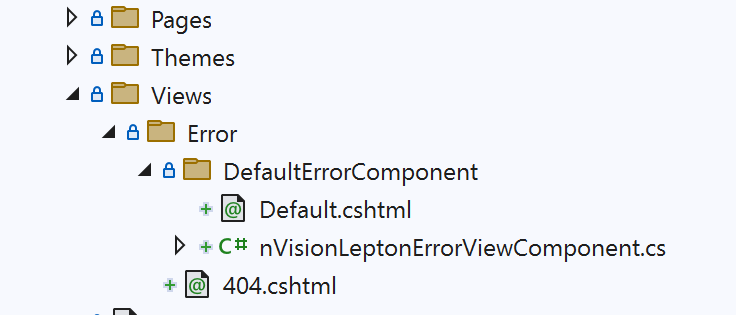
Our 404.cshtml is as follows:
@using FM.nVision.Blazor.Views.Error.DefaultErrorComponent;
@using Volo.Abp.AspNetCore.Mvc.UI.Theme.Lepton.Views.Error.DefaultErrorComponent
@model Volo.Abp.AspNetCore.Mvc.UI.Theme.Shared.Views.Error.AbpErrorViewModel
@(await Component.InvokeAsync<nVisionLeptonErrorViewComponent>(new { model = Model, defaultErrorMessageKey = "404Message" }))
Our nVisionLeptonErrorViewComponent is as follows:
using Volo.Abp.AspNetCore.Mvc.UI.Theme.Lepton.Views.Error.DefaultErrorComponent;

namespace FM.nVision.Blazor.Views.Error.DefaultErrorComponent;

public class nVisionLeptonErrorViewComponent : LeptonViewComponentBase
{
    public IViewComponentResult Invoke(AbpErrorViewModel model, string defaultErrorMessageKey)
    {
        var leptonModel = new LeptonErrorPageModel
        {
            ErrorInfo = model.ErrorInfo,
            HttpStatusCode = model.HttpStatusCode,
            DefaultErrorMessageKey = defaultErrorMessageKey
        };

        return View("~/Views/Error/DefaultErrorComponent/Default.cshtml", leptonModel);
    }
}
We still don't see our custom Default.cshtml in Views/Error/DefaultErrorComponent. Is there something else we are missing?
Thanks, would you have anything you can point me to in order to accomplish this in the Blazor Server ABP template?









