Activities of "berkansasmaz"

Hi 👋

Volo.Abp.EntityFrameworkCore.Oracle is not currently available for ABP 5.0. It will probably be available in the next version.

I have two questions:

  1. Do you get an error when you run YourProjectName.DbMigrator project after successfully running the dotnet ef migrations add ... command?
  2. Do you get the error only when using the Oracle database in ABP 5.0?

I am using the image of Redis with version 6.2.5.

Any chance of sharing the application you're having an error with, deleting all bin/obj and libs folders?

Please provide the relevant log record for the MicroService Blazor-Server and a minimal, reproducible example, if any, would be greatly appreciated.

PS: BTW, my Redis server version is the same as in the image you shared.

Hi,

I tested what you said for the Microservice Blazor-Wasm and Microservice Blazor-Server templates. Here are my steps:

  1. abp new MicroTemp -t microservice-pro -csf -u blazor or abp new MicroTemp -t microservice-pro -csf -u blazor-server

  2. cd MicroTemp

  3. dotnet build /graphBuild

  4. cd shared/MicroTem.DbMigrator

  5. cd .. && cd ..

  6. I ran the script ./run-tye.ps1

PS: Commands may vary depending on your operating system.

Since the slowness varies from person to person, I leave a GiF from the Microservice Blazor-Wasm project below.

PS: Microservice Blazor-Server provides almost the same experience as Microservice Blazor-Wasm.

So, if you're talking about a much bigger slowness than in the GiF, maybe it's because the redis server isn't running.

Redis is a requirement for all the templates you mention, and without it there can be a lot of slowness. For more information 👉 https://stackoverflow.com/a/69371513/9922629

Answer

5.0.0-rc2 highlight of menu item with NavigationManager.NavigateTo()

Those highlights menu item: /page /page?id=12345 /page?12345

This doesn't work: /page/12345

We generally solved the active menu item problem. But for now, it will not work on the following patterns:

/users/{id} /catalog/dresses/{CATALOG_ID}

Answer

https://support.abp.io/QA/Questions/2209#answer-2ff13a81-fdaf-5f46-f0da-3a00b902c975

I could not reproduce this problem. Here are my steps:

1.abp new BzTestApp -csf -d mongodb --preview -u blazor 2. I run BzTestApp.DbMigrator 3. I run abp suite command then create the Author entity and Book entity. Also, the Author entity has a Navigation property to the Book entity. I configured the navigation property as Required marked and UI pick type set to typehead.

Here are the configuration files of my entities created by Suite:

Then I run the app.

PS: Both Suite and the app I created have version v5.0.0-rc.2

I'm trying to understand your use case, will back-office application pages require a specific role but not end-points, aren't they?

If so, a code like the one below might work for you:

options.Conventions.AuthorizeFolder("/YourFolderName", MyProjectNamePermissions.Backoffice.Default);

I would like to share a little more information on the subject 😊

ABP extends ASP.NET Core Authorization by adding permissions as auto policies and allowing the authorization system to be usable in the application services too. Therefore, you can refer to these documents on the subject 👇👇

  1. https://docs.microsoft.com/en-us/aspnet/core/security/authorization/razor-pages-authorization?view=aspnetcore-6.0#require-authorization-to-access-a-folder-of-pages
  2. https://docs.microsoft.com/en-us/aspnet/core/security/authorization/policies?view=aspnetcore-6.0
  3. https://docs.abp.io/en/abp/latest/Authorization

No problem, you can always download EasyCrm 😊

Please check the link below 👇👇 https://docs.abp.io/en/commercial/latest/samples/easy-crm

Sorry for the misunderstanding, my mistake, I should have looked into your comments further.

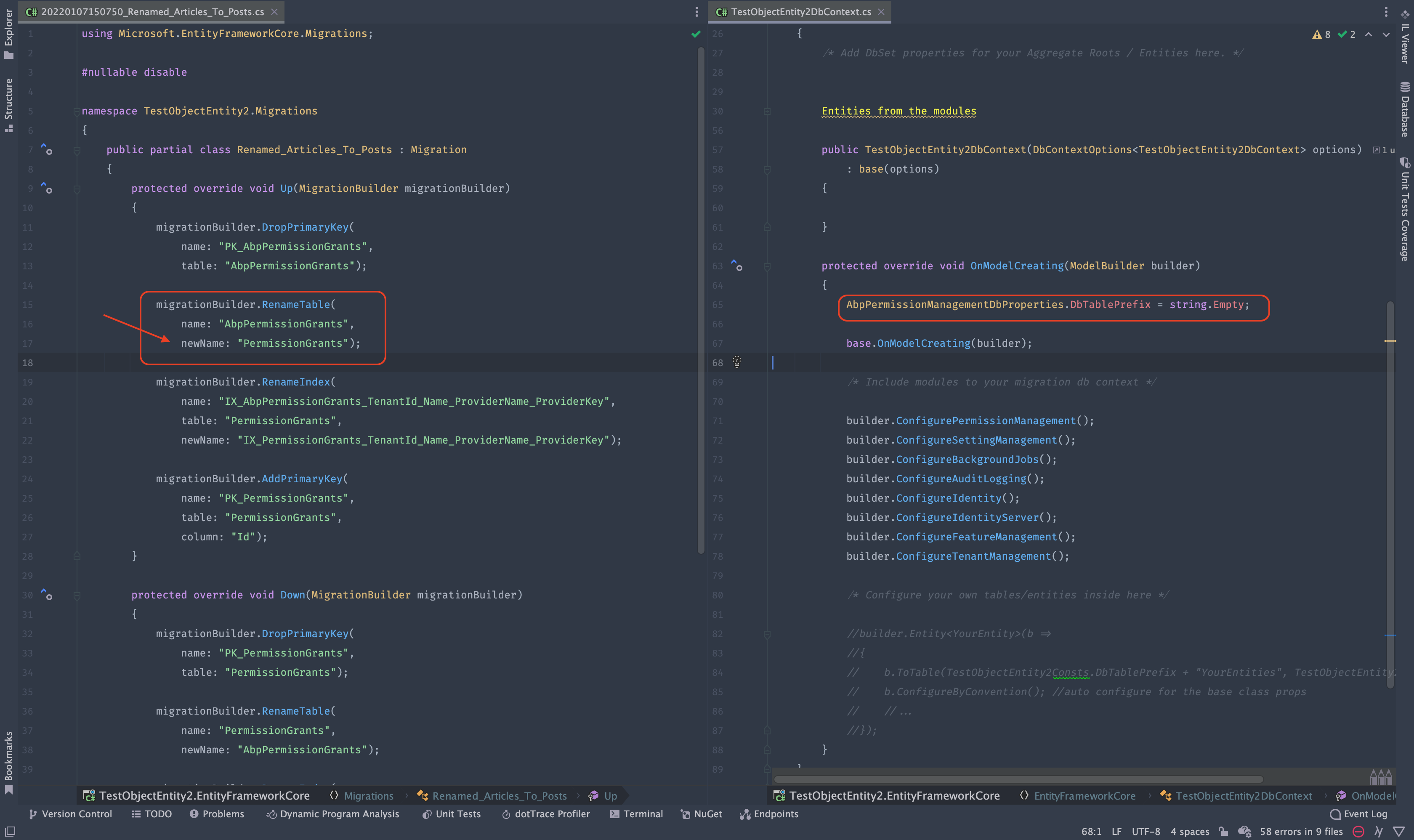
We do not currently intend to support older versions of Oracle. However, this does not mean that your question does not have a solution. I leave a sample code below.

MvcOracleProjectDbContext.cs

        protected override void OnModelCreating(ModelBuilder builder)
        {
            base.OnModelCreating(builder);

            /* Include modules to your migration db context */

            builder.ConfigurePermissionManagement();
            builder.ConfigureSettingManagement();
            builder.ConfigureBackgroundJobs();
            builder.ConfigureAuditLogging();
            builder.ConfigureIdentityPro();
            builder.ConfigureIdentityServer();
            builder.ConfigureFeatureManagement();
            builder.ConfigureLanguageManagement();
            builder.ConfigurePayment();
            builder.ConfigureSaas();
            builder.ConfigureTextTemplateManagement();
            builder.ConfigureBlobStoring();
            
            builder.Entity<ClientRedirectUri>(redirectUri =>
            {
                redirectUri.ToTable(AbpIdentityServerDbProperties.DbTablePrefix + "ClientRedirectUris", AbpIdentityServerDbProperties.DbSchema);

                redirectUri.HasKey(x => new { x.ClientId, x.RedirectUri });

                redirectUri.Property(x => x.RedirectUri).HasMaxLength(20).IsRequired(); // Updated line
            });
        }

As you can see from the code, I set the HasMaxLength of a property in the existing ABP table to 20.

Then I created a new migration, you can see the result below:

        protected override void Up(MigrationBuilder migrationBuilder)
        {
            migrationBuilder.AlterColumn<string>(
                name: "RedirectUri",
                table: "IdentityServerClientRedirectUris",
                type: "NVARCHAR2(20)",
                maxLength: 20,
                nullable: false,
                oldClrType: typeof(string),
                oldType: "NVARCHAR2(2000)",
                oldMaxLength: 2000);
        }

        protected override void Down(MigrationBuilder migrationBuilder)
        {
            migrationBuilder.AlterColumn<string>(
                name: "RedirectUri",
                table: "IdentityServerClientRedirectUris",
                type: "NVARCHAR2(2000)",
                maxLength: 2000,
                nullable: false,
                oldClrType: typeof(string),
                oldType: "NVARCHAR2(20)",
                oldMaxLength: 20);
        }

You are free to change the name of the table, column name, or anything like this.

Hi 👋,

Do you have EasyCrm source code?

If you have EasyCrm source code, you can examine the codes of the Account and Contact pages for Blazor UI.

Showing 661 to 670 of 738 entries
Boost Your Development
ABP Live Training
Packages
See Trainings
Mastering ABP Framework Book
The Official Guide
Mastering
ABP Framework
Learn More
Mastering ABP Framework Book
Made with ❤️ on ABP v10.1.0-preview. Updated on December 17, 2025, 07:08
1
ABP Assistant
🔐 You need to be logged in to use the chatbot. Please log in first.